
Catheter Tantalum Length Marks and Radiopacity in EVD Placement

Length marks and radiopacity help surgeons place, document and check a drainage catheter. Why tantalum marks matter and what distributors should explain.
Key Takeaways
- Length marks let the surgeon control and record how deep a catheter is inserted.
- Radiopacity makes the catheter visible on imaging, so position can be confirmed and rechecked.
- DESU ventricular catheters carry tantalum length marks from 5 to 15 cm; lumbar drainage catheters from 5 to 20 cm.
- Recorded depth at the skin helps teams notice if a catheter has moved.
Tantalum length marks show the surgeon how far a catheter has been inserted, and they stay visible on imaging because tantalum is a dense, radiopaque metal. With a radiopaque silicone catheter, they help teams place a drain at the intended depth, document it and later check whether it has moved. DESU ventricular catheters carry marks from 5 to 15 cm.
Length marks and radiopacity sound like small details, but neurosurgeons and neuro-ICU teams rely on them every day. They affect how a catheter is placed, how its position is documented, how imaging is read and how nurses check the exit site. For a distributor, these features are an easy way to show that a product has been designed with the clinical workflow in mind. This article explains why they matter.
Why does insertion depth matter for a ventricular catheter?
A ventricular catheter must reach the ventricle without going too far. The surgeon plans an entry point and trajectory and advances the catheter to a planned depth, typically aiming the tip toward the frontal horn of the lateral ventricle near the foramen of Monro. Too shallow and the drainage holes may sit in brain tissue rather than in CSF; too deep and the tip may reach structures it should not.
Length marks give the surgeon a direct visual reference during that advance. Instead of estimating depth, the surgeon can read the mark at the point where the catheter enters the skull. That reading then goes into the operative or procedure note as the documented depth.
What does radiopacity add?
After placement, teams usually confirm catheter position with imaging, most often CT. A radiopaque catheter is visible along its length on CT and plain radiographs, which makes it easier to see the trajectory and tip position. Radiopaque length marks add reference points along the catheter, so the radiologist and surgeon can relate the image to the depth recorded at placement.
Radiopacity also matters later. If drainage stops, if the patient deteriorates or if a nurse suspects that the catheter has been pulled during transport, imaging can show whether the catheter is still where it should be. A clearly visible catheter with clear marks makes that judgment faster.
Why tantalum for the marks?
Tantalum is a dense, corrosion-resistant metal with a long history of use in implantable medical devices, and it shows clearly on X-ray and CT. Small tantalum markers embedded in silicone create distinct points that do not depend on printed ink at the surface. That makes them suitable for marking a catheter that will be inside the body, sometimes for weeks in the case of a drain and permanently in the case of a shunt catheter.
When neurosurgeons ask about markers, they are usually asking two things: can I see them clearly during placement, and can I see them on imaging afterwards? Answer with the product facts and offer samples so the surgeon can judge the visibility directly.
Which DESU catheters carry tantalum marks?
Tantalum length marks are a common feature across the DESU catheter range. The figures below come from the published product descriptions.
| Product | Catheter | Tantalum length marks | Other features |
|---|---|---|---|
| Ventricular catheter kit | Radiopaque silicone | 5–15 cm | 24 drainage holes in four rows; standard or antibiotic-impregnated |
| Lumbar drainage catheter kit | 80 cm silicone | 5–20 cm | 24 drainage holes; standard or antibiotic-impregnated |
| Peritoneal catheter kit | 120 cm silicone | 5–20 cm | Standard or antibiotic-impregnated |
| Lumbar catheter kit (shunt) | 100 cm silicone | 5–20 cm | 24 drainage holes in four rows |
The ventricular catheter kit is the most relevant for EVD placement. Its radiopaque silicone catheter carries tantalum marks from 5 to 15 cm, a range relevant to ventricular access, and has 24 drainage holes arranged in four rows near the tip. For external lumbar drainage, the lumbar drainage catheter kit provides an 80 cm silicone catheter with marks from 5 to 20 cm.
On a lumbar drain, the marks serve the same purpose in a different anatomy. The clinician threads the catheter into the lumbar subarachnoid space to a chosen length and records it, and nurses later use the external length as a reference when checking the exit site in the lower back, an area that is harder to observe than the scalp. Clear, regular marks make that routine easier for everyone involved.
How do length marks support nursing care?
Nurses use the depth recorded at placement as a baseline. At dressing changes and routine checks, many units compare the mark visible at the skin, or the external length of the catheter, with the documented value. A change can be an early sign that the catheter has migrated or been pulled, prompting the nurse to alert the team. The exact practice is set by hospital protocol, but clear marks make it possible.
This is also why securing the catheter at the exit site matters so much. Marks do not prevent movement; they make it easier to detect. A rep should present them that way, without suggesting that they reduce the risk of dislodgement on their own.
How do marks help when the drain becomes a shunt?
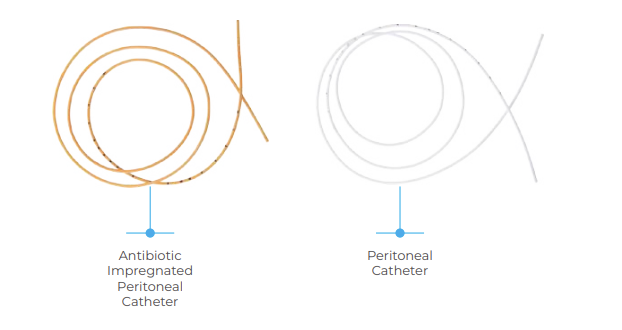
Many patients who need an EVD later need a permanent shunt. Shunt catheters are also placed to planned lengths, and the peritoneal catheter must be trimmed and positioned with care. The peritoneal catheter kit, with its 120 cm silicone catheter and tantalum marks from 5 to 20 cm, follows the same design principle. Surgeons who have used DESU marks during EVD placement will recognize them on the shunt catheters, which supports a consistent experience across the patient’s care.
What should a distributor explain in a product presentation?
In a presentation to neurosurgeons or a value-analysis committee, keep the message practical and accurate:
- The catheter is radiopaque silicone, so it is visible on CT and radiographs.
- Tantalum length marks provide reference points for insertion depth and later imaging.
- The mark ranges are 5 to 15 cm on the ventricular catheter and 5 to 20 cm on the lumbar drainage, lumbar and peritoneal catheters.
- Recorded depth gives nurses a baseline to detect catheter movement during care.
- Marks support detection of movement; they do not replace good securement at the exit site.
Above all, let the surgeons see for themselves. Bring samples, let them handle the catheter and read the marks under OR lighting, and, where the hospital allows, show how the catheter appears on a radiograph. A feature a surgeon has verified personally carries more weight than any description.
The EVD-010 Series, supplied with a 31 cm ventricular catheter, a 30 cm measuring scale, a 150 ml drip chamber and an 800 ml bag, may be the system an account uses most. When surgeons ask about the catheter in a specific configuration, confirm the marking details with DESU’s product specialists before answering.
Why does this matter in a value-analysis discussion?
Committees often focus on price and documentation, but clinical champions on the committee notice design details that make their work easier. Clear length marks and good radiopacity are features that neurosurgeons and nurses can verify themselves on a sample, which makes them more persuasive than any claim on a brochure. DESU manufactures its catheters in its own cleanrooms in Ankara, Türkiye, under ISO 13485, and its products carry the CE mark, giving the committee a clear quality basis alongside the hands-on evaluation.
Talk to a DESU product specialist
If neurosurgeons in your accounts have asked about catheter markings and radiopacity, DESU’s product specialists can provide samples, product details and documentation for your market. Email sales@desu.tr or use the contact page.
Frequently Asked Questions
What are tantalum length marks on a catheter?
They are small markers of tantalum, a dense radiopaque metal, embedded at set intervals along the catheter. They let the surgeon read insertion depth during placement and remain visible on X-ray and CT, so teams can relate the image to the depth recorded in the procedure note.
What length marks does the DESU ventricular catheter have?
The DESU ventricular catheter kit has a radiopaque silicone catheter with tantalum length marks from 5 to 15 cm and 24 drainage holes in four rows. It is available in a standard version and an antibiotic-impregnated version with 28-day controlled release.
Do length marks prevent catheter dislodgement?
No. Length marks make movement easier to detect by giving nurses and surgeons a documented baseline to compare against. Preventing dislodgement depends on securing the catheter at the exit site and on careful handling during care and transport, according to hospital protocol.
Why is a radiopaque catheter important after EVD placement?
Teams usually confirm catheter position with imaging after placement and may recheck it if drainage stops or displacement is suspected. A radiopaque catheter is visible along its length on CT and radiographs, which makes the trajectory and tip position easier to assess.
Sources
- Fried HI et al. The Insertion and Management of External Ventricular Drains: An Evidence-Based Consensus Statement. Neurocritical Care, 2016
- ISO 10993 series: Biological evaluation of medical devices
Talk to a specialist about this topic
Reach our team directly for product selection, technical specifications, sample requests or distributor enquiries.
Comments
No comments yet. Be the first to write one.