
EVD Drainage Bag Sizing and Change-Out: Points for ICU Buyers

Bag capacity and drip chamber size shape how often an EVD is opened. Practical points on drainage bag sizing and change-out for ICU buyers and educators.
Key Takeaways
- Bag and drip chamber capacity determine how often nurses handle the system.
- The EVD-010 Series pairs a 150 ml drip chamber with an 800 ml drainage bag.
- Change-out frequency is set by hospital protocol; the device should make the change simple and closed.
- Buyers should confirm which components are available separately before setting par levels.
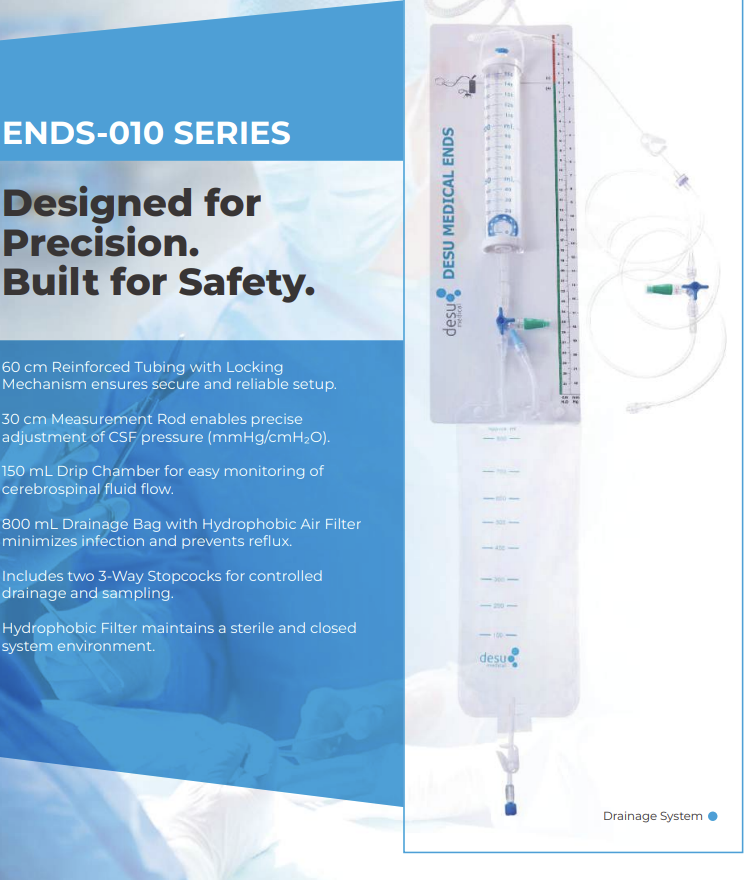
Drainage bag sizing matters because every bag change opens the EVD system and adds a task for a busy nurse. The DESU EVD-010 Series combines a 150 ml drip chamber, where output is measured, with an 800 ml drainage bag. How often the bag is changed is set by hospital protocol; the device should make each change straightforward.
For neuro-ICU buyers and nurse educators, the drip chamber and drainage bag are the parts of an EVD system that nurses touch most often after the scale. Their capacity, readability and the way they connect affect workload, closed-system practice and stocking. This article explains what to look at and which questions to ask during an evaluation.
How do the drip chamber and the bag work together?
In a typical gravity EVD, CSF passes from the catheter into a drip chamber mounted on the scale. The drip chamber is where hourly output is measured and recorded. At set intervals, or when it reaches a defined level, the nurse empties the drip chamber into the drainage bag below, which collects the fluid until the bag is changed.
The two components therefore do different jobs. The drip chamber needs to be large enough to hold output between emptying intervals, and clear enough to read accurately. The bag needs to be large enough to keep bag changes, and the system openings they involve, to a reasonable frequency.
What capacities do DESU systems offer?
The EVD-010 Series has a 150 ml drip chamber and an 800 ml drainage bag, together with a 31 cm ventricular catheter and a 30 cm measuring scale. The EVD-020 Series includes a drip chamber, a drainage bag, a pressure scale and a filter, and is used with a ventricular or a lumbar catheter. Ask a DESU product specialist for the exact capacities of each EVD-020 configuration in your market.
| Component | EVD-010 Series | Role in daily care |
|---|---|---|
| Drip chamber | 150 ml | Hourly measurement; emptied into the bag at intervals |
| Drainage bag | 800 ml | Collection between bag changes |
| Measuring scale | 30 cm | Sets the drip chamber height relative to the reference point |
| Ventricular catheter | 31 cm, standard or antibiotic-impregnated | Connects the ventricle to the system |
How much CSF does an EVD drain?
Adults produce roughly 500 ml of CSF per day, but an EVD drains only the volume that exceeds the pressure set by the drip chamber height. Actual output varies widely: some patients drain little, others a lot, and output changes as the clinical picture evolves or the treating team adjusts the height. That variability is why drip chamber and bag capacity should be considered against the unit’s own experience rather than a single average.
For a buyer, the practical question is how often bags will be changed at typical output on the unit, and whether that frequency fits nursing workload and the hospital’s closed-system practice.
When should the bag be changed?
Change-out frequency is set by hospital protocol. Common approaches include changing the bag when it reaches a defined fill level rather than waiting until it is full, and changing it when it is damaged or when the system is otherwise opened. Many protocols also limit how often the system is opened, because each opening is a potential route for contamination.
The device should support whichever protocol the hospital uses. During an evaluation, ask nurses to perform several bag changes on a demonstration unit and comment on:
- How clearly the fill level of the bag can be read.
- How the bag is disconnected and replaced, following the IFU sequence.
- How easily the change can be done without contaminating the connection.
- Whether the bag hangs securely and does not pull on the line.
- How the full bag is closed and disposed of according to hospital policy.
Units also differ in how they treat the drip chamber. Some empty it into the bag every hour after recording output; others empty it at longer intervals when output is low. Either way, the chamber must not overfill, so its capacity and the visibility of its markings matter. Ask the nurse educator how the unit handles this today, and show how the same routine works on the proposed system.
How do bag changes fit into infection prevention?
Infection prevention teams view every opening of an EVD as a potential route for contamination, and bag changes are among the most frequent openings. Hospitals therefore build bag handling into their EVD bundles: hand hygiene, clean gloves or sterile technique according to policy, protection of the connection, and documentation of each change.
Bag capacity is one of the few device factors that directly influences how often the system is opened. A bag that is too small for the unit’s typical output means more changes; a larger bag means fewer, all else being equal. Capacity is not the only consideration, since a very heavy bag can pull on the line, but it is a fair question to raise during an evaluation. Infection preventionists also ask whether the bag can be emptied rather than replaced, which depends on the configuration; confirm the details in the IFU for your market.
What should buyers ask about replacement components?
Whether replacement bags or other components are supplied separately, and in what quantities, affects both stocking and cost. Before setting par levels, a buyer should confirm with the manufacturer:
- Which components of each system are available as separate items in their market.
- Packaging quantities and shelf life of those items.
- Whether replacement items are compatible across the EVD-010 and EVD-020 systems.
- How replacement items are identified and recorded for lot traceability.
If replacement components are used, include them in the par level calculation for each location and in the consignment agreement, if there is one. A unit that runs out of replacement bags will improvise, and improvisation is exactly what an EVD protocol is designed to avoid.
How does lumbar drainage change the picture?
Lumbar drains often have different drainage orders from ventricular drains, sometimes specifying a target volume per hour. The collection principle is the same: CSF enters a drip chamber, is measured and is emptied into a bag. When the EVD-020 Series is used with the lumbar drainage catheter kit, which provides an 80 cm silicone catheter with 24 drainage holes, nurses use the same collection components for both routes. That consistency simplifies training, especially on units that see lumbar drains only occasionally.
How should bag handling be taught?
A short, focused training module on drip chamber emptying and bag change is one of the most valuable things a distributor can offer. Keep it to the device steps, use demonstration units and include practice on night shifts. Add a one-page sheet with the IFU sequence in numbered steps and a diagram showing each clamp. Revisit the module at one month, when nurses have real questions.
DESU designs and manufactures its EVD systems in Ankara, Türkiye, under ISO 13485, and its products carry the CE mark. Questions from nurse educators about component handling can go directly to the manufacturer’s specialists, who can answer in writing for the unit’s records.
Talk to a DESU product specialist
If you are evaluating EVD drip chambers and drainage bags for a neuro-ICU, DESU’s product specialists can confirm configurations, replacement components and packaging for your market. Email sales@desu.tr or use the contact page.
Frequently Asked Questions
What size is the drainage bag on the DESU EVD-010 Series?
The EVD-010 Series has an 800 ml drainage bag and a 150 ml drip chamber, together with a 31 cm ventricular catheter and a 30 cm measuring scale. The drip chamber is used for measuring output, and its contents are emptied into the bag at intervals set by the unit.
How often should an EVD drainage bag be changed?
That is set by hospital protocol. Many protocols change the bag at a defined fill level rather than when it is completely full, and also limit how often the system is opened. The device should allow each change to be done simply and in line with the Instructions for Use.
Why does drip chamber capacity matter?
The drip chamber is where hourly output is measured. It must hold the output between emptying intervals and be clear enough to read accurately. Capacity and readability together affect how easily nurses can record output and how often they need to handle the system.
Are replacement bags available separately?
Availability of separate components depends on the configuration and the market. Confirm with a DESU product specialist which components can be ordered separately, in what packaging quantities and with what shelf life, before setting par levels for each location and adding them to any consignment agreement.
Sources
- Fried HI et al. The Insertion and Management of External Ventricular Drains: An Evidence-Based Consensus Statement. Neurocritical Care, 2016
Talk to a specialist about this topic
Reach our team directly for product selection, technical specifications, sample requests or distributor enquiries.
Comments
No comments yet. Be the first to write one.