
EVD System Line-Up for Distributors: EVD-010 vs EVD-020
A complete external drainage line-up covers ventricular and lumbar routes. How the DESU EVD-010 and EVD-020 systems split the work for a distributor’s bag.
Bu yazının tam metni İngilizce olarak yayımlanmıştır. Türkçe özet ve öne çıkan başlıklar yukarıdadır.
A complete external drainage line-up gives a hospital one family of products for every route it drains cerebrospinal fluid: a ventricular system, a lumbar option and a choice of catheters. In the DESU range, the EVD-010 Series covers ventricular drainage as a configured system, while the EVD-020 Series pairs with either a ventricular or a lumbar catheter.
For a distributor or an independent neuro agency, that distinction matters more than any single feature. Accounts rarely buy “an EVD.” They buy a way to manage cerebrospinal fluid (CSF) across the neuro-ICU, the operating room and sometimes the step-down unit, and they want to standardize on as few suppliers as practical. This article walks through how the two DESU systems divide the work and how the surrounding catheter kits fill the gaps.
What does a complete external drainage line-up include?
Most neurosurgery departments drain CSF in two ways. Ventricular drainage uses a catheter placed into the lateral ventricle, usually through a burr hole or twist-drill hole, and is the familiar EVD. Lumbar drainage uses a catheter placed in the lumbar subarachnoid space and is chosen for other indications, such as some CSF leak management protocols or temporary diversion when the ventricles are not the target.
A line-up that only covers one route forces the hospital to keep a second supplier for the other. A line-up that covers both lets a value-analysis committee review one manufacturer, one quality file and one set of in-service materials. The building blocks are:
- An external collection system with a measuring or pressure scale, a drip chamber and a drainage bag.
- A ventricular catheter, available standard or antibiotic-impregnated.
- A lumbar drainage catheter for accounts that run lumbar drains.
- Connectors and accessories for the occasional non-standard configuration.
How is the EVD-010 Series configured?
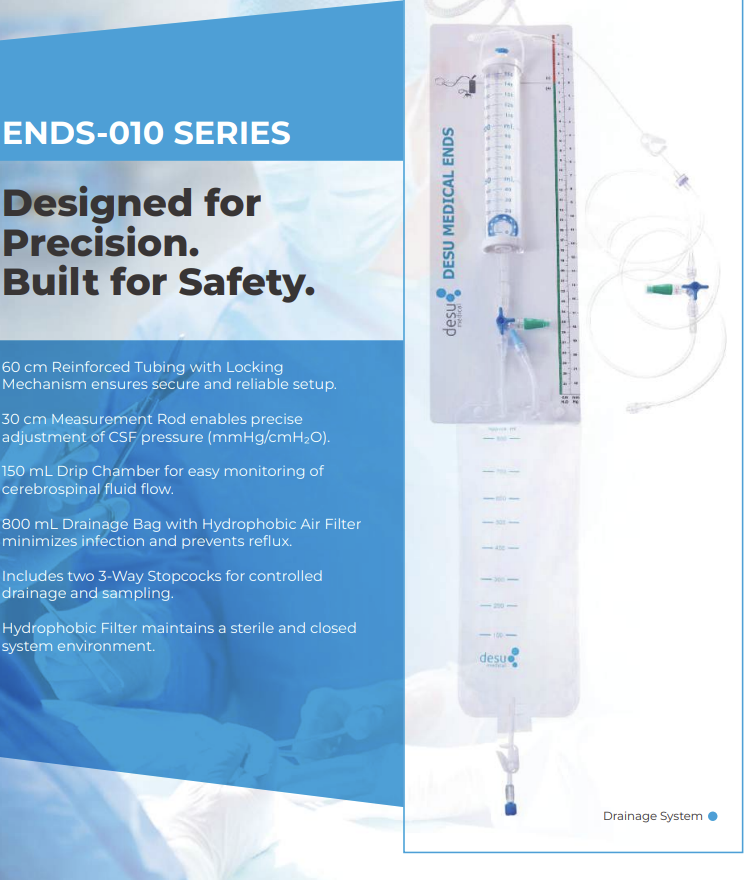
The EVD-010 Series is an external ventricular drainage system supplied with its main components defined: a 31 cm ventricular catheter, a 30 cm measuring scale, a 150 ml drip chamber and an 800 ml drainage bag. It is offered with a standard or an antibiotic-impregnated catheter.
That makes it a straightforward fit for accounts where the neurosurgery team places ventricular drains at a steady rate and wants a single, predictable item on the shelf. Nurses learn one scale, one drip chamber and one bag. Supply chain manages one item number per catheter type. For a distributor, it is the product that usually opens the conversation.
Where does the EVD-020 Series fit?
The EVD-020 Series is described as an advanced external drainage system used with a ventricular or a lumbar catheter. It combines a pressure scale, a drip chamber, a drainage bag and a filter in one system. The practical point for a distributor is flexibility: the same collection system can follow the patient whether the surgeon chooses the ventricular or the lumbar route.
In accounts that run both kinds of drain, standardizing on one collection system can simplify nurse education and reduce the number of different setups at the bedside. The catheter is then selected separately, which suits teams that have strong preferences about catheter type.
Catheters that complete the system
For lumbar drainage, the lumbar drainage catheter kit provides an 80 cm silicone catheter with application components, tantalum marks from 5 to 20 cm and 24 drainage holes, in standard and antibiotic-impregnated options. For ventricular placement, the ventricular catheter kit offers a radiopaque silicone catheter with tantalum length marks from 5 to 15 cm and 24 drainage holes in four rows.
EVD-010 vs EVD-020: how do they compare?
The table below summarizes the published product facts. It is a starting point for account planning, not a substitute for the Instructions for Use.
| Feature | EVD-010 Series | EVD-020 Series |
|---|---|---|
| Drainage route | Ventricular | Ventricular or lumbar, with the matching catheter |
| Scale | 30 cm measuring scale | Pressure scale |
| Drip chamber | 150 ml | Included |
| Drainage bag | 800 ml | Included |
| Filter | Hydrophobic filter included | Included |
| Catheter | 31 cm ventricular, standard or antibiotic-impregnated | Selected separately: ventricular or lumbar |
Which accounts need which system?
A useful way to plan is to sort accounts by how they drain CSF, not by bed count alone.
- Accounts that place ventricular drains only, often for hemorrhage or trauma, can usually start with the EVD-010 Series in one or both catheter versions.
- Accounts that run lumbar drains for skull base, spine or CSF leak protocols need a lumbar option, which points to the EVD-020 Series with the lumbar drainage catheter kit.
- Academic centers with several neurosurgeons often run both routes and may prefer one collection system across them, again favoring the EVD-020 Series.
- Accounts with a protocol for antibiotic-impregnated catheters in selected patients need both catheter versions stocked, which affects par levels.
None of this replaces the clinical team’s judgment. It simply helps a rep arrive at the first meeting with a sensible proposal instead of a catalog.
How do catheter versions shape the assortment?
Every system in the line-up can be paired with a standard or an antibiotic-impregnated catheter. The antibiotic-impregnated catheters are orange and release the agent in a controlled way over 28 days. For stocking, that doubles the catheter decision rather than the system decision: an account may use one collection system but two catheter versions.
In practice, distributors see three patterns. Some hospitals use antibiotic-impregnated catheters for every external drain, which keeps the shelf simple. Some reserve them for patients with an expected longer drainage period, which requires both versions at a ratio the account can estimate from its own history. A few use the standard version only. Ask which pattern applies before quoting, because it changes the item list, the par levels and the conversation with infection prevention.
Accessories that prevent improvisation
Straight, L-type and Y-type catheter connectors complete the line-up for the occasional case where the surgeon needs to join catheter segments or redirect a catheter without kinking. They are low-volume items, but having them in the same supplier file means the OR does not reach for a mismatched part from another vendor. Keep a small quantity at each account that uses them and review usage every quarter.
Why does a line-up approach help a distributor sell?
Hospitals increasingly ask suppliers to reduce complexity. A value-analysis committee would rather review one manufacturer that covers ventricular and lumbar drainage than two suppliers that each cover half. Nurse educators would rather run one in-service. Materials managers would rather track one vendor’s lot numbers.
A line-up also protects the account. When the neurosurgeon adds a lumbar drain protocol, the distributor already has the product, the quality documentation and the relationship. When another supplier’s ventricular system is under review, the distributor can propose a complete alternative rather than a single item.
Finally, a drainage line-up leads naturally to the next conversation. Many EVD patients later need permanent CSF diversion, and the same neurosurgery team then chooses a shunt and catheters. A distributor who already supports the EVD program is well placed to present DESU’s shunt families and catheter kits, without having to start a new relationship from scratch.
What should a distributor confirm with the manufacturer?
Before building a proposal, a distributor should confirm a handful of points with the manufacturer directly:
- The exact configurations and item codes available for each system and catheter version.
- Shelf life, packaging and storage conditions for warehouse planning.
- Quality documentation: DESU manufactures under ISO 13485 and its products carry the CE mark.
- In-service and training materials for nurses and residents.
- Lead times and how the manufacturer supports forecasting and replenishment.
DESU has designed and manufactured neurosurgical devices since 2007, starting as an R&D company at Hacettepe Teknokent in Ankara, Türkiye. Production runs in its own cleanrooms across 5,000 m², and the company exports to more than 50 countries. Those facts tell a distributor that it is dealing with the manufacturer itself, not a reseller, which shortens every technical answer.
Talk to a DESU product specialist
If you distribute neurosurgery or neuro-ICU products and want to map the EVD-010 and EVD-020 systems to your accounts, DESU’s product specialists can walk you through configurations, catheter options and documentation for your market. Email sales@desu.tr, use the contact page or request a quote to start the conversation.
Kaynaklar
- Fried HI et al. The Insertion and Management of External Ventricular Drains: An Evidence-Based Consensus Statement. Neurocritical Care, 2016
- ISO 13485:2016 Medical devices — Quality management systems — Requirements for regulatory purposes
Bu konuda uzmanımızla görüşün
Ürün seçimi, teknik özellikler, numune talebi veya distribütörlük başvurusu için ekibimize doğrudan ulaşabilirsiniz.
Yorumlar
Henüz yorum yok. İlk yorumu siz yazın.