
EVD Zeroing and Leveling Explained for Sales Reps

Zeroing and leveling are the two words nurses use most about an EVD. A plain explanation of the drip chamber and measuring scale for sales reps.
Bu yazının tam metni İngilizce olarak yayımlanmıştır. Türkçe özet ve öne çıkan başlıklar yukarıdadır.
EVD leveling means aligning the zero mark of the measuring scale with an anatomical reference point on the patient, usually the tragus or external auditory meatus as an approximation of the foramen of Monro. The drip chamber is then set at a prescribed height above that zero. Zeroing usually refers to calibrating a pressure transducer to atmospheric pressure.
Sales reps hear these terms every time they enter a neuro-ICU. Understanding them well is not about practicing nursing. It is about explaining a device accurately, answering questions without hesitation and recognizing why certain design features matter. This article explains the principles in plain language.
How does a gravity EVD actually work?
A standard external ventricular drain is a gravity system. CSF flows from the ventricle through the catheter into a drip chamber mounted on a vertical scale. CSF only drains when the pressure inside the head exceeds the height of the drip chamber’s entry point above the reference level. Raise the chamber and the drain opens at a higher pressure; lower it and CSF drains at a lower pressure.
That is why the height setting is a medical order, written in centimeters of water (cm H2O) or millimeters of mercury (mmHg), and why every change in patient position requires the system to be re-leveled.
What is the reference point, and why does it move?
The reference point represents the level of the ventricles. Most units use the tragus or external auditory meatus as an external landmark, but the exact landmark is set by hospital policy. When the patient sits up, rolls or is transported, the reference point moves relative to the bedside pole, so the scale must be realigned.
Nurses typically use a laser level or a bubble level to align the zero mark of the scale with the landmark. A scale that is easy to read and easy to adjust on the pole makes this frequent task faster and more consistent.
What is the difference between leveling and zeroing?
The two words are often used interchangeably at the bedside, which confuses new reps. The distinction is worth knowing:
| Term | What it means | When it happens |
|---|---|---|
| Leveling | Aligning the zero of the scale with the patient’s reference point | At setup and after every change in head or bed position |
| Zeroing | Calibrating a pressure transducer to atmospheric pressure | At setup and per policy when a transducer is used for ICP readings |
| Setting the height | Placing the drip chamber at the ordered height above zero | As ordered by the treating team |
Why do units differ: cm H2O or mmHg?
Drain heights are commonly ordered in cm H2O because the scale is physically a height. Intracranial pressure is usually charted in mmHg. One mmHg corresponds to about 1.36 cm H2O, so a scale showing both units, or a clear conversion on the unit’s reference card, reduces mental arithmetic at the bedside. A rep should know which units the account uses and whether the scale on the proposed system matches that habit.
How do DESU systems present the scale and drip chamber?
The EVD-010 Series has a 30 cm measuring scale and a 150 ml drip chamber, with an 800 ml drainage bag and a 31 cm ventricular catheter in standard or antibiotic-impregnated versions. The 30 cm range covers the drain heights typically ordered in neurocritical care while keeping the unit compact on the pole.
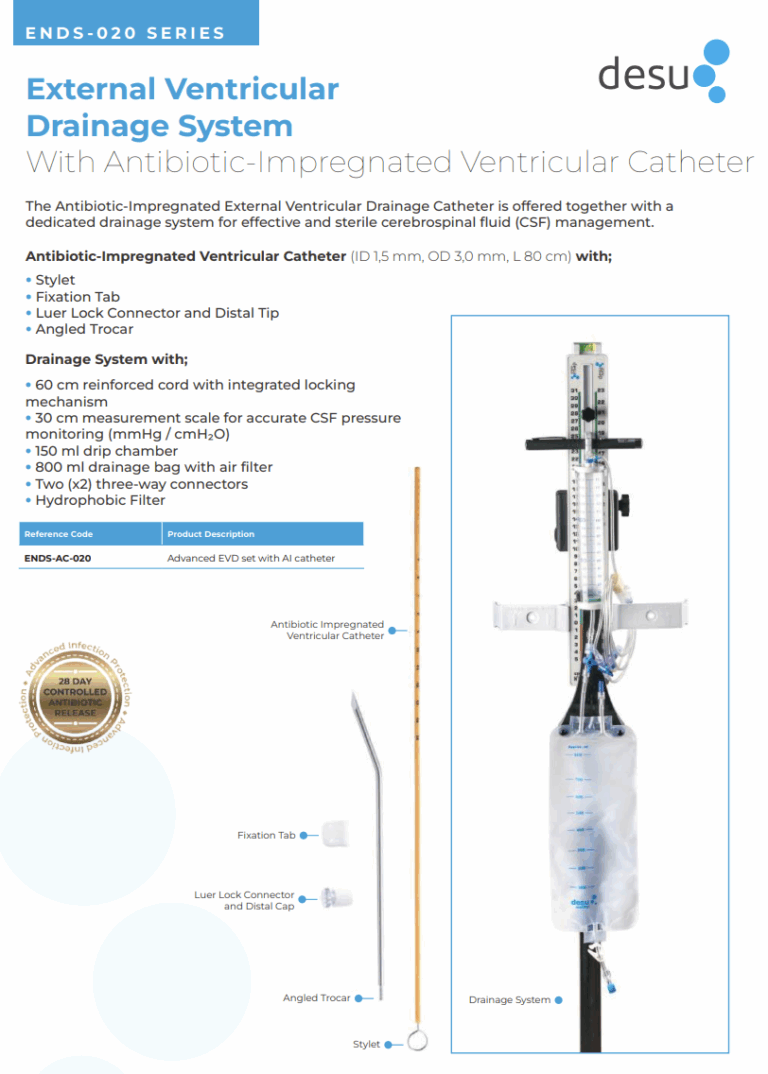
The EVD-020 Series has a pressure scale, drip chamber, drainage bag and filter, and is used with a ventricular or a lumbar catheter. For units that manage both kinds of drain, the same scale and leveling routine applies to each, which helps nurses work consistently.
What questions do nurses ask reps about the scale?
Expect these, and answer from the Instructions for Use:
- Where exactly is the zero line on the scale, and how is it aligned on the pole?
- Which point on the drip chamber corresponds to the height reading?
- How is the scale attached, and does it stay aligned when the pole is moved?
- How is the drip chamber emptied into the bag without disturbing the setting?
- What happens to the reading if the filter becomes wet?
Which leveling mistakes should a rep recognize?
Reps do not correct clinical practice, but they should recognize the common device-related errors, because these are often reported as product problems. Knowing them helps a rep ask the right follow-up question when a unit says a drain is not working as expected.
- The scale was not re-leveled after the head of the bed was raised or lowered, so the effective drain height changed.
- The scale slipped on the pole during transport or repositioning.
- The height was read from the wrong point on the drip chamber.
- A clamp was left closed after transport or a bag change.
- The filter on the drip chamber became wet, which can affect venting and flow.
When a complaint comes in, walking through this list with the charge nurse often identifies a handling issue that can be addressed with a short refresher. If it does not, the rep documents the details, keeps the product and packaging if possible, and reports it to the manufacturer through the agreed complaint route.
Lumbar drains follow the same logic
When the EVD-020 Series is used with a lumbar catheter, such as the 80 cm silicone catheter in the lumbar drainage catheter kit, the system still drains by gravity relative to a reference level. The landmark used for lumbar drains is set by hospital policy and may differ from the ventricular one, so reps should ask which landmark the unit uses before demonstrating the setup.
Why do these details matter in a sales conversation?
Leveling errors are a known source of over- or under-drainage, and neurocritical care consensus guidance gives attention to consistent EVD management. Nurses therefore judge a system largely by how easily it is leveled, read and emptied. A rep who can show these steps confidently on a demonstration unit earns a hearing from the nurse educator, and the nurse educator often carries the decision.
Practical features to point out in a demonstration include:
- Legible scale markings readable from the bedside.
- A drip chamber whose level and drip rate are easy to observe.
- A drainage bag sized for practical change-out intervals.
- Clear separation between the components a nurse adjusts and those that stay fixed.
How can a rep practice before the first demo?
Set up the system on an IV pole with a mannequin head or a marked reference point. Practice leveling with a simple laser level, moving the reference up and down to simulate head-of-bed changes. Empty the drip chamber, change the bag and identify each clamp. Twenty minutes of practice makes the difference between reading from the IFU and teaching from experience.
It also helps to rehearse the explanation itself. Practice describing the gravity principle in two sentences, the difference between leveling and zeroing in one, and the purpose of each component in a few words. Nurses are busy; a rep who can explain clearly and briefly, then hand over the device for hands-on practice, will be invited back.
Talk to a DESU product specialist
If you want demonstration units, training content or technical answers about the scale and drip chamber on DESU EVD systems, our product specialists can help you prepare for your market. Email sales@desu.tr, use the contact page or request a quote.
Kaynaklar
- Fried HI et al. The Insertion and Management of External Ventricular Drains: An Evidence-Based Consensus Statement. Neurocritical Care, 2016
Bu konuda uzmanımızla görüşün
Ürün seçimi, teknik özellikler, numune talebi veya distribütörlük başvurusu için ekibimize doğrudan ulaşabilirsiniz.
Yorumlar
Henüz yorum yok. İlk yorumu siz yazın.