
From EVD to Shunt: How a Drainage Account Opens New Lines
Many EVD patients later need a shunt. How a well-supported drainage account opens the door to shunt, catheter and accessory lines from the same manufacturer.
Bu yazının tam metni İngilizce olarak yayımlanmıştır. Türkçe özet ve öne çıkan başlıklar yukarıdadır.
An EVD account opens the door to shunts because the same neurosurgeons manage both: when a patient on external drainage cannot be weaned, the team plans permanent CSF diversion, usually a shunt. A distributor who has supported the drainage program well is in a natural position to present shunts, catheter kits and accessories from the same manufacturer.
For distributors, the EVD is often the first product a neurosurgery department evaluates from a new manufacturer. It is used frequently, it involves nursing and supply chain, and it builds a working relationship quickly. Shunts are a different kind of decision, more personal to the surgeon and with longer-term consequences for the patient, but they follow the same clinical pathway. This article explains how to make the step from drainage to shunts in a way that respects the account.
Why does the EVD lead to shunt conversations?
External drainage is temporary by design. In conditions such as hydrocephalus after hemorrhage, infection or tumor, a proportion of patients cannot be weaned from the drain and need permanent diversion. The team then chooses a shunt system: a valve, a ventricular catheter, a distal catheter and sometimes accessories such as an antisiphon device or connectors.
The people involved overlap almost completely. The neurosurgeon who placed the EVD often places the shunt. The neuro-ICU nurses who managed the drain care for the patient after shunting. Supply chain and value analysis already know the manufacturer’s documentation. A distributor who has earned trust on the drainage line has an advantage that a newcomer selling shunts alone does not.
There is also a practical continuity for the patient record. Catheter versions, lot numbers and documentation from one manufacturer follow the patient from the ICU drain to the permanent shunt, which some teams find simpler when reviewing a patient’s device history later.
What does the DESU shunt range offer?
DESU manufactures three shunt families, each with a distinct design, so a distributor can match the range to surgeon preference rather than forcing one design on every account.
| Family | Valve design | Pressure options | Notes from the product description |
|---|---|---|---|
| Depus | Polysulfone valve with ruby ball and titanium spring | Low, medium, high fixed; adjustable options | VP and LP kits; adjustable valve set with the Depus Adjustment Kit |
| Defit | Flat-bottom silicone | Low, medium, high fixed | Ultra Small, Small and Regular sizes; no metal; compatible with MRI and CT |
| Decurve | Burr-hole silicone | Low, medium, high fixed | Paediatric and adult valve sizes; reservoir; no metal |
The Depus shunts suit surgeons who want a choice between fixed and adjustable pressure in one family, with ventriculoperitoneal and lumboperitoneal kits. The Defit shunts offer a flat-bottom silicone design without metal in three sizes. The Decurve shunts provide a burr-hole silicone design with a reservoir, in paediatric and adult valve sizes.
Which catheters and accessories complete the line?
Shunt surgery uses catheters and accessories that a drainage account may not yet buy from you:
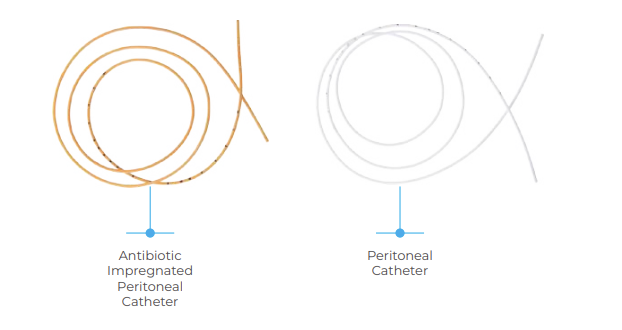
- The ventriculoperitoneal catheter kit, with ventricular and peritoneal silicone catheters with tantalum length marks, standard or antibiotic-impregnated.
- Ventricular, peritoneal, lumbar and lumboperitoneal catheter kits for revisions and specific configurations.
- The antisiphon device, which helps prevent overdrainage by closing against the siphon effect that can occur when the patient moves from horizontal to vertical.
- Straight, L-type and Y-type catheter connectors for joining catheter segments or creating additional inlets or outlets.
- The Depus Adjustment Kit, in 3 Pressure and 5 Pressure versions, for locating, reading and setting the adjustable Depus valve.
When is the right time to introduce shunts?
Timing is the most common mistake. Presenting shunts while the EVD evaluation is still running divides attention and can make the distributor look more interested in volume than in the account’s needs. A better sequence:
- Complete the EVD evaluation and conversion, with training on every shift and responsive follow-up.
- Wait until the drainage line is running smoothly and nursing feedback is positive.
- Ask the neurosurgery champion whether the department would be open to seeing other products from the manufacturer.
- Present the shunt range as an option, starting with the family that best matches the surgeons’ current practice.
- Offer samples and a hands-on session, and let the surgeons set the pace.
How do shunt conversations differ from EVD conversations?
EVD decisions are often team decisions driven by nursing workflow and supply chain. Shunt decisions are more individual: surgeons have long-standing preferences about valve type, pressure settings, adjustable versus fixed valves and catheter configuration. They ask detailed questions about valve mechanism, imaging, and how adjustable valves are read and set.
Prepare for that difference. Know the product descriptions thoroughly, bring the Instructions for Use, and route clinical and engineering questions to the manufacturer for written answers. For adjustable valves, demonstrate the Depus Adjustment Kit and explain its 3 Pressure and 5 Pressure versions. Never compare performance with other systems without a published source.
How should a shunt evaluation be supported?
Shunt evaluations tend to be slower and more personal than drainage evaluations. A surgeon may want to try a new valve in a small number of carefully selected cases before deciding, and the result may not be clear for months. A distributor supports that process best by being present and prepared rather than by pushing for volume.
- Agree with the surgeon which family, pressure options and catheter configurations to evaluate.
- Make sure the full set of sizes and pressures under evaluation is on the shelf before the first case.
- Offer an in-service for OR staff on the kit contents and, for adjustable valves, on the Depus Adjustment Kit.
- Attend early cases where the hospital allows it, to answer device questions.
- Brief the neurosurgery clinic and nursing staff who will see the patient after discharge.
- Record feedback in writing and route any product question to the manufacturer promptly.
Patience pays. A surgeon who has had time to form a considered view becomes a reliable advocate; one who feels rushed rarely does.
What does a portfolio account look like?
An account that buys drainage, shunts and catheters from one manufacturer is simpler for everyone. The value-analysis committee reviews one quality file; supply chain manages one supplier relationship for CSF management; nurse educators work with one support team. For the distributor, a broader portfolio deepens the relationship and makes it more resilient when any single product comes up for review.
The portfolio also includes the antibiotic-impregnated option across drainage and shunt catheters. Hospitals that use antibiotic-impregnated catheters for external drains often ask about them for shunts, and DESU’s catheter kits are available in both versions, with the orange antibiotic-impregnated catheters designed to release the agent in a controlled way over 28 days.
Why work with DESU across the pathway?
DESU has designed and manufactured neurosurgical devices since 2007, starting at Hacettepe Teknokent in Ankara, Türkiye. Its range covers external drainage, catheters, three shunt families and accessories, all produced in its own cleanrooms under ISO 13485, with CE-marked products exported to more than 50 countries. For a distributor, that means one manufacturer can support a neurosurgery department from the first emergency drain to the permanent shunt.
Talk to a DESU product specialist
If your drainage accounts are asking about shunts, DESU’s product specialists can help you choose which families to present, prepare samples and plan the conversation for your market. Email sales@desu.tr or request a quote.
Kaynaklar
- ISO 13485:2016 Medical devices — Quality management systems — Requirements for regulatory purposes
- Fried HI et al. The Insertion and Management of External Ventricular Drains: An Evidence-Based Consensus Statement. Neurocritical Care, 2016
Bu konuda uzmanımızla görüşün
Ürün seçimi, teknik özellikler, numune talebi veya distribütörlük başvurusu için ekibimize doğrudan ulaşabilirsiniz.
Yorumlar
Henüz yorum yok. İlk yorumu siz yazın.