
Lumbar Drainage vs Ventricular Drainage: Positioning the Kit
External lumbar drainage and ventricular drainage solve different problems. How to position a lumbar drainage catheter kit next to an EVD in a neuro account.
Bu yazının tam metni İngilizce olarak yayımlanmıştır. Türkçe özet ve öne çıkan başlıklar yukarıdadır.
Ventricular drainage removes cerebrospinal fluid from the lateral ventricle through a catheter placed via the skull; external lumbar drainage removes it from the lumbar subarachnoid space through a catheter placed in the lower back. They are not interchangeable. Each route serves different clinical situations, and the treating neurosurgeon decides which one a patient needs.
For a distributor, the practical question is how to present a lumbar drainage catheter kit in an account that already thinks of CSF drainage as “the EVD.” Done well, the lumbar kit is not a competing product but a natural extension of the drainage line. This article explains the difference between the routes, the products that serve each one and how to position them in a sales conversation without stepping into clinical decisions.
What is the clinical difference between the two routes?
A ventricular drain is placed directly into the CSF spaces inside the brain. It can drain CSF when the normal pathways are blocked, and it allows intracranial pressure to be measured. That is why it is the standard tool for obstructive hydrocephalus, intraventricular hemorrhage and many cases of severe traumatic brain injury and subarachnoid hemorrhage.
A lumbar drain is placed into the CSF space around the cauda equina, below the end of the spinal cord. It drains CSF that communicates freely between the head and the spine. Neurosurgeons and other specialists use it in situations such as managing CSF leaks after skull base or spine surgery, as a temporary diversion in communicating hydrocephalus, or as an extended drainage trial when normal pressure hydrocephalus is suspected.
Why lumbar drainage is not used in every patient
Lumbar drainage is generally avoided when CSF flow between the head and spine is obstructed or when a mass lesion creates a risk of downward herniation. That safety principle is well established in neurosurgical practice and is the main reason the route decision always belongs to the clinical team. A rep should understand it, mention it if asked, and never suggest a route for a patient.
How do the indications compare?
The following overview reflects common practice. It is meant to help reps understand where each product is used, not to guide treatment.
| Aspect | Ventricular drainage | External lumbar drainage |
|---|---|---|
| Catheter location | Lateral ventricle | Lumbar subarachnoid space |
| Typical settings | Obstructive hydrocephalus, intraventricular hemorrhage, ICP monitoring in TBI and SAH | CSF leak management, communicating hydrocephalus, extended drainage trials |
| Placement | Burr hole or twist-drill, at the bedside or in the OR | Lumbar puncture technique, usually with the patient on the side or seated |
| Key caution | Placement accuracy, infection, over-drainage | Avoided when there is obstruction or herniation risk |
| DESU products | EVD-010 Series; EVD-020 Series with ventricular catheter | Lumbar drainage catheter kit with the EVD-020 Series |
What is in the DESU lumbar drainage catheter kit?
The lumbar drainage catheter kit contains an 80 cm silicone catheter and the application components for external lumbar drainage. The catheter has tantalum marks from 5 to 20 cm, which help the clinician judge insertion depth, and 24 drainage holes. It is offered in standard and antibiotic-impregnated versions; the antibiotic-impregnated catheter is orange and designed to release its agent in a controlled way over 28 days.
A common source of confusion is the lumbar catheter kit, which is a different product. That kit contains a 100 cm silicone lumbar shunt catheter for permanent lumboperitoneal shunting, not for temporary external drainage. Reps should make the distinction clear in every quote, because an item mix-up between a drainage catheter and a shunt catheter is exactly the kind of error that damages trust with an OR.
How does the collection system fit both routes?
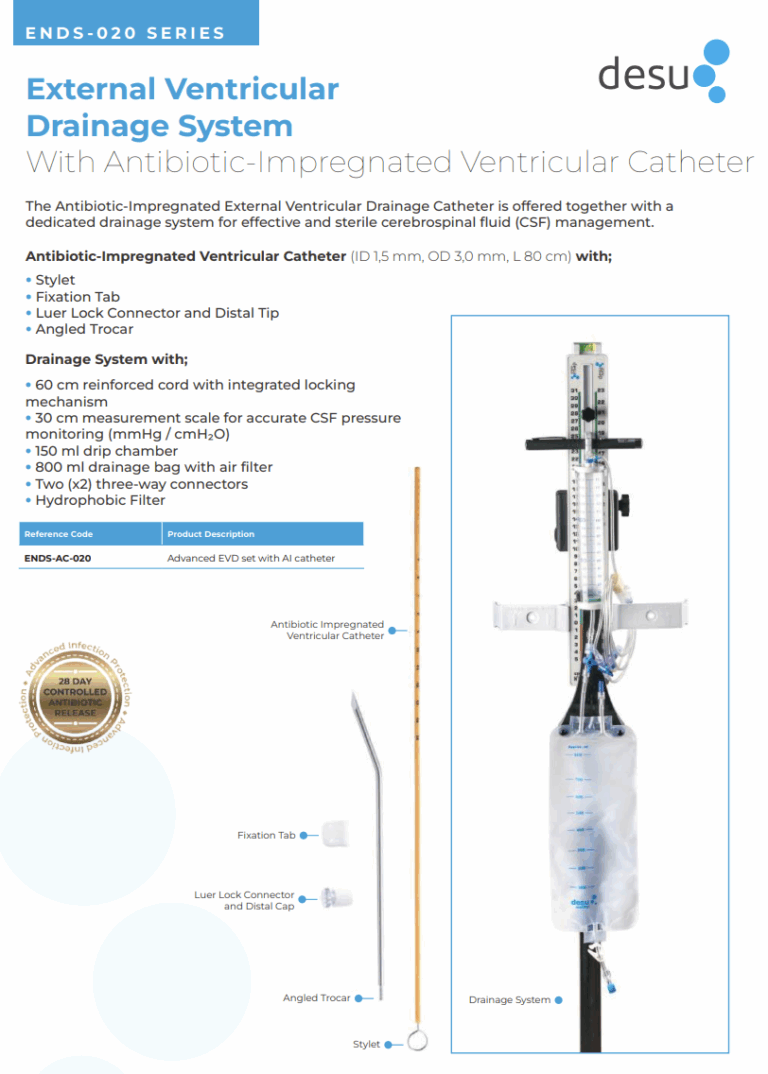
A lumbar catheter needs a collection system just as a ventricular catheter does: a scale to set the drainage level, a drip chamber and a bag. The EVD-020 Series is built for this. It combines a pressure scale, drip chamber, drainage bag and filter and is used with either a ventricular or a lumbar catheter.
For a neuro-ICU or neurosurgery floor, that means nurses learn one collection system for both drain types. Leveling, emptying the drip chamber and changing bags follow the same steps, even though the reference landmark and drainage orders may differ by route. Where an account only places ventricular drains, the EVD-010 Series remains a simple, configured option with its 31 cm ventricular catheter, 30 cm measuring scale, 150 ml drip chamber and 800 ml bag.
What do nurses need to know about a lumbar setup?
For nurses, a lumbar drain looks familiar but behaves in ways that deserve attention. The collection system is the same, yet the patient position, the reference landmark and the drainage orders may differ, and the catheter exits in the lower back where it is harder to see. When introducing the lumbar kit to a unit that already uses DESU ventricular drains, build a short add-on session rather than repeating the full in-service.
- Show how the lumbar catheter connects to the EVD-020 collection system, step by step from the IFU.
- Point out the tantalum marks and how insertion depth is documented at placement.
- Explain where the clamps are and how they are used for repositioning and transport, as described in the IFU.
- Remind staff that the reference landmark for lumbar drains is set by unit policy and may differ from the ventricular one.
- Show how to tell the orange antibiotic-impregnated catheter from the standard version.
Leave a one-page quick-reference sheet specific to the lumbar setup. Nurses who rarely manage lumbar drains will thank you for it on the night they need it.
Who uses lumbar drains in a hospital?
Lumbar drains are not used only by cranial neurosurgeons, which is good news for a distributor. Depending on the institution, they may be placed or requested by:
- Skull base teams, including neurosurgery and otolaryngology, managing or anticipating CSF leaks.
- Spine surgeons dealing with durotomy and persistent CSF leakage.
- Neurosurgeons and neurologists running extended drainage trials for suspected normal pressure hydrocephalus.
- Some cardiovascular surgery programs, where lumbar CSF drainage is part of certain aortic procedures, according to the hospital’s own protocol.
- Anesthesia and interventional teams who assist with placement in some hospitals.
Each of these groups is a potential conversation. Before approaching them, confirm with the manufacturer which indications are covered in the Instructions for Use for your market, and keep the discussion to what the product is and how it is supplied.
How should a rep position the lumbar kit in an EVD account?
The simplest positioning is “one manufacturer for both drainage routes.” The account already reviewed DESU for ventricular drainage; adding the lumbar kit uses the same quality documentation, the same collection system and the same support relationship. Practical steps:
- Ask the neuro-ICU educator how many lumbar drains the unit manages each month and what system is used now.
- Identify which surgeons place them and in which locations: OR, ICU, procedure room.
- Offer an in-service on the lumbar setup with the EVD-020 Series, focusing on device steps only.
- Quote the lumbar drainage catheter kit separately from the lumbar shunt catheter to avoid confusion.
- Confirm whether the account wants the standard, the antibiotic-impregnated version or both.
What questions do surgeons ask about a lumbar drainage catheter?
Experienced surgeons tend to ask about catheter flexibility and kink resistance, how the length marks are read, how the catheter is secured at the skin and how it connects to the collection system. Answer from the IFU and offer a sample for hands-on review. Where a question concerns clinical technique or patient selection, acknowledge it and leave it with the surgeon; your role is to supply accurate product information.
DESU manufactures its catheters in its own cleanrooms in Ankara, Türkiye, under an ISO 13485 quality system, and the products carry the CE mark. That allows technical questions to go straight to the design and production teams, which shortens response times during an evaluation.
Talk to a DESU product specialist
If you want to add external lumbar drainage to your EVD offering, DESU’s product specialists can help you choose configurations, prepare in-service content and plan the conversation for your market. Email sales@desu.tr or use the contact page.
Kaynaklar
- Fried HI et al. The Insertion and Management of External Ventricular Drains: An Evidence-Based Consensus Statement. Neurocritical Care, 2016
- ISO 13485:2016 Medical devices — Quality management systems — Requirements for regulatory purposes
Bu konuda uzmanımızla görüşün
Ürün seçimi, teknik özellikler, numune talebi veya distribütörlük başvurusu için ekibimize doğrudan ulaşabilirsiniz.
Yorumlar
Henüz yorum yok. İlk yorumu siz yazın.