
Oral Surgery Success: Collagen Bone Grafts for Dental Implants
How collagen bone grafts for dental implants support socket preservation, sinus lifts and peri-implant defects, and what to look for when choosing a graft.
Bu yazının tam metni İngilizce olarak yayımlanmıştır. Türkçe özet ve öne çıkan başlıklar yukarıdadır.
Dental implants are one of the most important contributions of modern dentistry to restoring smile aesthetics and chewing function. However, at the core of every successful implant is a strong bone structure to hold it firmly in place. Thus, collagen bone grafts for dental implants, the unsung heroes of surgical procedures are significant. Going beyond being just a filling material, these grafts help rebuild lost bone so that the implant has a sound foundation.
When a tooth is lost or extracted, the body considers the bone in that area no longer needed and begins to rapidly resorb it. This natural process leads to significant volume loss in areas where implants will be placed. Collagen bone grafts for dental implants are used to limit this volume loss and to start rebuilding the site.
Socket Preservation and Early Intervention of Collagen Bone Grafts
Timing is extremely important in implant treatment. Grafting performed during or immediately after tooth extraction can help avoid more complex augmentation later. In this practice, called socket preservation, the tooth extraction site is filled with collagen bone graft for dental implants.
The graft has two main roles here. First, its collagen component helps stabilize the blood clot in the socket. Second, it maintains space so that bone, rather than collapsing soft tissue, can fill the site. Because soft tissue grows faster than bone, many clinicians cover the grafted site with a resorbable barrier membrane such as COLL-OS, a pure Type I bovine collagen membrane, to keep the gingiva out while the bone cells (osteoblasts) do their work.
Sinus Lifting and Advanced Surgical Applications
Tooth loss in the back of the upper jaw, combined with sagging of the sinus cavity, leaves insufficient vertical bone height for implant placement. Sinus lift procedures are delicate interventions performed to provide this height. The collagen bone graft placed beneath the elevated sinus membrane fills the new space and provides the scaffold for new bone formation.
Handling matters in a site where gravity works against the surgeon. The collagen in a collagen-based graft helps hold the particles together so that they can be placed and kept in position under the sinus mucosa. A stable graft supports the ingrowth of new blood vessels (angiogenesis), on which the graft’s gradual replacement by the patient’s own bone depends.
Tissue Support in the Aesthetic Field: Collagen Bone Grafts for Dental Implants
Success in dental implants is not limited to the fusion of the implant with the bone, it is also necessary for the gums to have a natural and aesthetic appearance. In anterior implants, insufficient bone volume can cause the gums to collapse and the metal implant neck to appear gray. Collagen bone graft for dental implants supports not only hard tissue (as bone) but also indirectly supports soft tissue.
Adequate bone volume also supports a healthy, natural-looking gingival contour. For these sites, the choice of graft particle size and the use of a barrier membrane are part of planning for both function and aesthetics.
What to Look for in a Collagen Bone Graft for Dental Implants
There are many graft alternatives on the market. What should surgeons and distributors look at when evaluating DESU’s collagen bone grafts for dental implants?
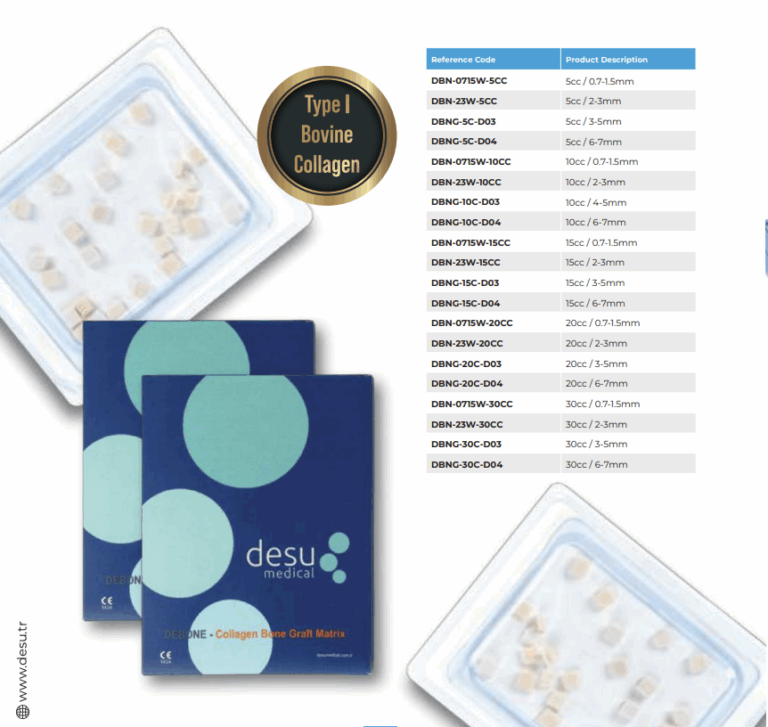
Composition and quality: XENOBONE is a bioresorbable, osteoconductive bone graft based on Type I bovine collagen and supplemented with β-TCP. DESU manufactures it in its own cleanrooms under an ISO 13485 quality system, and its products carry the CE mark. Because the collagen is of animal origin, sourcing and processing are controlled in line with the ISO 22442 series.
Handling and choice: XENOBONE is offered in 0.7–1.5 mm, 2–3 mm and 4–5 mm particle sizes, so the particle size can be matched to the defect, from a single socket to a larger augmentation. It can be used together with the COLL-OS barrier membrane from the same product family.
Accelerating Osseointegration
The fundamental measure of implant success is osseointegration, the direct structural connection between the titanium implant and living bone. In peri-implant defects, collagen bone grafts fill the spaces around the implant and guide bone healing toward the implant surface. The graft takes up the patient’s blood and its growth factors, and over time it is resorbed and replaced by new bone, which helps the implant transfer chewing forces to the jaw.
Planning Ahead with Collagen Bone Grafts
In dentistry, planning grafting early — rather than waiting for bone loss — can simplify later implant treatment. Whether the case is a single tooth or a full-arch rehabilitation, DESU offers graft and membrane options in different particle sizes and dimensions to suit the situation.
Talk to a DESU product specialist
Dental distributors, clinics and oral surgeons evaluating collagen bone grafts and barrier membranes can discuss XENOBONE particle sizes, COLL-OS dimensions and product codes with a DESU product specialist. Write to sales@desu.tr, use the contact page or request a quote.
Kaynaklar
- ISO 22442 series: Medical devices utilizing animal tissues and their derivatives
- ISO 13485:2016 Medical devices — Quality management systems
Bu konuda uzmanımızla görüşün
Ürün seçimi, teknik özellikler, numune talebi veya distribütörlük başvurusu için ekibimize doğrudan ulaşabilirsiniz.
İlgili yazılar
- DESU’dan HaberlerModern Cerrahide Yenilikçi Kemik Greft Çözümleri
- DESU’dan HaberlerCollagen Based Graft Substitute Technologies: The Future of Bone Regeneration
- DESU’dan HaberlerErfolg in der Oralchirurgie: Kollagen-Knochentransplantate für Zahnimplantate
- DESU’dan HaberlerFortschrittliche resorbierbare Kollagen-Knochentransplantat-Lösungen
Yorumlar
Henüz yorum yok. İlk yorumu siz yazın.