
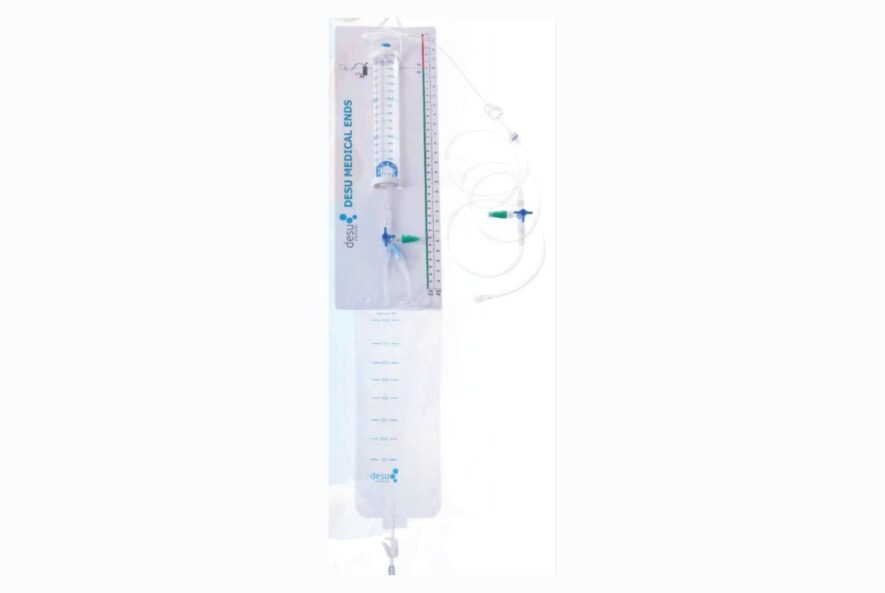
What is an External Ventricular Drain (EVD) System?
Control of intracranial pressure (ICP) and cerebrospinal fluid (CSF) is one of the most important parameters in contemporary neurosurgical procedures for the patient’s survival. The process that is executed and potentially life and limb saving is the most commonly performed procedure in brain surgery which is referred to in literature and worldwide as External Ventricular Drainage. So, What is an External Ventricular Drain (EVD) System?
An External Ventricular Drain (EVD) is a closed drainage system, that captures extra cerebrospinal fluid, blood, or infected material in the brain ventricles (filled cavities) and drains them outside the body. In healthy settings the brain is producing a certain amount of CSF per day, and that cerebral fluid is constantly absorbed in a cycle. But in trauma, bleeding or blockage, this cycle gets impaired.
The excess fluid builds up and compresses the brain tissue when the pressure builds up within the closed cage of the skull. That is where the EVD system serves as a safety valve, draining excess fluid to get the brain breathing. Modern EVD systems constructed by well-technologybased medical manufacturers such as Desu (such as EVD-010 and EVD-020 series) are not only a set of tubes and bags.
As life support devices of tremendous complexity, these are pressure-adjusting systems that retain millimeter sized precision and can be tailored up or down in a second, have the highest infection barrier value and support the surgeon in off the spot measurements.
The latter state of the art EVD systems adhere to the closed system principle, as compared to existing designs. This essentially omits the system from exposure to the ambient air allowing hospital infection to become a smaller risk for the clinician. Functioning as both a therapeutic and diagnostic tool, they are essential components of all ICU systems.
Key Components of an EVD Kit and Setup
The quality, sterilization and compatibility of EVD systems are directly related to their safety and effectiveness, when implanted surgically. Every part must be durable for its own sake.
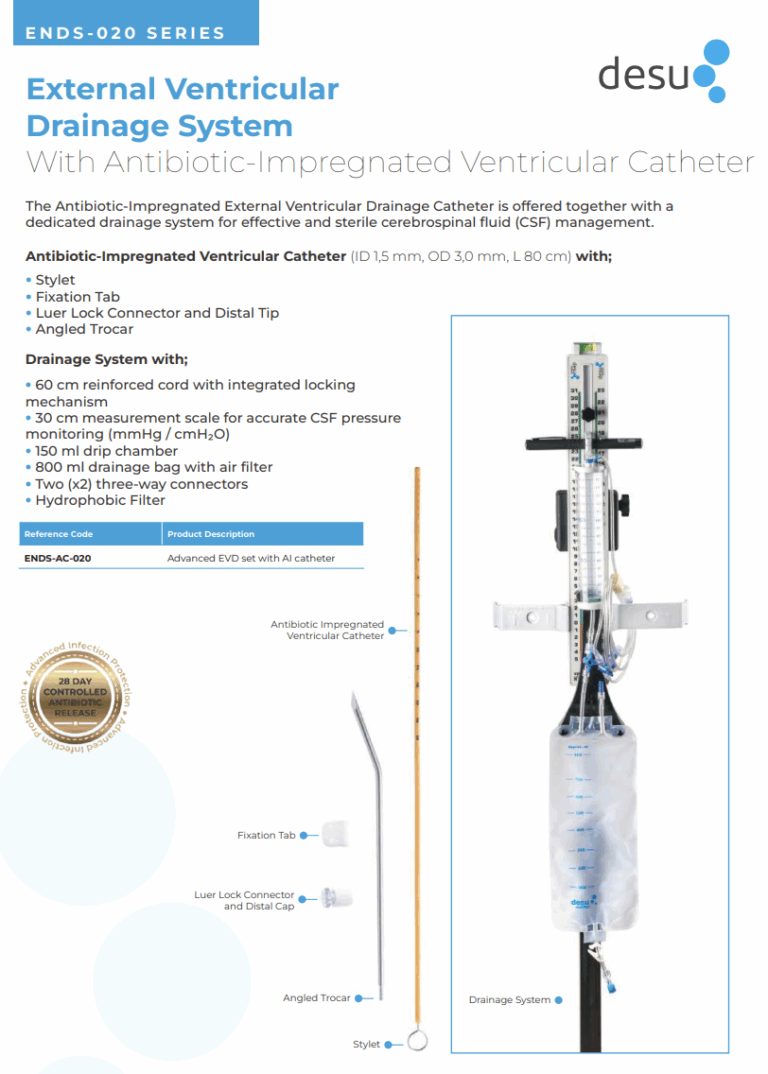
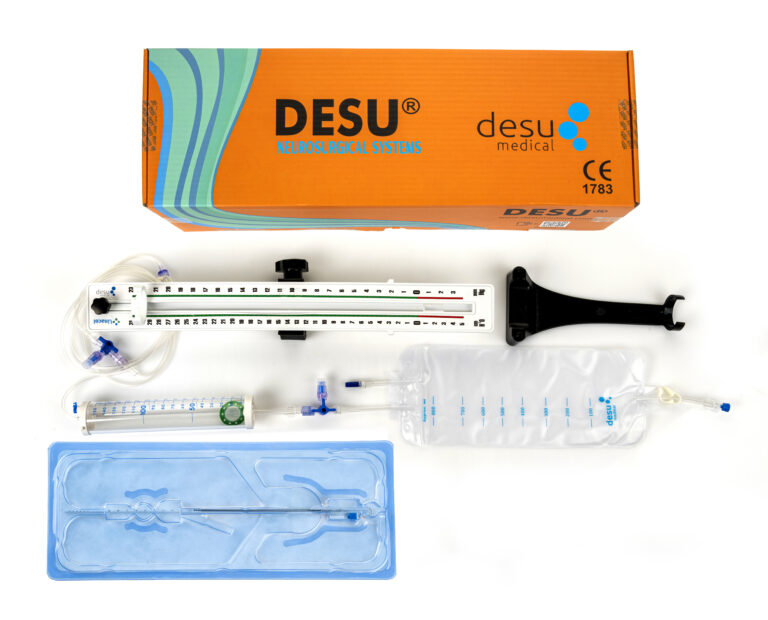
Based on the Desu.tr product range (especially EVD-010 and EVD-020 series), as defined by the following Key Components of an EVD Kit and Setup process.
Ventricular Catheter: But its radiopaque (visible on X-ray) property means the surgeon can examine to confirm that the tip of the catheter is in its correct position through CT or MRI.
Antimicrobial Technology: Especially unlike standard catheters the Desu EVD-020 series has a unique silicone structure impregnated with Rifampicin and Clindamycin. Desu technology allows organisms in the environment by controlling the amount of antibiotics released on the surface of the catheter for up to 28 days to prevent the growth of gram positive bacteria. This feature dramatically reduces the risk of infection in patients who need long-term drainage.
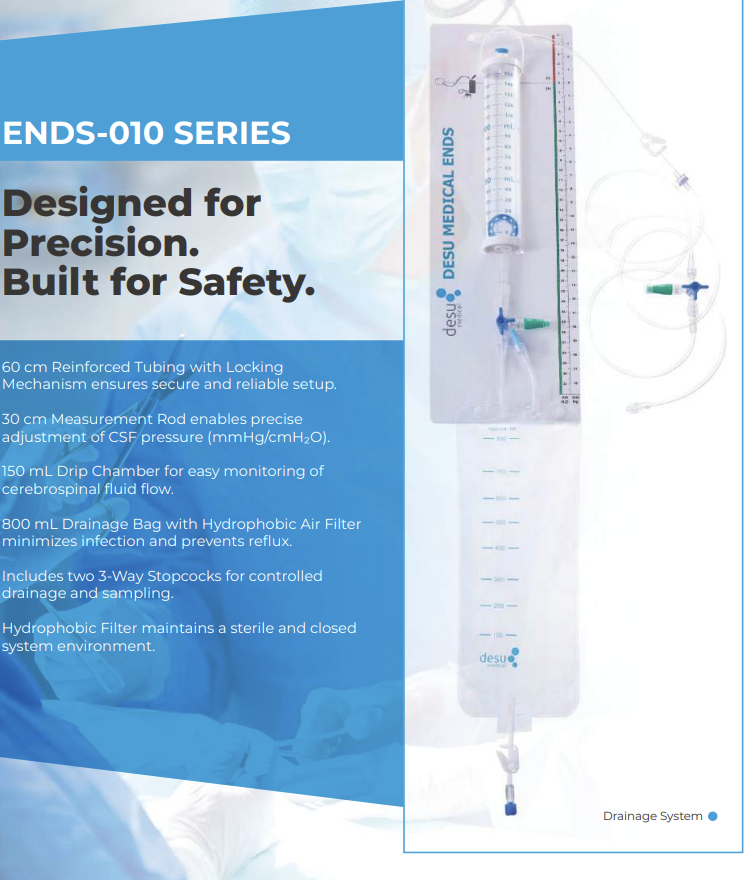
Drip Chamber: This is the control center of the system. This transparent chamber, where CSF drips drop by drop, is typically 100 ml in capacity with a graduated scale. The hydrophobic air filter on the chamber blocks air from coming into the system, while the pressure balance is at rest. The flow rate and color of the fluid whether the fluid is bloody or clear can be seen through this chamber.
Pressure Scale/Manometer: This is the scale on drip chamber, it takes values in mmHg and cmH2O. This scale will give the surgeon the means for establishing a target pressure. Calibrating to the patient’s standard value is important for the precision of treatment utilizing laser alignment devices.
Collection Bag: This is where the waste fluid is collected. These bags are ideally sized for Desu systems, usually to a limit of 700 ml, when full, the bags can be easily changed without losing the system’s integrity. Moreover, valves and filters found at the bag inlet prevent flow back out of the bag thereby preventing the occurrence of retrograde infection.
Connection Tubes and Stopcocks: There are 3 way stopcocks on the line from the catheter to the bag to direct the flow. Standard luer-lock connectors make sure it is leak-proofing. Such stopcocks enable the surgeon to stop the flow temporarily, draw a sterile sample, or inject medication into the system. This kink-resistant tubing geometry maintains a steady flow.
Indications: When is EVD Placement Required?
When do we need EVD placement? When to place EVD usually needs to be an emergency as opposed to a nice option. From a neurosurgical standpoint, the answer to the question Indications: When is EVD Placement Required is pathological conditions in which intracranial pressure reaches intolerable levels. The most common symptom is Acute Hydrocephalus. Tumors in the brain, cysts, or congenital anomalies can restrict the passage of CSF (for example, the Sylvian aqueduct). So, the fluid, trapped in the ventricles, starts outwardly pushing the brain. The EVD overcomes this blockage, drains the volume of fluid in the area and relieves the brain.
Second, patients with Intraventricular Hemorrhage (IVH) and Subarachnoid Hemorrhage (SAH) fall into the next wide category of patients. In the presence of rupture of aneurysm or bleeding due to hypertension, blood can plug the ventricles. Clotted blood can obstruct the granulations necessary for the absorption of CSF. In this situation both the blood and EVD helps to drain blood so that the blockage is cleared and prevents the breakdown products of blood forming which damage the brain, -vasospasm-. The large inner diameter of Desu EVD catheters can give some speed advantage to prevent clot blockages in this phase.
EVD is also regularly utilized in traumatic damage to the brain (TBI). In severe brain injuries the brain tissue also takes on edematous size. As the skull can’t expand, pressure rises. EVD is utilized in these patients to drain fluid, but is also used to continuously monitor intracranial pressure (ICP). Also, in central nervous system infections like Meningitis or Ventriculitis, only the infected, purulent liquid is drained.
In these high-risk circumstances, Desu EVD-020 series catheters containing Rifampicin and Clindamycin is known to be a preferred approach for surgeons due to reduced susceptibility for shunt infection. Intracranial Pressure Regulation Through EVD Systems. The EVD system operates on the principle of gravity physics and hydrostatic pressure and it is far more than a mere fluid drain process.
How EVD Systems Regulate Intracranial Pressure
Its basic operating principle in essence is built on the principle of vessels communicating with each other. The leveling process is the most important activity during the installation process. The anatomical point in the patient’s external auditory canal or The Foramen Monro is considered as the zero point. With alignment tools in Desu EVD sets, the system’s pressure scale is equalized to this point.
The doctor decides the level of pressure level suitable for the patient. This is adjusted to the level of the drip chamber. In other words, when the patient’s intracranial pressure exceeds 10 cmH2O, the fluid because of physics will withstand gravity and ascend up the tube into the chamber. The flow automatically stops even to a low pressure lower than 10 cmH2O.
This Drainage on Demand system ensures that the brain is not allowed to be too drained. Uncontrollable drainage of fluid can collapse the ventricles (slit ventricle syndrome) and cause bleeding between brain membrane and brain. The EVD system protects the brain from these complications. Meanwhile the system is able to produce waveforms to be shown on a monitor via an electronic transducer.
More recently, there are systems -such as Desu’s- which incorporates manual in-service drainage and digital monitoring to guarantee safe care of patients in intensive care. As a result, EVD systems are one of the primary building blocks of brain surgery. The Desu brand EV-010 and antibiotic-coated EVD-020 series, with its high production standards and biocompatible materials, allows surgeons to handle intracranial pressure safely even in the most aggressive cases.
If you would like to receive detailed information about DESU Medical products or explore distributorship and partnership opportunities, please do not hesitate to contact us. Our team will be happy to support you with product specifications, certifications, pricing structures, and collaboration models tailored to your market and needs.
For sales inquiries, product catalogs, and distributorship requests, you may reach us directly at [email protected]
We look forward to building long-term, value-driven partnerships and supporting healthcare professionals with reliable, high-quality medical solutions.
