

In neurosurgery, dura mater repair is a critical stage that directly determines both surgical success and patient recovery. This tough membrane covering the brain and spinal cord must be reliably closed whenever it is damaged during surgery or has to be removed, and this is where a dependable dural graft comes into play. In recent years, dural grafts made from type I bovine collagen have become one of the preferred solutions, offering standout advantages for both the surgeon’s working comfort and the patient’s healing process. This article covers the benefits of the type I bovine collagen dural graft, how it works, and why it has become so widely adopted.
What Is Type I Bovine Collagen?
Collagen is the most abundant structural protein in the human body, providing tissues with integrity, flexibility, and durability. Type I collagen is the most common subtype among them, found predominantly in skin, bone, tendons, and connective tissue. The type I bovine collagen used in dural grafts is obtained at high purity from bovine-derived tissues and processed through purification steps to make it suitable for medical use.
An important distinction to make here: a dural graft is not an oral dietary supplement but an implant placed directly at the surgical site. For this reason, the purity, structure, and biological compatibility of the graft carry far greater importance than they would for a supplement. As the purity level rises, the likelihood of the body recognizing the graft as a “foreign object” decreases, and the healing process proceeds more predictably.
The Role of the Collagen Graft in Dura Mater Repair
The dura mater is the tough membrane that protects the central nervous system from external factors and surrounds the cerebrospinal fluid (CSF). When an opening in this membrane is not closed properly, it can lead to serious complications such as CSF leakage, infection, and delayed wound healing. When primary suture closure is not possible, or when harvesting a graft from the patient’s own tissue is not suitable, collagen grafts step in as a dural substitute.
Here, the collagen graft does not behave like a passive patch. It acts as a natural scaffold (matrix) onto which the body’s own cells can migrate and settle. Fibroblasts attach to this scaffold and produce new tissue, and over time a structure resembling the patient’s own tissue forms at the graft site. This process transforms the repair from a temporary closure into a biological reconstruction.
Key Advantages of the Type I Bovine Collagen Dural Graft
High biocompatibility and low rejection risk
Type I collagen is a protein naturally present in the human body. The fact that the graft is made from this protein and manufactured at high purity significantly reduces the likelihood of the body identifying it as a foreign object. This means the inflammatory response and immune rejection remain at lower levels. Keeping the purity level high supports more harmonious integration of the graft with surrounding tissue.
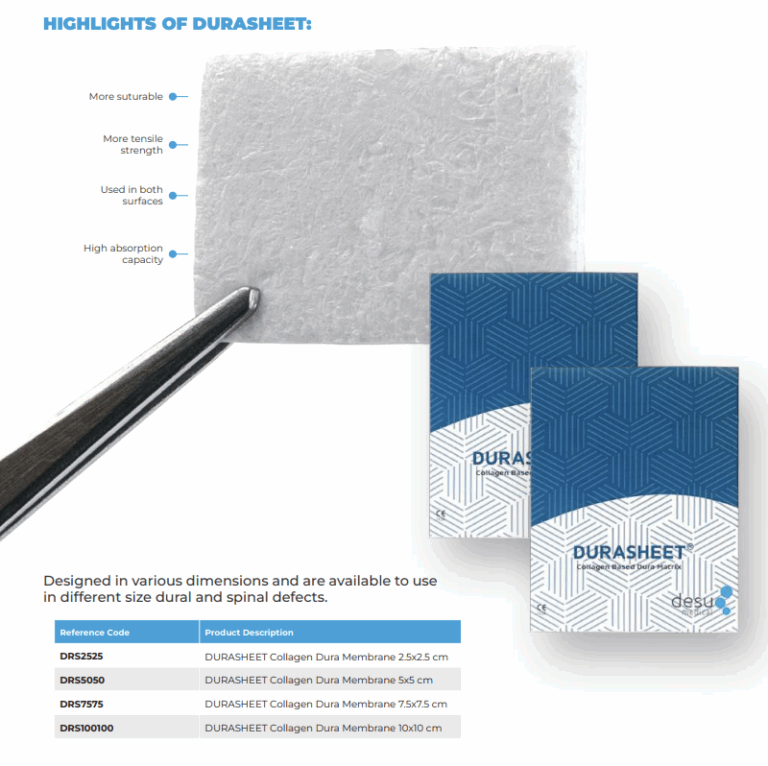
A scaffold for natural tissue regeneration
One of the most valuable features of the collagen graft is that it gives the body a foundation on which to run its own repair process. The graft creates a framework that supports cell migration and tissue growth. In this way, healing progresses through the patient’s own biology rather than relying on a permanent material placed from the outside. This approach contributes to more natural and durable long-term outcomes.
Bio-resorbability: the vanishing scaffold
Organic collagen grafts are bio-resorbable, meaning that once they have completed their task, the body slowly breaks them down and the patient’s own tissue takes their place. Unlike synthetic grafts, these grafts do not remain in the body permanently. This feature reduces the long-term risk of foreign-body-related complications and allows the healed area to gradually resemble native tissue.
An effective barrier against CSF leakage
One of the core goals of dural repair is to achieve a watertight closure. Collagen matrix dural substitutes are used to reduce the risk of CSF leakage in various neurosurgical procedures. By forming an effective barrier, they help limit fluid leakage in the postoperative period and the associated risk of infection. This helps safeguard the healing process, especially in sensitive cases.
Ease of application and surgical flexibility
Another advantage of organic collagen grafts is that, by virtue of their natural structure, they are hydrophilic and conform easily to the complex, curved surfaces of neural anatomy. Unlike synthetic meshes that can be rigid and difficult to place, collagen grafts give the surgeon a “natural feel.” Allowing both sutured and sutureless onlay applications, they offer flexibility across different case scenarios and help speed up the surgical workflow.
Organic Collagen Grafts Compared to Synthetic Grafts
There is a clear difference between synthetic and organic grafts in dural repair. Synthetic grafts remain in the body permanently and can sometimes create challenges such as stiffness, adhesions, or long-term foreign-body reactions. Organic collagen grafts, on the other hand, provide a structure that the body can gradually replace with its own tissue.
This difference is not merely a technical preference. Choosing a resorbable material can directly affect both the healing process and operational success. In clinical experience, better tissue integration and lower complication rates have been reported with collagen-based grafts. The combination of natural flexibility and durability makes collagen grafts particularly valuable in challenging neurotrauma cases.
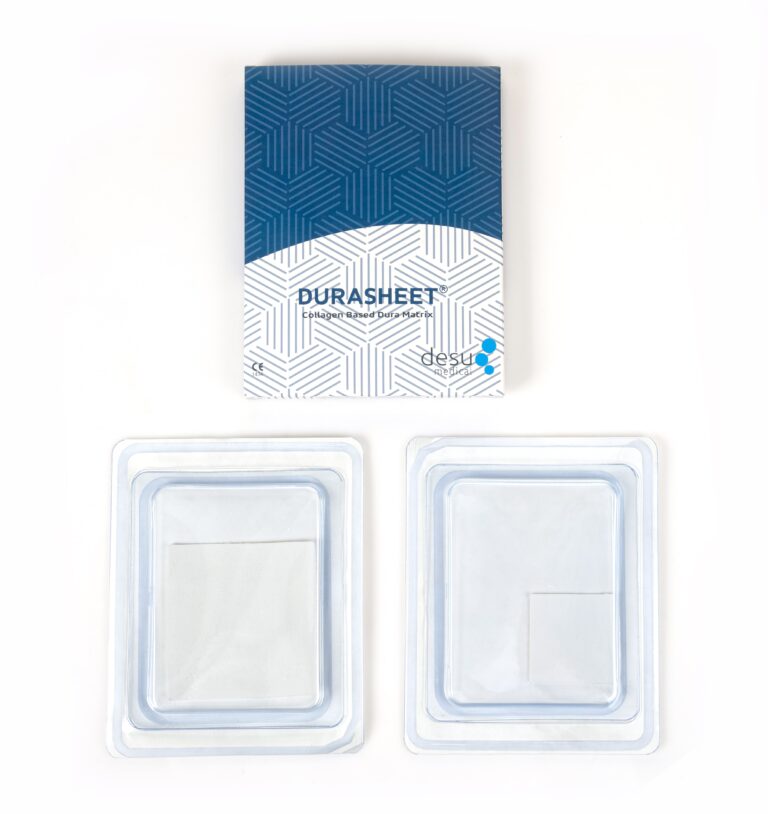
Desu Dural Grafts: Pure Type I Bovine Collagen
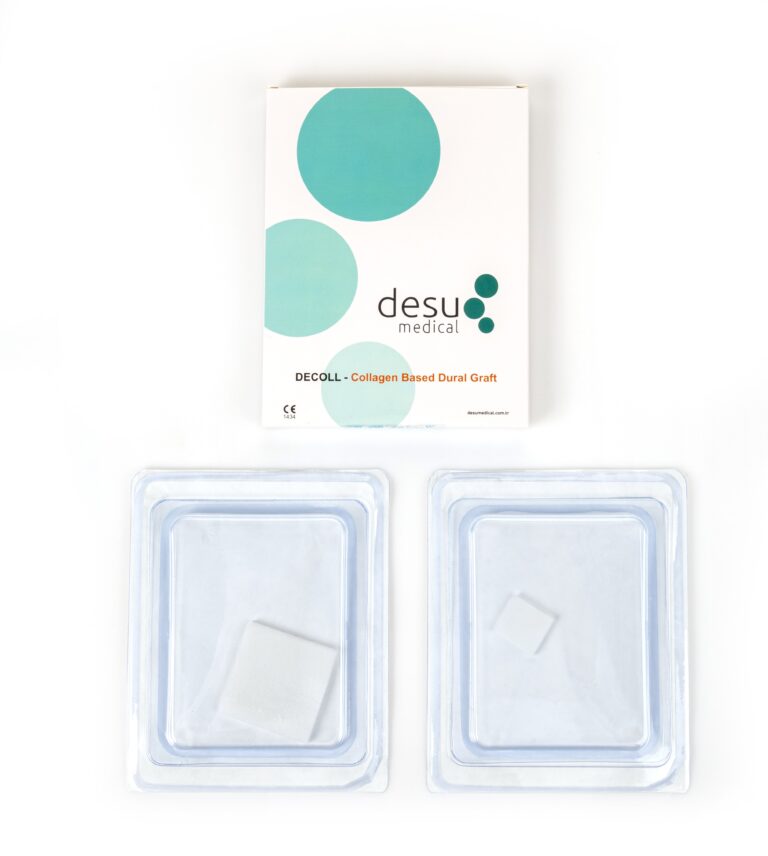
At Desu, we understand the challenges of dura mater repair and reconstruction. That is why we developed our Decoll and Durasheet products to are made of pure type I bovine collagen. High purity supports the graft’s natural integration with human tissue and brings the following advantages:
- Reduced risk of inflammatory response and immune rejection
- Support for tissue regeneration thanks to collagen’s natural compatibility with the body
- An optimized environment that accelerates healing and improves outcomes
- Easy application and a smoother working experience for the surgeon
- A bio-resorbable structure that is absorbed by the body over time, making room for native tissue
Our grafts are designed to mimic the structure and function of native dura mater, providing superior integration with surrounding tissues. Collagen is the body’s own building block for repair and regeneration. Choosing a graft made of a pure collagen matrix means greater confidence in healing and fewer procedural complications.
Frequently Asked Questions
What is a type I bovine collagen dural graft?
It is a surgical implant made from high-purity, bovine-derived type I collagen, used to repair openings in the dura mater. It is not an oral supplement but a material placed directly at the surgical site.
Why is a dural graft used?
It is used when the dura mater cannot be closed with primary sutures, or when harvesting a graft from the patient’s own tissue is not suitable, in order to provide a watertight closure and reduce the risk of CSF leakage.
Is there a rejection risk with a bovine collagen dural graft?
Because pure type I bovine collagen is a protein naturally present in the human body, the risk of biological rejection is quite low. The body treats the graft as a scaffold for healing rather than a foreign object.
How long does the graft stay in the body?
Organic collagen grafts are designed to be bio-resorbable. Once they complete their task, they break down over time and the patient’s own tissue takes their place.
What is the difference between organic and synthetic dural grafts?
Organic grafts are made from high-purity collagen and can be replaced by the body with its own tissue. Synthetic grafts remain in the body permanently.
In which surgeries is a dural graft used?
It is used in cranial and spinal surgery, neurotrauma repairs, and various neurosurgical procedures where there is a risk of CSF leakage.
Conclusion
The type I bovine collagen dural graft has become one of the standout solutions in modern neurosurgery by combining biocompatibility, natural tissue regeneration, and bio-resorbability in dura mater repair. High-purity collagen offers both a safe healing environment and ease of application for the surgeon. Since the right material choice directly affects surgical success and patient recovery, the source and quality of the graft carry critical importance. Desu’s collagen-based dural grafts offer a reliable alternative engineered with precision for exactly this need.
For more information, please contact Desu.
Further reading: PubMed research on Dural Graft
