
In neurotrauma, a dural graft for neurotrauma has to satisfy two contradictory demands. It must be usable within seconds of opening the package, and it must go on working biologically for months. Desu Medical builds its collagen membranes from pure Type I bovine collagen precisely so that immediacy and integration are not traded against each other.
The Emergency Setting
Traumatic brain injury frequently produces dural laceration, tissue loss and brain swelling in the same patient. Decompressive craniectomy requires expansive duraplasty rather than primary closure. Meanwhile the team is working against physiological deterioration, so any material that requires rehydration, mixing or preparation adds risk.
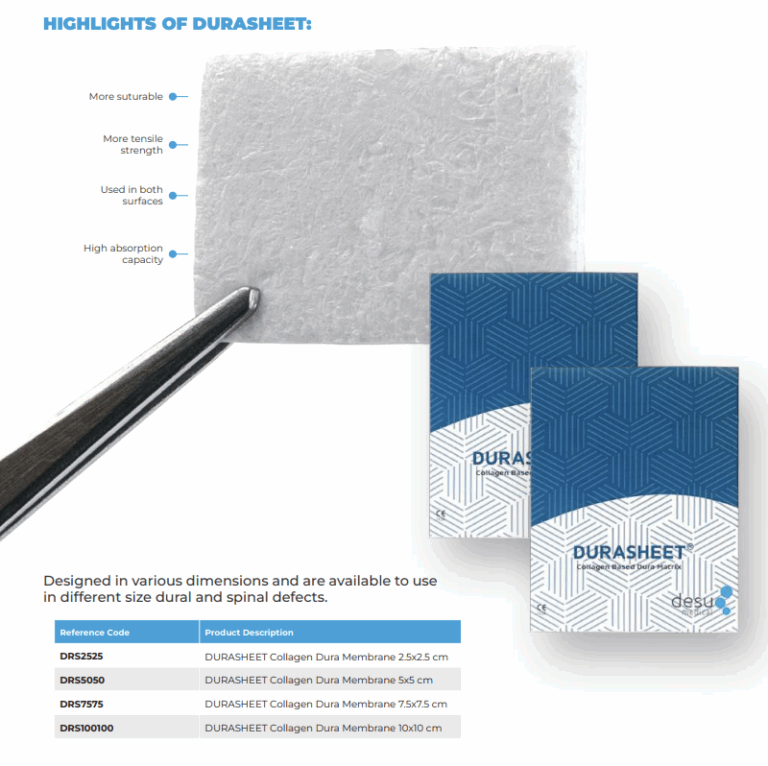
Both DECOLL and DURASHEET are supplied ready to use. The package is opened and the membrane is placed. There is no preparation step and no variability between one emergency case and the next.
Why Biological Material Suits Trauma
Traumatic wounds are contaminated, oedematous and unpredictable. A permanent implant left in such a field remains a permanent interface. In contrast, a purified collagen scaffold is resorbed and replaced by the patient’s own connective tissue. Consequently, once healing is complete there is no residual foreign material at a site that may well require further surgery.
Furthermore, high-purity Type I collagen presents the same molecular identity as native dura. Host fibroblasts recognise it and populate it. The repair therefore becomes biological rather than mechanical.
Expansive Duraplasty
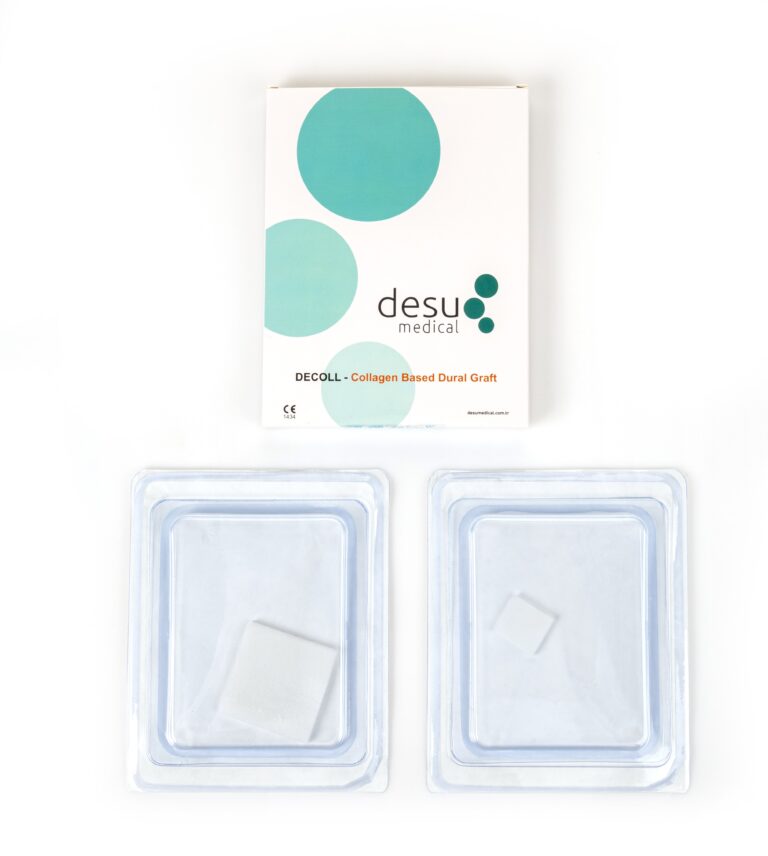
After decompressive craniectomy the dura cannot be closed under tension without defeating the purpose of the decompression. Expansive duraplasty needs surface area. The DCL7575 (7.5 x 7.5 cm) and DCL100100 (10 x 10 cm) DECOLL formats are intended for this scenario, and both may be trimmed to the required shape with surgical scissors.
Handling Under Pressure
- No orientation decision. DECOLL offers dual-surface usability, so either face may contact tissue.
- Dimensionally stable. The membrane resists curling, fragmentation and shrinkage in contact with blood and irrigation.
- Suturable or onlay. Technique can follow the anatomy rather than the material.
- Trimmable. Irregular traumatic defects rarely match a square, so the sheet is cut to shape.
These properties matter most when the operating field is bloody and the clock is running.
Cranioplasty and Later Surgery
Many neurotrauma patients return for cranioplasty months after decompression. A resorbable collagen dural graft for neurotrauma leaves no permanent membrane to dissect at that second operation, and the reconstructed dura is host tissue. This simplifies the re-entry and reduces the risk of injury to underlying cortex during dissection.
Quality Documentation for Trauma Units
Desu manufactures under an ISO 13485 quality management system with CE certification for the dural graft range. Biocompatibility has been evaluated across the ISO 10993 series, and the collagen matrix has been assessed for mechanical durability, absorption behaviour and tissue integration. Trauma centres standardising their emergency neurosurgical tray can request the full technical file from [email protected].
Frequently Asked Questions
How quickly can the graft be deployed?
Immediately. The membrane is supplied sterile and ready to use, with no rehydration or preparation required.
Is the material suitable for contaminated fields?
Surgical judgement governs use in contaminated wounds. The product is terminally gamma sterilised and single-use.
What should a trauma unit keep in stock?
A minimum quantity of large formats for decompressive cases, plus smaller sizes for focal repairs. Our team can advise par levels at [email protected].
Building the Emergency Neurosurgical Tray
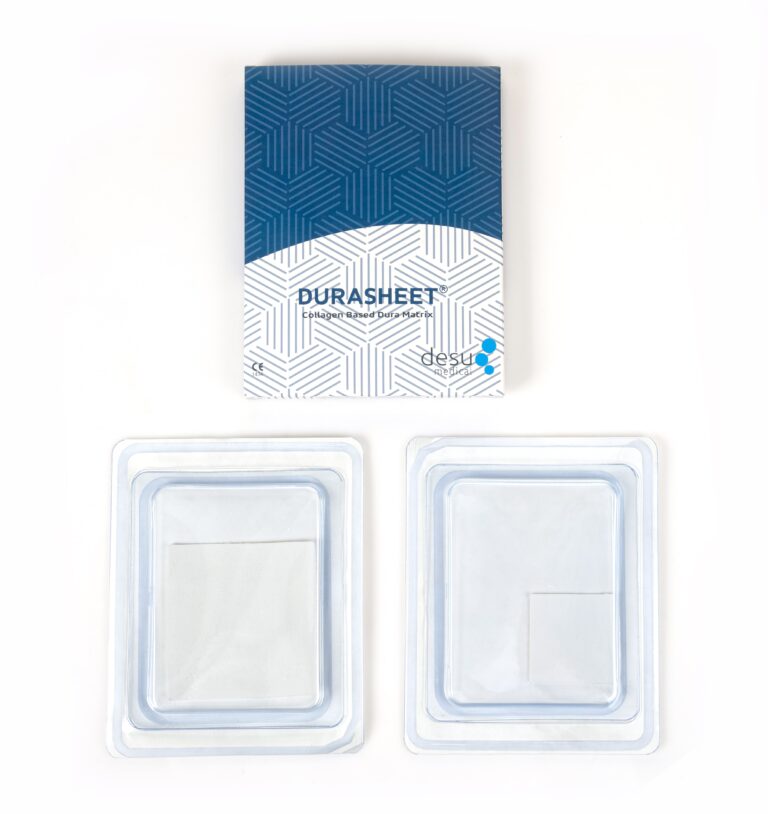
A trauma service is judged by what is available at three in the morning, not by what is on the catalogue. Dural graft material belongs on the standing tray rather than in a special order queue. Because the membranes require no refrigeration and are individually packaged with lot and expiry marking, they store easily alongside other emergency consumables.
A practical minimum holds at least one 10 x 10 cm and one 7.5 x 7.5 cm sheet for decompressive work, plus smaller formats for focal repairs. Departments can refine these levels against their own trauma volume, and our team can help with the calculation.
Paediatric and Elderly Considerations
Dura is thinner and more friable at both ends of the age range, which makes suture-based repair harder and increases the value of a membrane that can be applied as an onlay with generous overlap. Clinical judgement governs use in any specific patient group, and the instructions for use set out the indications and precautions that apply.
Documentation in the Trauma Pathway
- Lot traceability. Every sheet is marked, which supports incident review and vigilance reporting.
- Single use. No reprocessing, so the sterility chain is unambiguous.
- Certification on file. CE certificate and technical file available for governance review.
- No preparation record needed. Ready-to-use presentation removes a documentation step.
Working Alongside the Wider Neurosurgical Range
Neurotrauma care rarely involves one device. External ventricular drainage, intracranial pressure monitoring and, in selected patients, shunt placement often follow the initial decompression. Desu manufactures across this range, which means a single supplier relationship, a single quality system, and one commercial contact for documentation and stock.
For trauma units this has a practical value beyond convenience. Consolidated supply simplifies tender administration, reduces the number of technical files a governance committee has to review, and makes emergency stock replenishment a single call rather than several. Details of the full product range, including drainage systems and pressure monitoring, are published at desu.tr/, and our team can prepare a consolidated proposal on request.
One further consideration applies specifically to trauma services. Emergency stock has to survive audit as well as use, so par levels should be documented, rotation should be scheduled against expiry dates, and the named contact for out-of-hours replenishment should be recorded where theatre staff can find it. None of this is complicated, but units that skip it tend to discover the gap during the case rather than during the review.
Equip Your Trauma Service
Full product specifications and reference codes are published at desu.tr/. For evaluation samples, emergency stock recommendations, CE documentation or quotations, write to [email protected] and our specialists will respond with a proposal for your unit.
For healthcare professionals. Refer to the instructions for use.
About Desu Medical
Desu Medical is a medical research and development company founded in 2007 and headquartered in Ankara, Turkiye. The company designs and manufactures neurosurgical devices in-house, including hydrocephalus shunt systems, external ventricular drainage sets, catheters, intracranial pressure monitoring, bone grafts and the collagen dural graft range comprising DECOLL and DURASHEET. Every dural graft is produced from pure Type I bovine collagen sourced from controlled and traceable tissue, gamma sterilised, and supplied ready to use.
Manufacturing operates under an ISO 13485 certified quality management system, the dural graft range carries CE certification, and biocompatibility has been evaluated across the ISO 10993 series. Desu supplies healthcare professionals internationally through direct institutional relationships and distribution partners. For product specifications, CE documentation, evaluation samples or quotations, visit desu.tr/ or contact the team at [email protected].
Frequently Asked Questions
Which dural graft sizes suit decompressive craniectomy?
For decompressive work, the large DECOLL formats, 7.5 x 7.5 cm and 10 x 10 cm, are intended for broad dural defects, and each dural graft can be trimmed with surgical scissors.
How much dural graft stock should a trauma unit hold?
A practical minimum is at least one 10 x 10 cm and one 7.5 x 7.5 cm dural graft for decompressive cases, plus smaller formats for focal repairs.
Is the Desu dural graft ready for emergency use?
Yes. Each dural graft is terminally gamma sterilised, single-use and supplied ready to use, with CE documentation available for governance review.
