
Kolajen Greft Rezorpsiyonu: Dural Onarımdan Sonra Ne Olur

Rezorpsiyon tek bir olay değil, iyileşmeyle örtüşen bir süreçtir: bariyer evresi, hücresel infiltrasyon, enzimatik yıkım ve konak dokuyla yer değiştirme.
Öne Çıkanlar
- Rezorpsiyon dört evrede ilerler: bariyer, hücresel infiltrasyon, enzimatik yıkım, doku replasmanı.
- İskelet Tip I kolajen olduğu için fibroblastlar matrise tutunup içinde ilerleyebilir.
- Endojen kolajenazlar implante matrisi, doğal kolajen yapım-yıkım döngüsüne benzer şekilde yıkar.
- Süreç sonunda onarım bölgesi, çevre dokuyla sürekli otolog bağ dokusundan oluşur.
Bu yazının tam metni İngilizce olarak yayımlanmıştır. Türkçe özet ve öne çıkan başlıklar yukarıdadır.
Collagen graft resorption is the quiet endpoint that separates a biological dural repair from a mechanical one. A permanent membrane holds the defect closed indefinitely. A resorbable one disappears, leaving the patient’s own tissue in its place. DESU manufactures dural grafts from pure Type I bovine collagen because that second outcome is the better one.
The Sequence After Placement
Resorption is not a single event. It is a sequence that overlaps with healing.
Immediate Barrier Phase
From the moment of placement, the membrane acts as a physical barrier. A collagen membrane such as DECOLL, placed as an onlay, covers the defect while biology gets to work.
Cellular Infiltration
Fibroblasts migrate inward from the dural margins. Because the scaffold is Type I collagen, the same protein those cells normally encounter, the cells can attach to and migrate along the matrix. The cells then begin depositing new extracellular matrix within and around the scaffold.
Enzymatic Breakdown
Endogenous collagenases progressively degrade the implanted matrix, much as they do in normal collagen turnover. Consequently, the scaffold thins as host tissue thickens.
Tissue Replacement
Finally, the repair site consists of autologous connective tissue continuous with the surrounding dura. The graft, functionally and structurally, is gone.
Why Purity Governs the Timeline
Residual non-collagenous proteins, lipids and cellular debris provoke reaction, and reaction distorts remodelling. Encapsulation, chronic inflammation and fibrotic walling-off all interfere with the orderly sequence above. Therefore purification to pure Type I collagen is not simply a safety measure. It also helps resorption and new tissue deposition stay in balance.
Clinical Consequences
- No removal procedure. The graft does not require a secondary operation for retrieval or revision.
- Simpler reoperation. Patients returning for cranioplasty or further decompression encounter host tissue rather than a permanent membrane.
- Simpler imaging. No permanent implant remains at the repair site to complicate interpretation.
- Less long-term interface concern. Once the material has been replaced, there is no retained foreign membrane at the site.
Factors That Influence Resorption
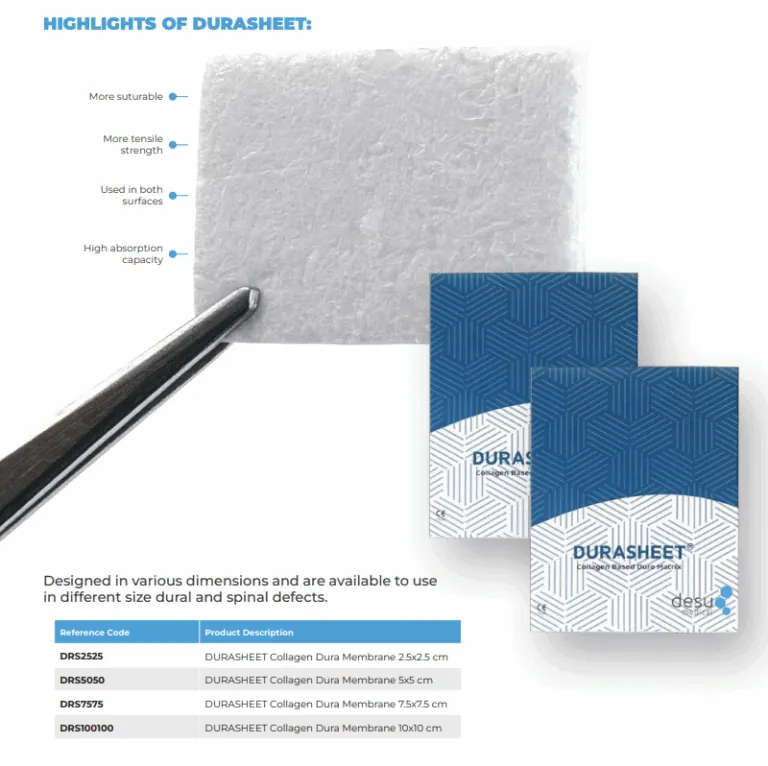
Timelines vary with defect size, local vascularity, patient age and comorbidity. Larger reconstructions naturally take longer to populate than focal repairs. Furthermore, the surgical technique matters: generous overlap onto well-vascularised dura gives cells a shorter distance to travel. For this reason DECOLL and DURASHEET each come in four sizes, so the surgeon can size for overlap rather than economy.
Evidence and Testing
DESU dural grafts are manufactured under an ISO 13485 quality management system and carry the CE mark; the biological evaluation of medical devices follows the ISO 10993 series. Institutions can request product documentation from sales@desu.tr.
Resorbable Versus Permanent: The Long View
The difference between a resorbable and a permanent dural implant is not visible in the first week. It becomes visible at reoperation, at follow-up imaging, and in the small proportion of patients who develop a chronic response to a retained material. A membrane that has been replaced by host tissue leaves no retained material behind to cause these concerns.
For younger patients in particular, the time horizon matters. A permanent implant placed at thirty is present at seventy. A resorbable collagen scaffold placed at thirty is gradually replaced by the patient’s own connective tissue.
Surgical Factors That Support Remodelling
- Overlap onto vascularised dura. Cells enter from the margins, so healthy margins matter more than graft area.
- Avoid tension. A graft under tension apposes poorly, and poor apposition slows integration.
- Debride devitalised edges. Non-viable tissue contributes no cells to the repair.
- Handle minimally. The membrane is ready to use, so extended manipulation adds nothing.
What Resorption Does Not Mean
Resorbable does not mean fragile, and it does not mean the barrier disappears before healing completes. The processes are designed to overlap: host matrix deposition proceeds alongside scaffold breakdown rather than after it. Equally, resorption is not a substitute for adequate surgical technique. A poorly apposed graft does not become a good repair through biology alone.
Explaining Resorption to Patients and Colleagues
Patients frequently ask whether something permanent has been left inside them. The answer with a purified collagen graft is straightforward: the material is a temporary scaffold made of the same protein already present throughout the body, and it is gradually replaced by the patient’s own tissue. Nothing remains to be removed later.
The same explanation is useful with colleagues in radiology and with theatre staff. Radiologists interpreting follow-up imaging benefit from knowing that no permanent membrane is present at the repair site. Theatre teams benefit from understanding why the material is handled minimally and placed without preparation. DESU’s product specialists can support departments adopting the range with product education on these points.
One further point is worth making to procurement colleagues. Resorption reduces a category of long-term concern in the cost model, because a material that is no longer present does not need removal and does not complicate a future operation at the same site. That is difficult to price in a tender spreadsheet, yet it is one of the clearest advantages a purified collagen scaffold holds over a permanent implant.
About DESU
DESU is a medical device manufacturer founded in 2007 as an R&D company at Hacettepe Teknokent in Ankara, Türkiye. The company designs and manufactures neurosurgical devices in its own cleanrooms, including hydrocephalus shunt systems, external ventricular drainage systems, catheters, bone grafts and the collagen dural graft range comprising DECOLL and DURASHEET. Every dural graft is produced from pure Type I bovine collagen, gamma sterilized and supplied ready to use.
Manufacturing operates under ISO 13485 and the products carry the CE mark. DESU exports to more than 50 countries through direct institutional relationships and distribution partners.
Talk to a DESU Product Specialist
Specifications for both membranes are on the product pages and in the e-catalogue. To obtain product documentation, arrange evaluation samples or discuss your market, contact a DESU product specialist at sales@desu.tr, use the contact page or request a quote.
Information for healthcare professionals. Refer to the instructions for use.
Kaynaklar
- ISO 10993 series: Biological evaluation of medical devices
- ISO 22442 series: Medical devices utilizing animal tissues and their derivatives
Bu konuda uzmanımızla görüşün
Ürün seçimi, teknik özellikler, numune talebi veya distribütörlük başvurusu için ekibimize doğrudan ulaşabilirsiniz.
Yorumlar
Henüz yorum yok. İlk yorumu siz yazın.