
Choosing a dural graft is one of the quietest but most consequential decisions a neurosurgical team makes. The membrane you place over an open dura mater will either become part of the patient or remain a foreign object for years. At Desu Medical, we build every dural graft from a single material: pure Type I bovine collagen. This article explains what that purity means at the operating table, and why a natural collagen matrix behaves differently from a manufactured polymer sheet.
What a Dural Graft Actually Has to Do
The dura mater is a dense connective tissue membrane, and its own structural backbone is collagen. Therefore, when a surgeon replaces a section of dura, the ideal replacement is not a clever imitation but the same protein the body already recognises. A dural graft has three jobs. First, it must form an immediate watertight barrier against cerebrospinal fluid. Second, it must hold a suture line or sit reliably as an onlay without curling or tearing. Third, and most importantly, it must invite the patient’s own fibroblasts to migrate in, deposit new tissue and gradually replace the graft entirely.
Materials that only satisfy the first two requirements leave a permanent implant behind. In contrast, a resorbable collagen matrix satisfies all three. This is the reason Desu has never diversified away from collagen chemistry.
Purity Is Not a Marketing Number
When we state that a Desu dural graft contains pure Type I bovine collagen, we are describing what is absent as much as what is present. Non-collagenous proteins, lipid residues, cellular debris and telopeptide fragments are the components most often associated with immune recognition. Consequently, every trace of non-collagen material removed during purification lowers the biological noise the patient’s tissue has to filter out.
The source tissue is bovine, sourced from controlled and traceable herds, and processed through a validated purification sequence. Afterwards, the membrane is terminally sterilised by gamma irradiation at a dose selected to guarantee sterility without denaturing the triple-helical collagen structure. As a result, what reaches the surgical field is a natural protein scaffold, not a chemically modified derivative.
Type I Collagen and the Native Dura
Type I collagen is the dominant structural protein of the human dura mater, tendon, skin and bone. Because Desu grafts present the same molecular architecture, host cells encounter binding sites they already know how to use. Integrin-mediated attachment proceeds without a preparatory inflammatory phase. Furthermore, the fibrillar arrangement gives the membrane tensile strength along the plane of the repair, which is precisely where suture tension is applied.
DECOLL and DURASHEET: Two Formats, One Material
Desu manufactures two collagen dura membranes, and both share the same pure Type I bovine collagen composition.
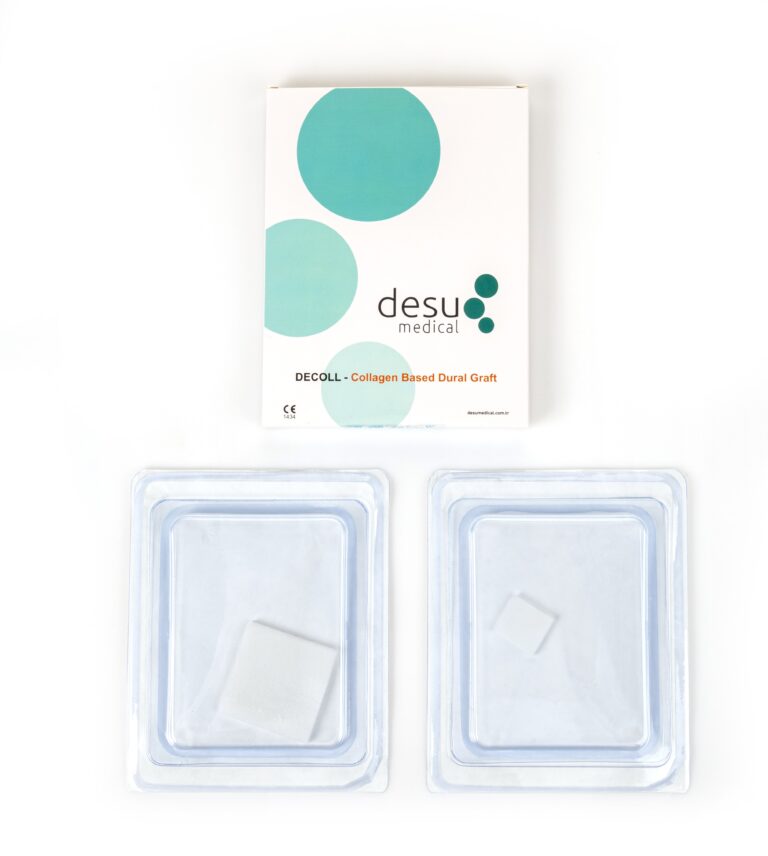
- DECOLL is a single-use collagen dura membrane supplied ready to use, with an impermeable pore structure and dual-surface usability. Either face may be placed against tissue, which removes an orientation step during closure.
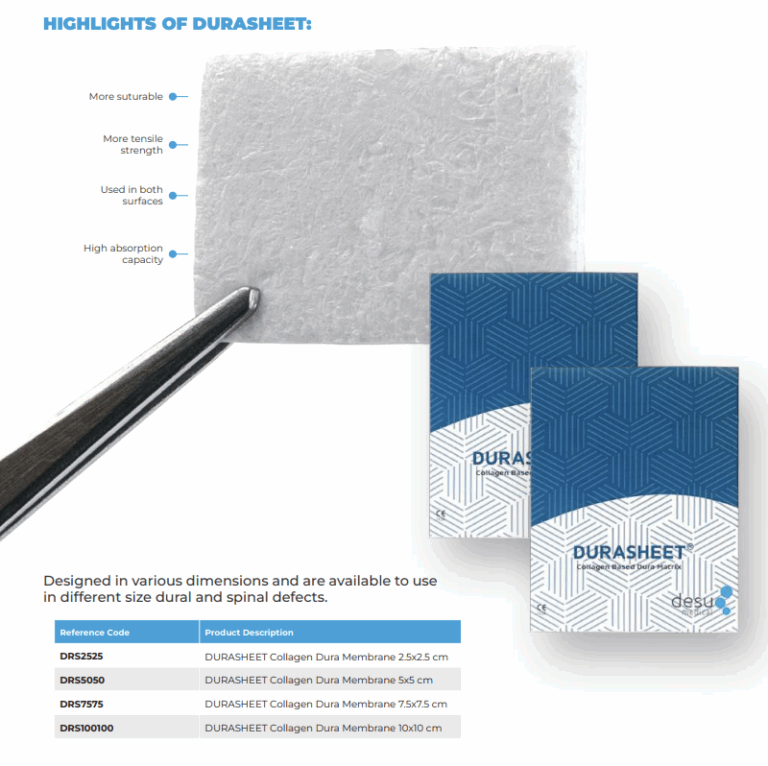
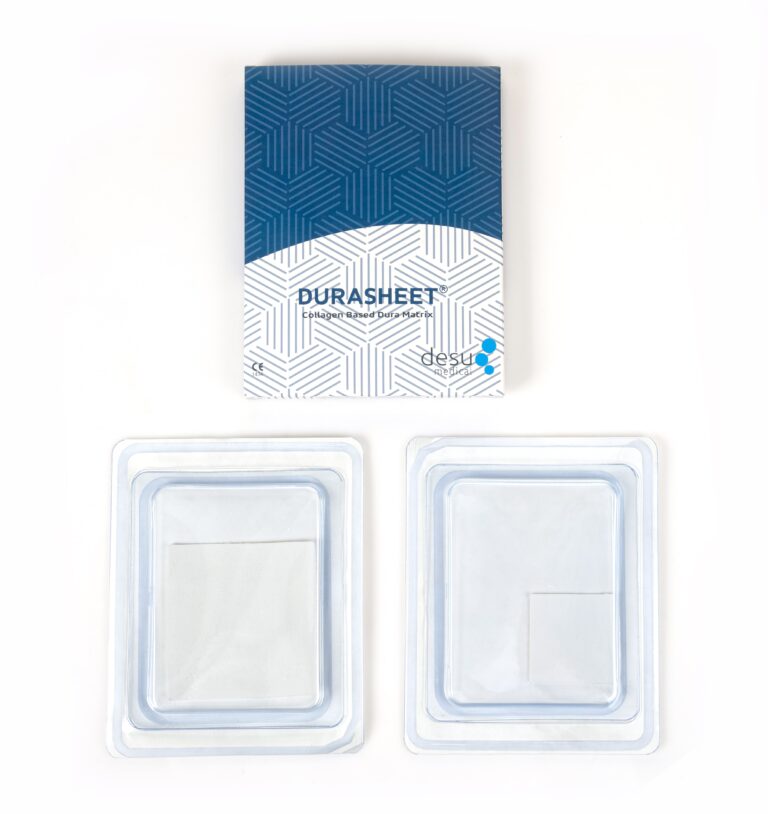
- DURASHEET is a single-use collagen implant designed for cranial and spinal duraplasty, offering a compliant handling profile for surfaces that are not flat.
Neither product requires rehydration, chemical activation or pre-operative preparation. Moreover, both can be trimmed with standard surgical scissors and positioned with forceps under microscope or loupe magnification.
Sizes That Match Real Defects
Waste is a hidden cost in graft procurement. For that reason DECOLL is supplied in four square formats: 2.5 x 2.5 cm (DCL2525), 5 x 5 cm (DCL5050), 7.5 x 7.5 cm (DCL7575) and 10 x 10 cm (DCL100100). Each sheet is individually sterile-packaged with lot traceability and expiry marking. Departments performing a mix of small revision cases and large decompressions can therefore stock proportionally instead of cutting down oversized sheets.
Regulatory Position and Documentation
Desu manufactures under an ISO 13485 quality management system, and the dural graft range carries CE certification. Biocompatibility has been evaluated to the ISO 10993 series, covering cytotoxicity, sensitisation, systemic toxicity and implantation response. In addition, the collagen matrix has been assessed for mechanical durability, absorption behaviour and tissue integration.
A complete technical file and quality assurance documentation are available on request. Procurement teams, tender committees and hospital clinical engineering departments can obtain this package directly by writing to [email protected].
Handling Notes from the Field
A dural graft that behaves unpredictably costs operating time. Desu membranes resist curling, fragmentation and shrinkage during manipulation, and they hold their properties in the presence of blood and irrigation. Surgeons may suture the membrane into the dural edge or apply it as an onlay, depending on defect geometry and preference. Finally, the visual clarity of the sheet supports accurate placement in deep or narrow corridors.
Frequently Asked Questions
Does a Desu dural graft need to be removed later?
No. The collagen matrix is resorbable. It is gradually replaced by the patient’s own connective tissue, so no removal or revision procedure is required for the graft itself.
How low is the rejection risk?
Because the material is pure Type I collagen, a protein already present throughout the human body, the immunological profile is favourable. Purification removes the non-collagenous fractions most associated with host reaction.
Can the graft be sutured?
Yes. Tensile strength is sufficient for suture placement, and the membrane may also be used as a sutureless onlay when the defect and surrounding anatomy allow.
The Cost of Getting the Material Wrong
A dural graft is a low-value line item on a purchasing report and a high-value decision in theatre. When a repair fails, the consequences are measured in reoperation, extended intensive care, antibiotic exposure and delayed rehabilitation. Therefore the meaningful comparison between graft options is not unit price but total episode cost.
Three variables drive that calculation. First, leak rate, which determines readmission and reoperation. Second, the need for any secondary removal procedure, which a resorbable material eliminates entirely. Third, waste, which is controlled by having a size range that matches real defects rather than a single universal sheet.
Evidence, Standards and Honest Claims
Desu does not publish outcome claims that its documentation cannot support. What can be stated precisely is the following. The material is pure Type I bovine collagen from controlled and traceable sources. Manufacturing operates under a certified quality management system. Biocompatibility has been evaluated to the ISO 10993 series across cytotoxicity, sensitisation, systemic toxicity and implantation response. Mechanical durability, absorption behaviour and tissue integration have been assessed.
Surgeons evaluating any dural graft should ask suppliers for the same category of information in writing. A specification sheet that states a purity figure, a sterilisation method, a certification status and a size range tells you more than a brochure full of adjectives. Our technical file is written to be read by clinical engineering and tender committees, not only by clinicians.
Working with Distributors
Desu supplies internationally through distribution partners and also handles direct institutional enquiries. Registration status, available reference codes and lead times vary by market, so the fastest route to accurate information is a direct enquiry naming your country and institution.
Request Documentation or Evaluation Samples
If you are reviewing your department’s dural graft standard, the fastest route is a direct conversation with our clinical team. Explore the full range at desu.tr/, and send size requirements, tender documentation requests or sample enquiries to [email protected]. Our specialists respond with technical files, reference codes and pricing for your market.
This content is intended for healthcare professionals and does not replace the product instructions for use.
About Desu Medical
Desu Medical is a medical research and development company founded in 2007 and headquartered in Ankara, Turkiye. The company designs and manufactures neurosurgical devices in-house, including hydrocephalus shunt systems, external ventricular drainage sets, catheters, intracranial pressure monitoring, bone grafts and the collagen dural graft range comprising DECOLL and DURASHEET. Every dural graft is produced from pure Type I bovine collagen sourced from controlled and traceable tissue, gamma sterilised, and supplied ready to use.
Manufacturing operates under an ISO 13485 certified quality management system, the dural graft range carries CE certification, and biocompatibility has been evaluated across the ISO 10993 series. Desu supplies healthcare professionals internationally through direct institutional relationships and distribution partners. For product specifications, CE documentation, evaluation samples or quotations, visit desu.tr/ or contact the team at [email protected].
