
Clinical Protocols for Monitoring Intracranial Pressure and Signal Interpretations
Real-time monitoring of intracranial dynamics is necessary in neurocritical care management to preserve cerebral homeostasis and prevent secondary brain injury. Intracranial Pressure (ICP) Monitoring is at the core of this monitoring, with the objective to not only read a numerical pressure value, but also a physiological evaluation of cerebral compliance, perfusion, and autoregulation capacity.
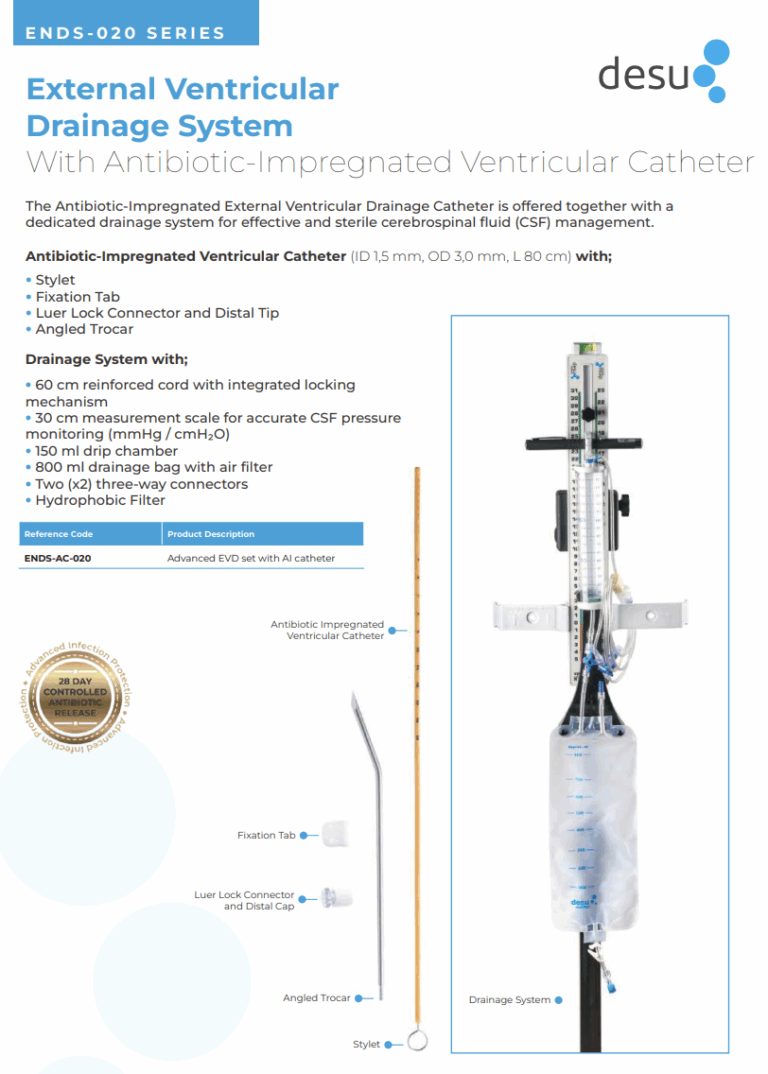
The EVD (External Ventricular Drainage) systems in the Desu medical portfolio provide a twofold interface in this process. The device comprises therapeutic decompression (CSF drainage), intraventricular pressure monitoring (considered the “gold standard”), and intraventricular pressure measurements thanks to internal transducer interconnectors.
In contemporary medicine, the precision of invasive monitoring is closely related to the quality of the catheter material, fluid column integrity, and the competency of the medical professionals to interpret signals.
Why ICP Monitoring is Important for Traumatic Brain Injury?
The pathophysiological cascades and their effects after TBI deserve reference through the application of the Monro-Kellie doctrine, as well. The skull is a rigid box with a fixed volume that cannot expand. When swelling or hematoma form after trauma and the balance between the three major components that comprise this volume (brain parenchyma, blood, and CSF) is altered, compensatory mechanisms engage. Nevertheless, if these mechanisms fail, intracranial pressure rises exponentially.
The solution to this question Why ICP Monitoring is Important in Traumatic Brain Injury can be found in the Cerebral Perfusion Pressure (CPP) equation at this stage. Using the formula CPP = MAP (Mean Arterial Pressure) – ICP, increase in ICP per unit decreases cerebral perfusion (oxygen supply). To mitigate severe ischemic injury, continuous monitoring of ICP values is also important and should be managed and controlled by medico/surgical interventions. Desu EVD systems are not only ‘observers’ in TBI cases.
As the pressure rises, the ICP can be reduced immediately by controlled CSF drainage through the system. This ability to monitor therapy is not limited to fiberoptic cables (where parenchymal measurements are done using fiberoptic cables), and allows EVD systems such as Desu wide-lumen and occlusion-resistant catheter technology, which are imperative for trauma management.
How to Interpret Intracranial Pressure (ICP) Monitoring Waveforms and Values
In a clinical setting, taking a view to the average pressure value (15 mmHg) is a missing piece. The clinically trained clinician can view the real data in the morphology of the waveform on the monitor. How ICP Waveforms and Values Are Interpreted Under this heading, it can be analyzed three components of the pulse wave that is synchronized with each heartbeat as follows:
P1 (Percussion Wave): This reflects arterial pulsation in the choroid plexuses. It is often the strongest wave of the type and indicates systolic pressure.
P2 (Tidal Wave): This wave is most important and refers to the compliance (elasticity) of the brain parenchyma. In the physiological setting, P2 amplitude is diminished compared to P1.
P3 (Dicrotic Wave): This represents the diastolic phase associated with the closure of the aortic valve.
When the intracranial volume reserve is low in this pathological pathophysiology, the P2 wave is raised to one of magnitude above P1 (P2 > P1). This morphological change can serve as an early sign that the brain has become stiff and that pressure will go through the roof just for a small increase in volume.
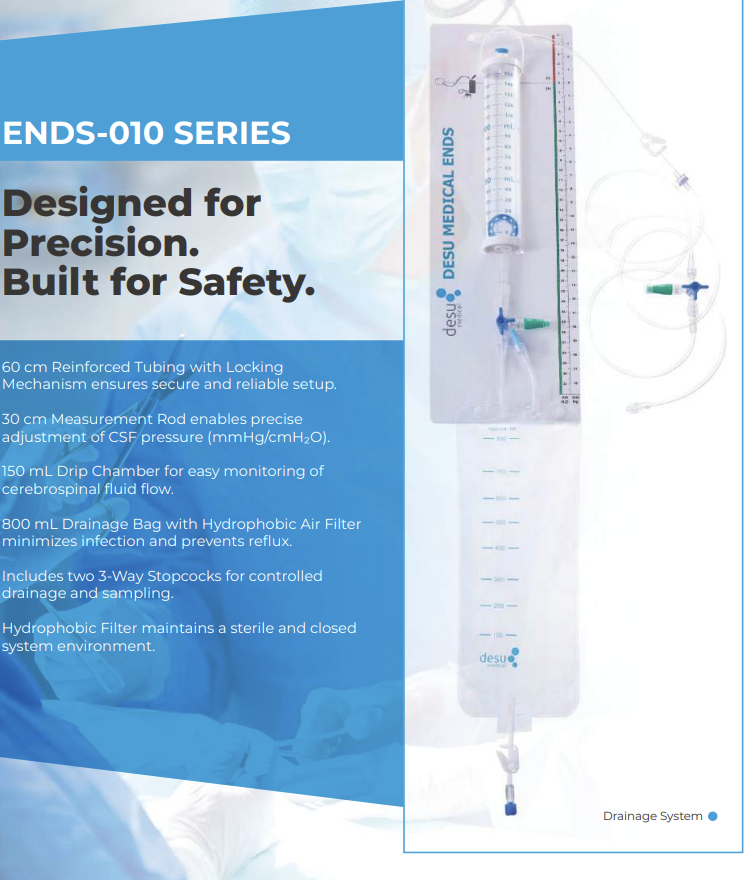
The firm structure of the fluid column in Desu EVD sets and the smooth technology in their embedded surface area which eliminates the formation of air bubbles ensure that these delicate waveforms are transmitted to the monitor undampened.
As a result, the surgeon is able to see the P2 raising very clearly and forecast the risk of herniation in time.
Normal vs. Critical Intracranial Pressure Ranges
ICP values are not stable, but change with respiration, position, and intrathoracic pressure. Despite this, internationally recognized reference ranges exist to help establish treatment protocols. The normal vs. critical Intracranial Pressure Ranges have been distinguished based on patient ages and pathology:
Physiological Range: In a healthy adult, the ICP value varies from 5 to 15 mmHg (7-20 cmH2O) in the supine position.
Pathological Threshold: If values are > 20 mmHg, these are deemed to be at the level of “intracranial hypertension” if they remain above 5 min.
Threshold for the Intervention: According to the Brain Trauma Foundation guidelines, continuous pressure increases above 22 mmHg will need aggressive intervention (CSF drainage, osmotic therapy, and sedation) as these increase the risk for death.
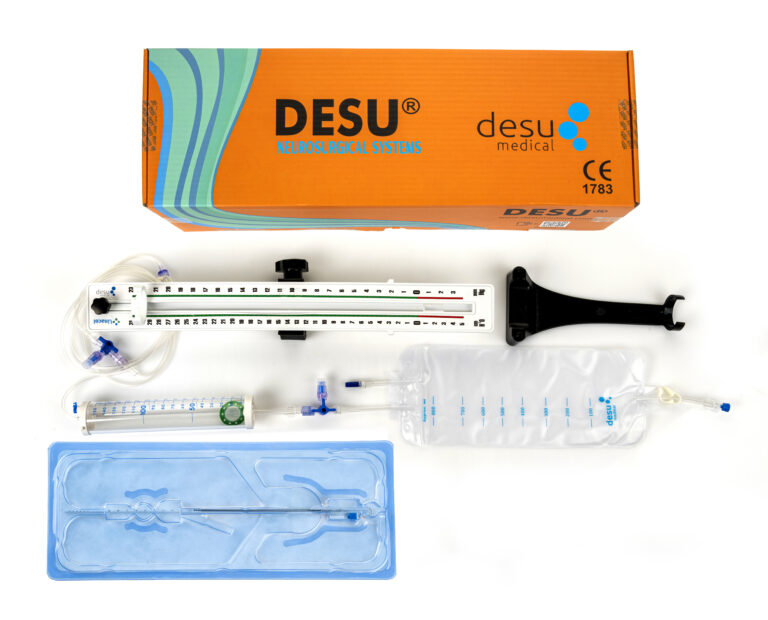
These critical thresholds can be accurately monitored for millimeters with the manometer scales and transducer sets of the Desu EVD systems. The transparency of the pressure scale, and more specifically of the Desu EVD-010 and EVD-020 series, reduces all parallax errors which can occur in manual readings and guarantee the diagnosis based upon correct data for treatment decisions.
Troubleshooting Intracranial Pressure (ICP) Monitoring Signal Errors
Invasive monitoring systems are often faced with technical artifacts and signal error. In some cases, it can cause unnecessary surgery or missing the treatment required. Hence, Troubleshooting ICP Monitoring Signal Errors algorithms is an area of technical precision the intensive care team needs to become proficient at.
The biggest challenge is dampening. At this point the waveform on the monitor flattens and P1-P2-P3 distinction is lost. Possible causes and solutions in the context of Desu system:
Air Bubble: Microscopic air bubbles suspended in the fluid line absorb the pressure wave. Air removal is made by the hydrophobic filters and smooth connector structures during the priming step of Desu sets. To flush out the air, the line needs to be flushed.
Catheter Occlusion: This is where a clot or brain tissue blocks the tip of the catheter in the ventricle. Desu catheters use a multi-pore tip design to ensure drainage and signal transmission proceeds through the other pores regardless of blockage of a single point.
Kinking: Crushing of the tubing line under the patient’s head. Desu EVD sets use tubing made from kink-resistant polymer to prevent signal loss.
Zero Drift: Incorrect zeroing of the transducer with respect to atmospheric pressure or drift of the reference point (Tragus). Re-leveling of the system is essential with Desu laser alignment devices on any change in positioning of patients.
In summary, ICP monitoring is an amalgamation between high efficiency technology and patient care. Desu brand EVD solutions with its optimized hardware (in signal fidelity, high fidelity signals, and safe use) offer clinicians a robust structure for processing those challenging physiologic parameters.
If you would like to receive detailed information about DESU Medical products or explore distributorship and partnership opportunities, please do not hesitate to contact us. Our team will be happy to support you with product specifications, certifications, pricing structures, and collaboration models tailored to your market and needs.
For sales inquiries, product catalogs, and distributorship requests, you may reach us directly at [email protected]
We look forward to building long-term, value-driven partnerships and supporting healthcare professionals with reliable, high-quality medical solutions.
