
Standardization in Dural Repair: Biological Dural Graft Substitute for Neurosurgery Solutions
For years, surgeons have considered tissues taken from the patient’s own body (autografts) to be the best option for repairing dural defects. Although these repairs, usually performed with thigh muscle fascia or scalp fascia, are beneficial in terms of biological compatibility, they present significant challenges. The need for an additional incision, prolonged surgery time, and the risk of pain or complications in the donor site have led modern medicine to seek more practical solutions.
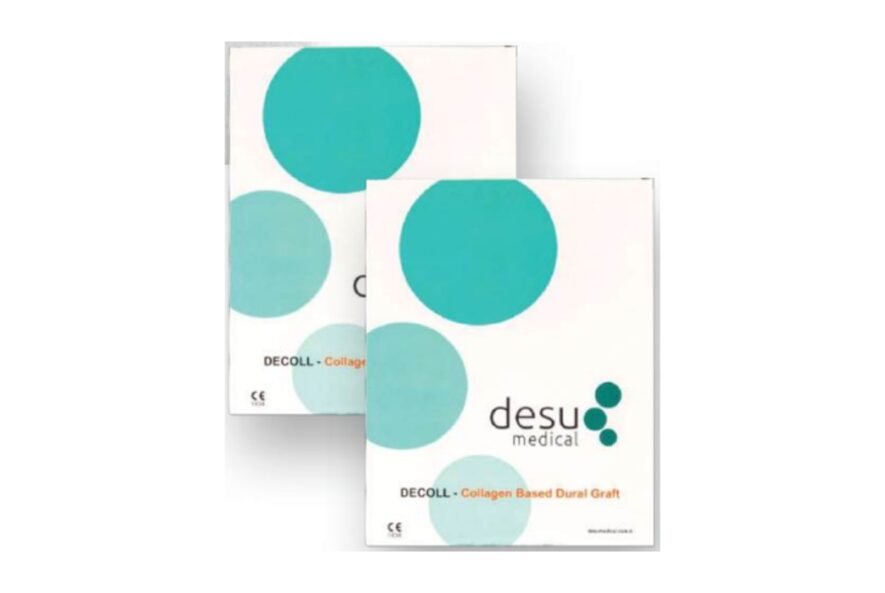
The resulting biological dural graft substitute has become indispensable in operating room applications as a shelf-stable, sterile, and standardized solution that relieves surgeons of the burden of tissue collection. Desu Medical has pioneered this transformation with advanced collagen-based substitute materials that mimic the biological advantages of autografts while eliminating their disadvantages.
Desu dural graft substitutes offer more reliable performance than the patient’s own tissue. Since the patient’s own fascia may be thin, weak, or irregular, the high-purity collagen grafts produced by Desu are always of the same thickness, durability, and quality. This standardization prevents the surgeon from encountering unexpected situations and ensures that case planning runs smoothly.
Why Biological Dural Graft Substitute Instead of Autograft?
With traditional methods, the surgeon had to stop at the most critical moment of brain surgery to harvest fascia from the patient’s leg. This procedure extended the anesthesia time by at least 30-45 minutes. Additionally, patients may complain of pain in their legs, difficulty walking, or hematoma formation at the wound site. The use of a Desu biological dural graft substitute completely eliminates this additional step and the extra harm caused to the patient.
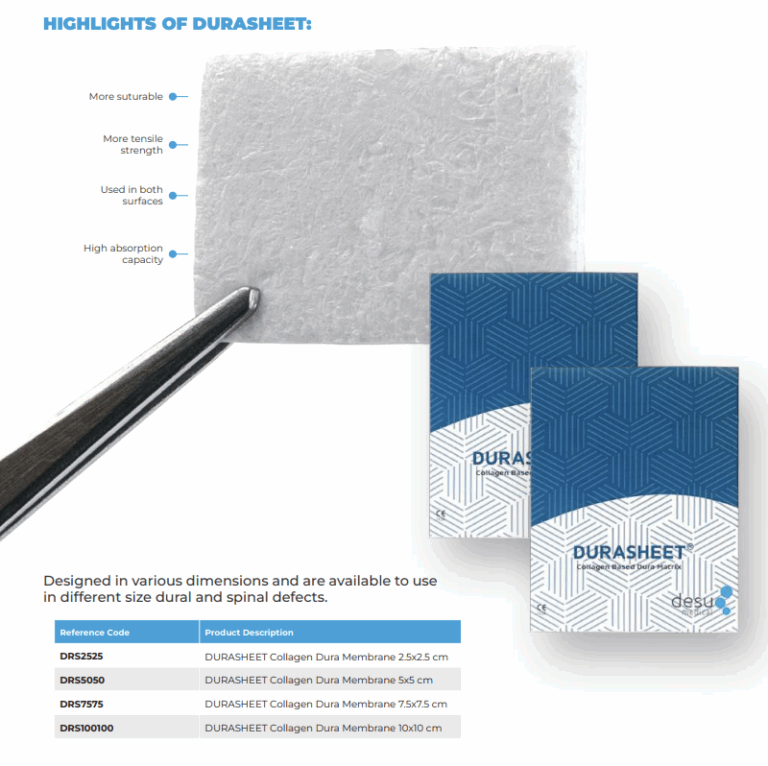
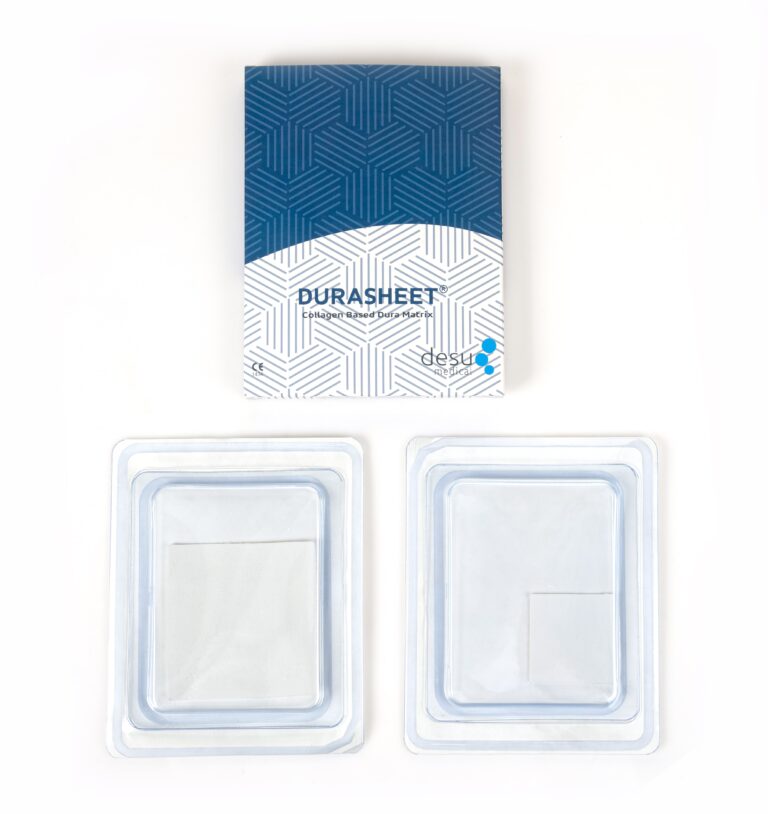
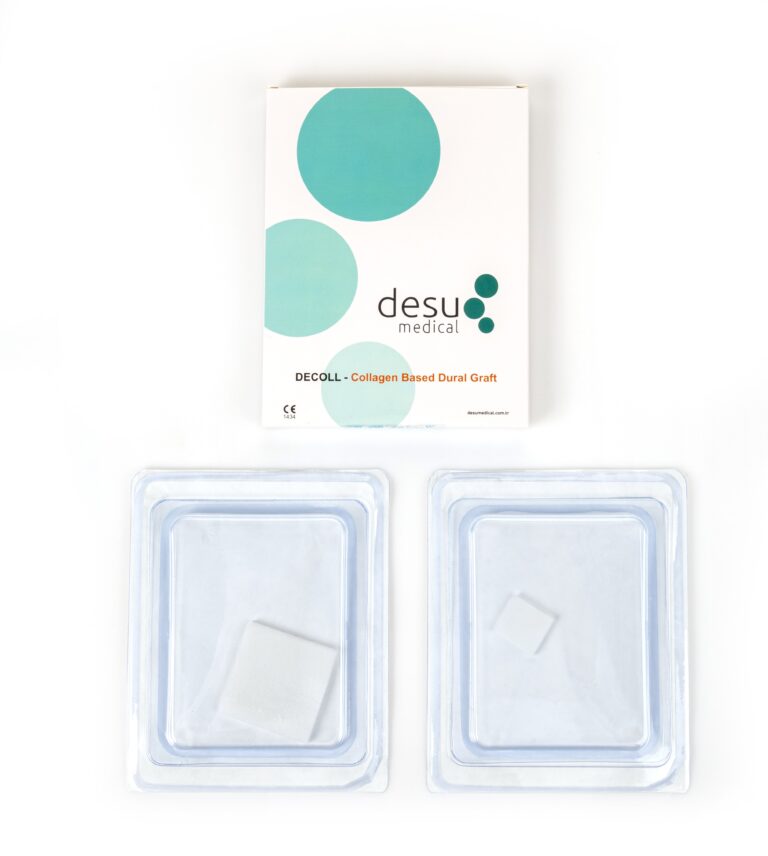
Desu products are ready for immediate use as soon as they are removed from the sterile package. No pre-preparation such as soaking, shaping, or cleaning is required. This “off-the-shelf” approach is particularly critical in emergency trauma cases. The surgeon can focus solely on the brain tissue. This time-saving translates into reduced risk of infection and increased patient comfort.
Essential Characteristics of an Ideal Biological Graft
A material must possess certain qualities to perform the function of the dura mater, which has evolved over millions of years. Desu focuses on the following four fundamental characteristics in the development process of collagen-based dural graft substitutes:
-
Impermeability: The substitute material maintains at least as much resistance to cerebrospinal fluid (CSF) pressure as the natural dura.
-
Biocompatibility: Being fully biological, it is not rejected by the body and does not cause chronic inflammation associated with synthetic plastics.
-
Mechanical Strength: It does not tear when sutured but is flexible enough to accommodate brain pulsations.
-
Integration (Neoduralization): Unlike permanent synthetic barriers, Desu grafts are invaded by the patient’s cells over time and transform into living tissue.
Desu Medical’s collagen-based solutions provide the optimal balance of these properties. The products are easy to use, do not stick to gloves, and have a structure that adapts perfectly to the tissue surface.
The Superiority of Collagen-Based Substitutes Over Synthetics
Every situation is different, but the goal of dural repair is always natural healing. While older technologies relied on synthetic polymers (plastics), modern neurosurgery prefers biological solutions. Desu Medical specializes exclusively in high-performance Xenografts (Bovine Collagen) for distinct reasons:
-
Collagen-Based Substitutes (Desu Standard): These are Type 1 collagen matrices obtained from purified bovine tendons. They are the materials most similar to the dura mater biologically. They integrate completely with the body and are absorbed over time, leaving no foreign body behind.
-
Synthetic Polymer Substitutes (Old Technology): Grafts made from polyurethane or similar plastics remain in the body forever as foreign objects. They carry a risk of encapsulation (scar tissue formation) and long-term infection.
This is why Desu Medical offers a wide range of biological options tailored for different needs (e.g., thicker grafts for spinal, thinner conformable grafts for cranial), ensuring the surgeon always has a regenerative solution.
Cost Effectiveness and Hospital Efficiency
Initially, using the patient’s own tissue may seem free while using a ready-made graft is considered costly. However, from a health economics perspective, the situation is quite the opposite. The use of Desu dural graft substitutes provides significant savings in operating room time.
Considering the cost per minute of an operating room, the 30-40 minutes saved more than offset the cost of the graft. Furthermore, treating complications that may arise in the donor site (such as infection or hematoma) constitutes an additional burden. Desu Medical products are intelligent solutions that reduce total treatment costs and optimize hospital stays.
Desu Medical’s Safety and Sterilization Standards
The biggest advantage of a ready-made graft is the possibility of guaranteed sterilization. When an autograft is taken, the surgical area expands and the risk of contamination increases. Desu biological grafts, on the other hand, are manufactured and sterilized in controlled industrial environments.
Desu Medical uses the most advanced purification and sterilization methods. Each product batch undergoes rigorous endotoxin, bioburden, and viral inactivation testing. When a surgeon opens a Desu package, they can be confident that the product inside is highly purified. Desu’s advanced processing removes all immunogenic components from the animal tissue, ensuring a safety profile that rivals even synthetic materials without the biological downsides.
Clinical Outcomes and Tissue Regeneration
The success of a dural graft substitute application is evaluated based on post-operative recovery. An ideal substitute should not create artifacts in MRI scans. Desu Medical grafts are radiolucent (radiation-transmitting), allowing the surgeon to easily check for tumor recurrence or bleeding without distortion—a common problem with some dense synthetic materials.
The long-term expectation is regeneration. Desu Medical’s porous matrix technology allows fibroblast infiltration, enabling the graft to transform into living tissue. In a revision surgery performed months later, there is often no visible difference between the graft and the patient’s own tissue. This situation is defined as “complete healing” and is the ultimate goal of Desu Medical engineering.
Sutureless Options: The Onlay Technique
Another innovation offered by Desu biological technology is sutureless applications. While traditional autografts must be sutured to ensure leak-proofing, modern Desu dural graft substitutes can be applied using the onlay technique.
Desu Medical’s surface tension-optimized grafts adhere spontaneously when placed over dura damage due to their biological nature. This feature greatly facilitates surgery for hard-to-reach skull base tumors or narrow spinal canals. Eliminating the need for suturing ensures less trauma to the dura edges and no risk of leakage from needle holes—an advantage rarely achieved with rigid synthetic plastics.
Desu Medical has transformed dura repair from a risky, time-consuming procedure into a safe, standardized, and regenerative one.
If you would like to receive detailed information about DESU Medical products or explore distributorship and partnership opportunities, please do not hesitate to contact us. Our team will be happy to support you with product specifications, certifications, pricing structures, and collaboration models tailored to your market and needs. For sales inquiries, product catalogs, and distributorship requests, you may reach us directly at [email protected] We look forward to building long-term, value-driven partnerships and supporting healthcare professionals with reliable, high-quality medical solutions.
