
Collagen Based Graft Substitute Technologies: The Future of Bone Regeneration

Collagen-based bone graft substitutes combine Type I collagen with β-TCP for an osteoconductive, resorbable scaffold in dental and orthopedic bone regeneration.
Bu yazının tam metni İngilizce olarak yayımlanmıştır. Türkçe özet ve öne çıkan başlıklar yukarıdadır.
The quest for perfect repair continues in the world of medicine. Particularly in orthopedics and dentistry, the regeneration of lost bone tissue means not only filling the void but also restoring function to that area. For many years, autografts (the patient’s own bone tissue) were considered the only solution. However, surgical difficulties, donor site pain, and limited resources have led researchers to seek more innovative solutions.
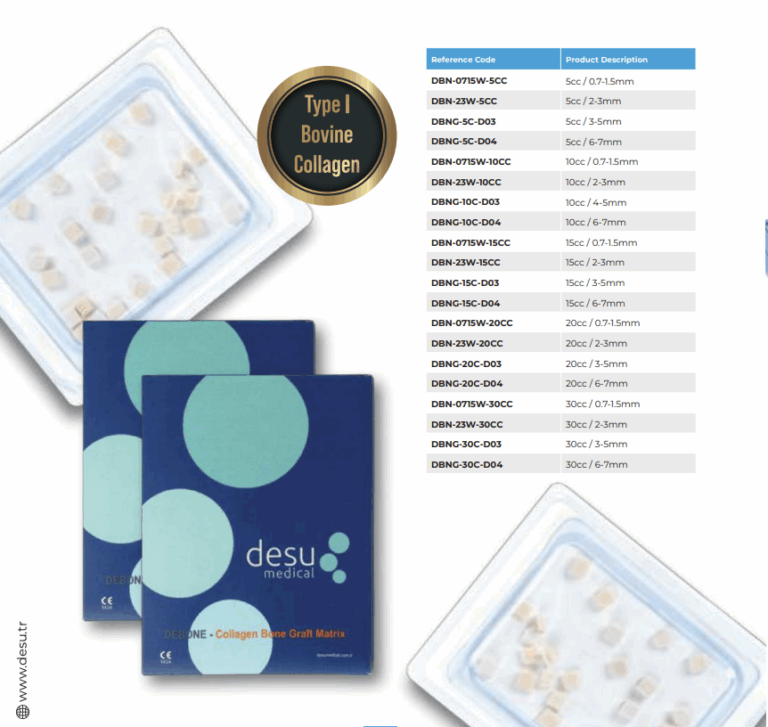
Collagen-based bone graft substitutes are one result of that search. They combine an osteoconductive mineral with a collagen matrix, the protein framework of natural bone. DESU’s DEBONE Collagen Based Bone Grafts and XENOBONE Bovine-Derived Collagen Graft follow this principle: pure Type I bovine collagen supplemented with β-TCP in a bioresorbable, osteoconductive graft.
What Does a Collagen–Mineral Hybrid Add to Synthetic Grafts?
Purely ceramic grafts such as calcium phosphate granules are osteoconductive and provide volume, but loose granules can be harder to handle and may scatter or migrate when exposed to blood.
Adding a collagen matrix changes the handling. The collagen holds the mineral component in a coherent structure, so the graft can be placed in cyst cavities or extraction sockets and adapted to the defect more easily. DEBONE is supplied in granule and sponge forms, and XENOBONE in 0.7–1.5 mm, 2–3 mm and 4–5 mm particles, so the form can be matched to the defect.
How Does the Collagen-Mineral Matrix Work?
A bone graft is judged not only by the volume it provides but by how well it guides the body’s own cells to form bone (osteoconduction). Collagen–mineral grafts are designed to resemble the composition of natural bone, which combines collagen fibres with mineral.
- The Mineral Component: Provides the calcium and phosphate ions necessary for new bone formation.
- The Collagen Scaffold: Creates a biological mesh structure for cells to attach to and proliferate.
Together, the two components give cells a framework and the building blocks they need. An open, porous structure allows blood vessels to grow into the graft, which matters because new bone forms where there is a blood supply. As bone forms, the graft is designed to resorb and be replaced by the patient’s own bone.
Versatility in Dentistry and Orthopedic Applications
Collagen-Enhanced Bone Graft materials offer great flexibility in various clinical applications:
- Dental implantology: after tooth extraction, the ridge tends to lose volume. Collagen–mineral grafts such as XENOBONE are used for socket and ridge preservation and other oral grafting procedures, where the COLL-OS Collagen Barrier Membrane can cover the grafted area.
- Trauma and orthopedics: bone voids left by trauma or by removing a cyst or lesion need a scaffold for new bone. Collagen–mineral grafts fill such voids and support bone formation; they are not structural implants, so stability must come from the bone or from fixation.
Safety and Standardization: Why DESU?
The origin and processing of a biological material determine its safety. DESU uses pure Type I bovine collagen, and devices made with animal tissue are managed under the ISO 22442 series, which covers controlled sourcing and the validation of viral and TSE risk reduction, while biological safety is evaluated under the ISO 10993 series.
For surgeons, consistency means predictability. DESU designs and manufactures its collagen products in its own cleanrooms in Ankara, Türkiye, under an ISO 13485 quality system, and its products carry the CE mark. Each product family is made to a defined specification, so a graft behaves the same way from one case to the next.
Tissue engineering keeps getting closer to the structure of natural tissue. Collagen-based bone graft substitutes are part of that progress: they make the surgeon’s work easier and give the patient’s own bone a scaffold to regenerate on.
Talk to a DESU Product Specialist
Distributors, hospital teams and surgeons evaluating collagen-based bone graft substitutes can talk to a DESU product specialist about forms, sizes, documentation and availability in their market. DESU designs and manufactures in its own cleanrooms in Ankara, Türkiye, under an ISO 13485 quality system, and its products carry the CE mark. Write to sales@desu.tr, use the contact page or request a quote.
Kaynaklar
- ISO 22442 series: Medical devices utilizing animal tissues and their derivatives
- ISO 10993 series: Biological evaluation of medical devices
Bu konuda uzmanımızla görüşün
Ürün seçimi, teknik özellikler, numune talebi veya distribütörlük başvurusu için ekibimize doğrudan ulaşabilirsiniz.
İlgili yazılar
- DESU’dan HaberlerModern Cerrahide Yenilikçi Kemik Greft Çözümleri
- DESU’dan HaberlerOral Surgery Success: Collagen Bone Grafts for Dental Implants
- DESU’dan HaberlerErfolg in der Oralchirurgie: Kollagen-Knochentransplantate für Zahnimplantate
- DESU’dan HaberlerFortschrittliche resorbierbare Kollagen-Knochentransplantat-Lösungen
Yorumlar
Henüz yorum yok. İlk yorumu siz yazın.