
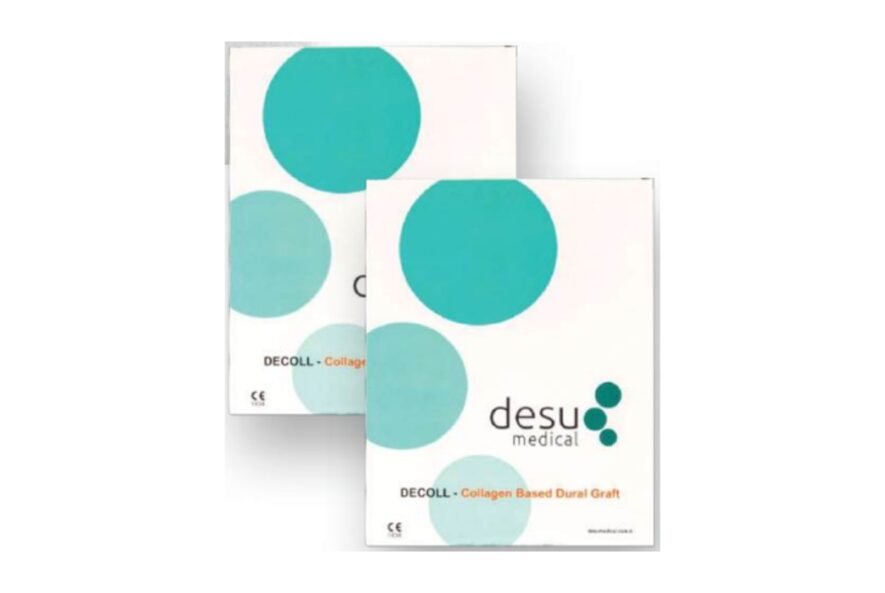
What Is the Importance of Collagen-Based Dural Graft Matrix?
In neurosurgery, the meticulous repair of the dura mater is a decisive factor in preventing cerebrospinal fluid (CSF) leaks and safeguarding the neural parenchyma. While various materials have been utilized historically, the shift toward high-purity collagen-based dural graft matrices has revolutionized outcomes, with Desu leading the way in biocompatible solutions.
Beyond the Limitations of Synthetic Grafts
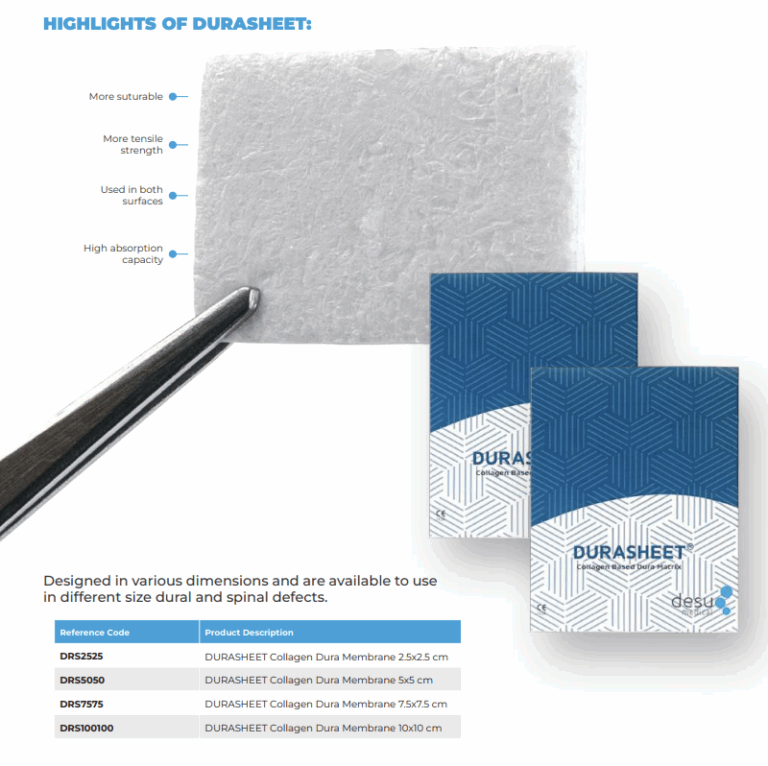
Many surgeons are moving away from traditional synthetic dural graft matrices due to their inherent nature as “foreign bodies.” While synthetic options are engineered in labs using polymers (plastics), they often lack the intuitive biological cues required for seamless healing. Desu’s advanced biological solutions (natural, pure Type I bovine collagen) address the common pitfalls of purely synthetic materials:
-
Minimizing Chronic Inflammation: Unlike synthetic materials that remain as a permanent foreign body, a biological collagen matrix serves as a temporary scaffold. It allows the patient’s fibroblasts to infiltrate the graft, promoting the formation of “neodura” (new natural dura tissue). This natural integration significantly reduces the risk of encapsulation or foreign body reactions often seen with artificial substitutes.
-
Superior Sealing (Watertight Closure): Traditional synthetics can be rigid or prone to “memory,” making them difficult to conform to irregular surfaces. Desu’s collagen grafts offer the flexibility needed for a truly watertight seal, preventing CSF leaks.
-
Natural Tissue Scaffold: While synthetics act as a permanent or temporary plastic-like wall, Desu provides a bio-friendly scaffold that encourages actual neoduralization—allowing the body to heal itself naturally.
The Desu Medical Advantage: Precision and Safety
Desu focuses on the “surgeon’s touch” and the “patient’s recovery.” Our products are engineered to outperform standard industrial polymers in every clinical metric.
1. Advanced Mechanical Integrity and Suture Retention
One of the primary frustrations with synthetic matrices is their tendency to tear under tension or “cheese-wire” when sutured. Desu has solved this through refined structural engineering. Our collagen grafts (natural, pure Type I bovine collagen) allow for secure suturing even at the edges, maintaining high tensile strength without sacrificing the softness required for delicate brain tissue contact.
2. Enhanced Biological Safety Profile
Synthetic materials often involve chemical solvents and catalysts during production that can leave micro-residues. Desu Medical utilizes ultra-pure processing to ensure our grafts are immunologically inert. By avoiding the harsh inflammatory response sometimes seen with synthetic “plasticity,” we facilitate a smoother, faster recovery for the patient.
3. Crystal Clear Post-Operative Imaging
A significant drawback of some dense synthetic materials is the artifact (distortion) they create in follow-up MRIs or CT scans. Desu grafts are designed to be “radiologically silent,” ensuring that surgeons have a clear, unobstructed view of the surgical site during critical follow-up periods.
Surgeon-Centric Design: Ease of Use
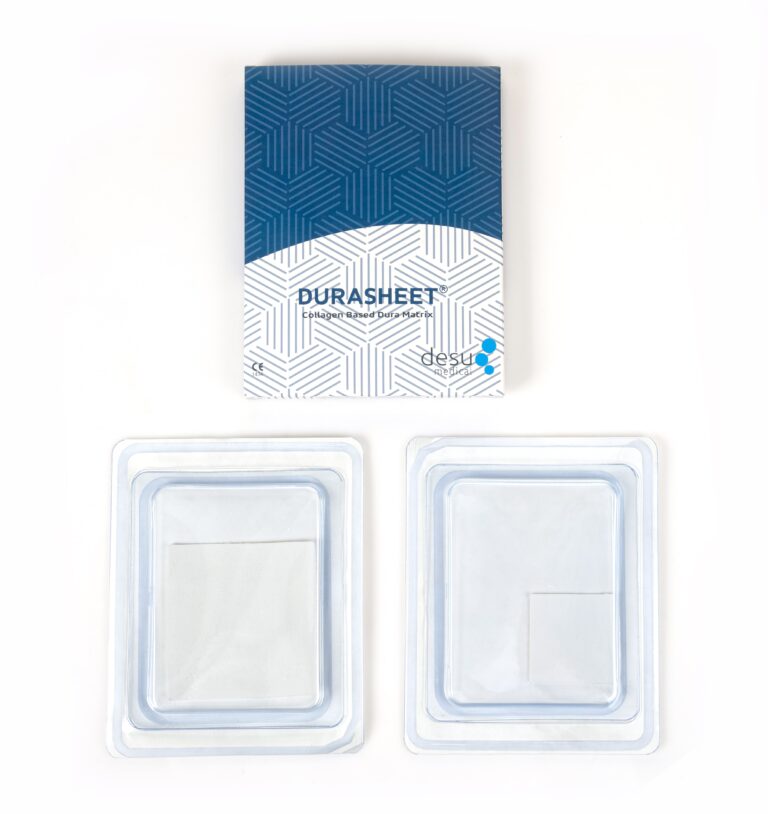
Desu Medical grafts are not just technologically superior; they are practical in the high-pressure environment of the OR:
-
Non-Stick Handling: Unlike many synthetic alternatives, our biological grafts do not adhere to surgical gloves or instruments, even when wet.
-
Customizable Geometry: They can be trimmed to any shape or size without fraying or delaminating, ensuring clean margins for every defect.
-
Instant Readiness: No lengthy rehydration or complex preparation is required. Desu products are ready for immediate use, saving vital minutes in trauma or complex tumor surgeries.
The Future of Dural Repair is Biological
Choosing Desu Medical means choosing a partner dedicated to the science of healing. We provide the reliability of a standardized product with the biological “soul” of natural tissue integration. Escape the risks of rigid synthetics and embrace the sophisticated engineering of Desu’s collagen matrices.
For Partnership and Product Inquiries: Explore our full range of regenerative technologies and dural repair solutions. Our team is ready to provide technical specifications, certifications, and global partnership models.
Email: [email protected]
Connect with us: LinkedIn
Frequently Asked Questions (FAQ)
1. What makes Desu Dural Grafts superior to synthetic alternatives? While synthetic dural grafts are made from lab-produced polymers that can act as a permanent foreign body, Desu Dural Grafts are composed of high-purity bovine collagen. This biological composition allows the graft to act as a natural scaffold, promoting true neoduralization (natural tissue regeneration) rather than just acting as a plastic-like barrier.
2. Is there a risk of inflammatory response with these grafts? Unlike many synthetic matrices that can trigger chronic inflammation or immune rejection due to their chemical nature, Desu’s collagen-rich grafts are highly biocompatible and immunologically inert. They mimic the body’s own dura mater, significantly reducing the risk of post-operative complications.
3. How does the graft prevent Cerebrospinal Fluid (CSF) leakage? Desu Dural Grafts are engineered with an advanced fluid barrier. Unlike rigid synthetic patches that may struggle to conform to irregular anatomical structures, our collagen grafts provide exceptional flexibility and a watertight seal. This ensures a robust closure even in complex skull base or spinal surgeries.
4. Can Desu Dural Grafts be used with sutures? Yes. One of the primary disadvantages of some synthetic grafts is their tendency to tear or “cheese-wire” during suturing. Desu Dural Grafts feature superior mechanical strength and suture retention, allowing surgeons to secure the graft firmly without risk of material failure.
5. Do these grafts interfere with post-operative MRI or CT scans? No. Some high-density synthetic materials can cause imaging artifacts (distortions). Desu’s collagen-based grafts are radiotransparent, ensuring that follow-up imaging is crystal clear, allowing for precise patient monitoring.
6. How should the graft be prepared before application? Desu Dural Grafts are designed for surgical efficiency. Unlike some biological or synthetic materials that require lengthy rehydration, our grafts are ready for use almost immediately, maintaining their structural integrity and non-stick properties throughout the procedure.
7. Is there a risk of disease transmission with bovine collagen? Safety is our top priority. Desu utilizes highly purified bovine collagen and rigorous processing techniques that meet international medical standards. This eliminates the risk of biological agent transmission, making it a safer, more natural alternative to both synthetic polymers and less-processed xenografts.
Email: [email protected]
Connect with us: LinkedIn
