
A dural sealant is a material applied over a dural repair to reinforce it against cerebrospinal fluid (CSF) leakage. Sealants are now widely used in cranial and spinal surgery, often together with sutures and dural grafts. They are not a replacement for a good closure, but an additional layer that can help seal needle holes and small gaps. This article explains the main types of dural sealant, how they are used with collagen grafts and what to consider when choosing them.
Why Use a Dural Sealant?
Even a carefully sutured dural closure has needle holes and small gaps between stitches. When CSF pressure rises, for example when the patient coughs or sits up, fluid can pass through these openings. A dural sealant forms a layer over the suture line or the edges of a graft that helps close these small paths while the tissue heals. Sealants are especially attractive where suturing is difficult, such as at the skull base or around venous sinuses.
3 Main Types of Dural Sealant
1. Fibrin Sealants
Fibrin sealants are made from fibrinogen and thrombin, which react to form a fibrin clot similar to the final stage of natural blood clotting. They have been used in surgery for many years and are absorbed by the body over time. Some are derived from human plasma, which should be considered when discussing the materials used with patients.
2. Synthetic Hydrogel Sealants
Polyethylene glycol (PEG) based hydrogels are applied as a liquid or spray and polymerise into a flexible gel that adheres to the tissue. They are absorbed over a period of weeks. Some hydrogels swell after application, which may matter in confined spaces such as the spinal canal or near the optic nerves; the manufacturer’s instructions usually describe these cautions.
3. Sealant-Coated Patches
Some products combine a carrier, such as a collagen sponge, with sealant components on its surface. These patches are pressed onto the repair and adhere as the components react. They are used both as haemostats and as sealing layers in some procedures.
How a Dural Sealant Works With a Collagen Graft
In many repairs, the dural graft provides the structural barrier and the dural sealant reinforces the junction between the graft and the native dura. A typical sequence is:
- Close the dura directly where possible.
- Insert a collagen graft to cover any defect, suturing it or placing it as an onlay.
- Test the repair with a Valsalva manoeuvre.
- Apply the dural sealant over the suture lines and graft edges, following the manufacturer’s instructions.
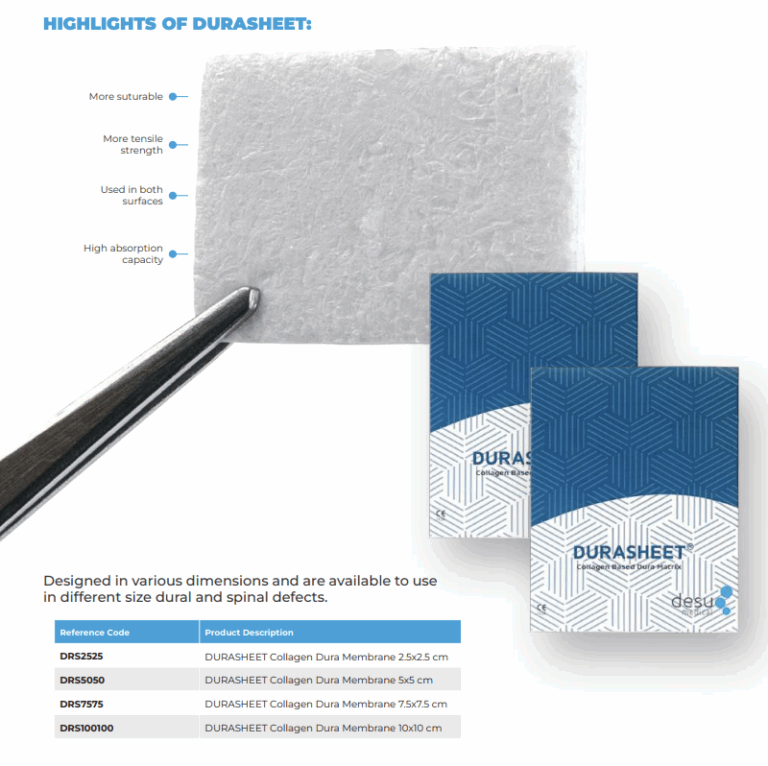
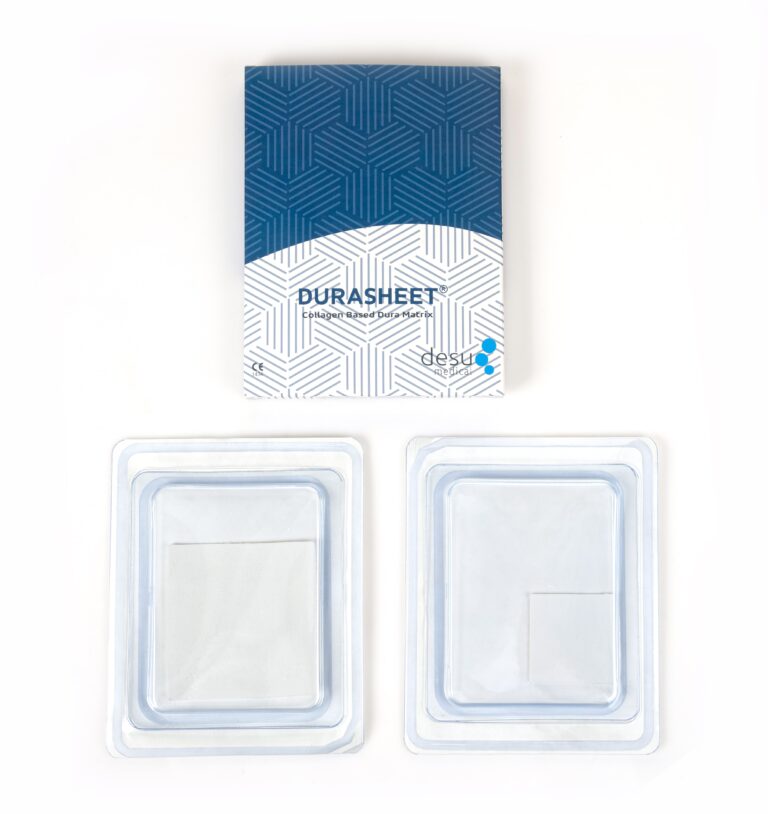
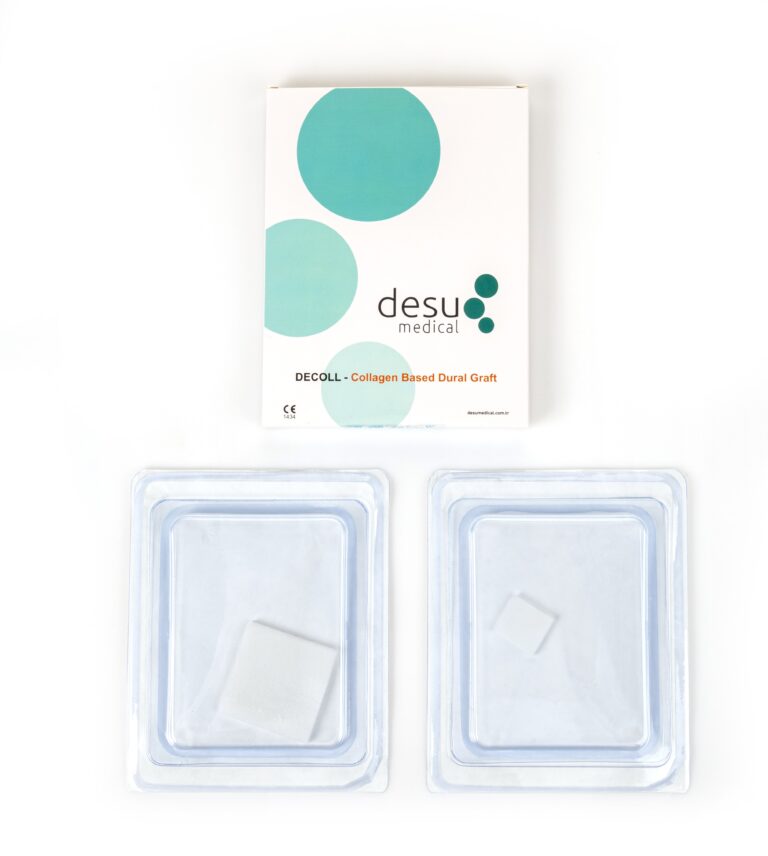
Natural collagen grafts such as Desu’s DURASHEET and DECOLL, made from pure Type I bovine collagen with an impermeable pore structure, provide the barrier layer. A sealant can then be added where the surgeon judges extra reinforcement to be useful. Compatibility between specific products should be checked in the Instructions for Use of both devices.
Applying a Dural Sealant Correctly
- Dry the field: most sealants adhere poorly to wet surfaces, so CSF and blood should be controlled before application.
- Apply a thin, even layer: thicker is not always better, especially with swelling hydrogels.
- Cover the junctions: extend the sealant a little beyond the suture line and the graft edges.
- Allow it to set: avoid irrigating or touching the area until the sealant has polymerised.
Evidence and Limitations
Clinical studies have examined whether adding a dural sealant reduces CSF leakage after cranial and spinal surgery. Results vary between procedures and study designs, and a sealant cannot compensate for a poorly closed dura or an inadequate soft tissue closure. Many surgeons use sealants selectively, in operations with a higher risk of leakage, such as posterior fossa and skull base procedures, rather than in every case. Readers can explore the current literature through the references below.
Cost and Practical Considerations
Sealants add cost and preparation time. Some need to be thawed or mixed before use, and they must be prepared at the right moment so that they are ready when the closure is complete. For theatre teams, it helps to agree in advance whether a dural sealant will be used and to have it prepared in time. See our guide to dural graft handling for preparation of the graft itself.
Summary
A dural sealant is a useful adjunct that reinforces a sutured or grafted dural repair. It works best on a dry field, over a well-closed dura and in combination with a graft that provides the main barrier. Natural collagen grafts and sealants each have a role, and the choice of whether to use them together depends on the procedure, the defect and the surgeon’s judgement.
Frequently Asked Questions
Can a dural sealant replace sutures?
In general, no. A dural sealant reinforces a repair but does not replace a careful closure. In some locations where suturing is difficult, onlay grafts and sealants are combined as part of a layered reconstruction.
Do sealants swell after application?
Some synthetic hydrogel sealants swell as they absorb fluid. This can matter in confined spaces such as the spinal canal, so the manufacturer’s instructions should be followed.
Can a sealant be used over a collagen dural graft?
Sealants are often applied over the edges of a collagen graft and the suture line. Check the Instructions for Use of both products for compatibility.
References and Further Reading
- PubMed: dural sealant trials
- PubMed: fibrin sealant in dural closure
- Desu Medical, DURASHEET collagen dura membrane
About this article
Prepared by the Desu Medical editorial team. Desu Medical has designed and manufactured neurosurgical devices in Ankara, Türkiye, since 2007, including the DURASHEET and DECOLL collagen dura membranes, which are made from natural, pure Type I bovine collagen. Manufacturing operates under an ISO 13485 quality management system and the dural graft range is CE certified. This article is written for healthcare professionals and general information; it does not replace the Instructions for Use or clinical judgement. Last reviewed: October 2026.

1 Comment
Dural Repair Glossary: Clear Definitions of 35 Key Terms
[…] Dural sealant: a material applied over a repair to reinforce it against leakage. See dural sealants. […]