
Articles and product information about dural repair use many specialised terms. This glossary brings together the most common ones in plain language, with links to our more detailed articles. It is intended for surgical trainees, theatre nurses, hospital purchasing teams and patients who want to understand the vocabulary of dural repair.
Anatomy
- Dura mater: the tough outer membrane surrounding the brain and spinal cord. See dura mater anatomy and function.
- Arachnoid mater: the thin middle membrane beneath the dura, enclosing the subarachnoid space.
- Pia mater: the delicate inner membrane that adheres to the surface of the brain and spinal cord.
- Meninges: the collective name for the dura, arachnoid and pia.
- Cerebrospinal fluid (CSF): the clear fluid that surrounds and cushions the brain and spinal cord.
- Dural venous sinuses: channels within the dura that drain blood from the brain.
- Posterior fossa: the part of the skull that contains the cerebellum and brainstem.
- Skull base: the floor of the skull, on which the brain rests. See skull base dural repair.
Techniques
- Durotomy: an opening in the dura, either planned or accidental (incidental durotomy).
- Duraplasty: repair or enlargement of the dura using a graft.
- Primary closure: closing the dura by suturing its edges together directly, without a graft.
- Expansile duraplasty: sewing in a graft to enlarge the dural space, for example in Chiari decompression.
- Onlay graft: a graft laid over the dural defect, overlapping its edges, without sutures.
- Inlay graft: a graft placed beneath the dural edges, inside the defect.
- Watertight closure: a dural repair that does not leak CSF when tested. See watertight dural closure.
- Valsalva manoeuvre: a temporary rise in intrathoracic pressure, induced by the anaesthetist, used to test a dural repair for leaks.
- Multilayer reconstruction: a dural repair built from several layers, commonly used at the skull base.
Materials
- Dural graft (dural substitute): any material used to replace or patch the dura.
- Autologous graft: tissue taken from the patient, such as pericranium or fascia lata.
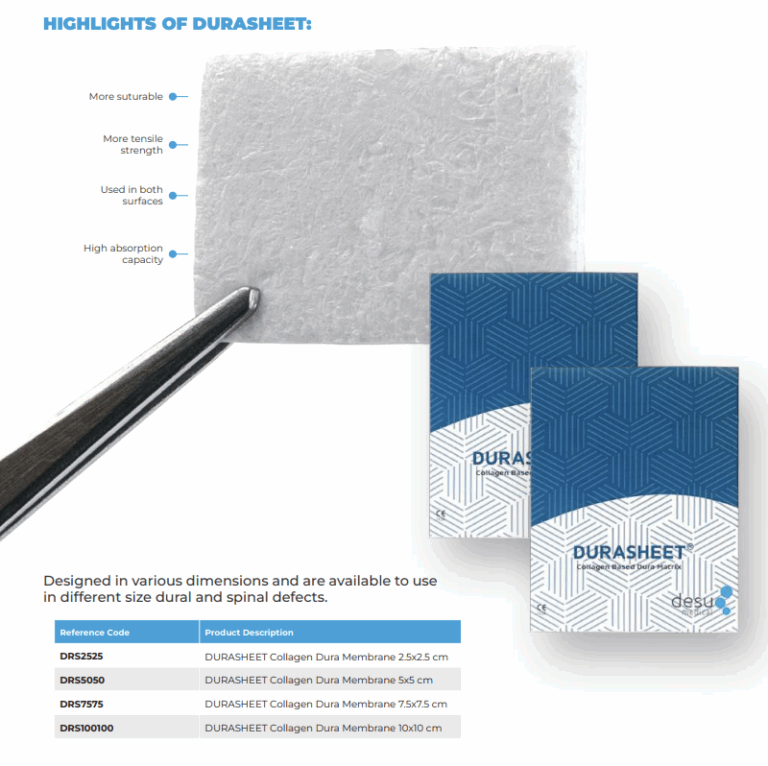
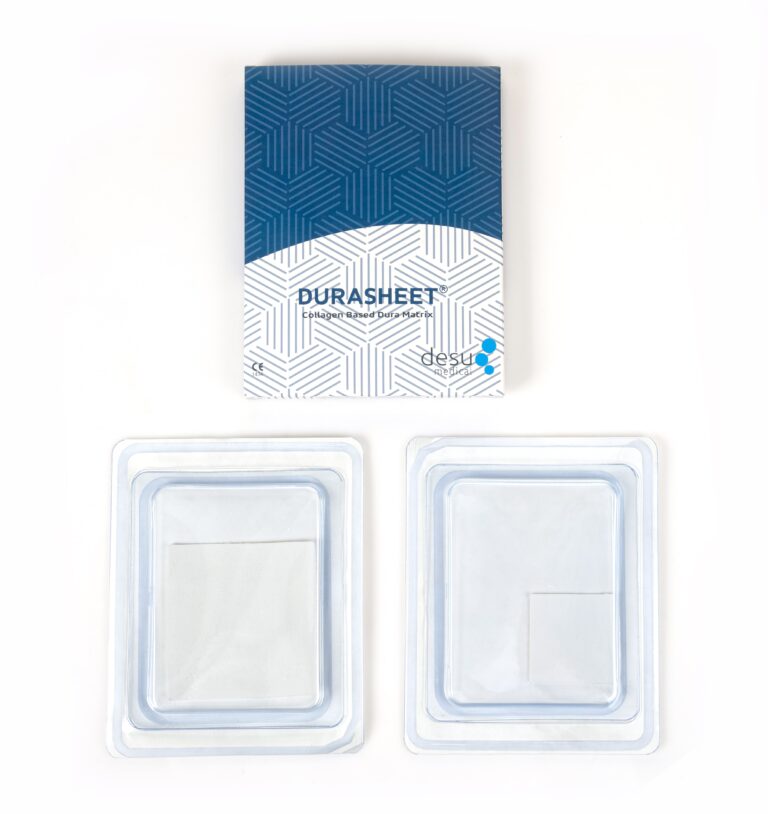
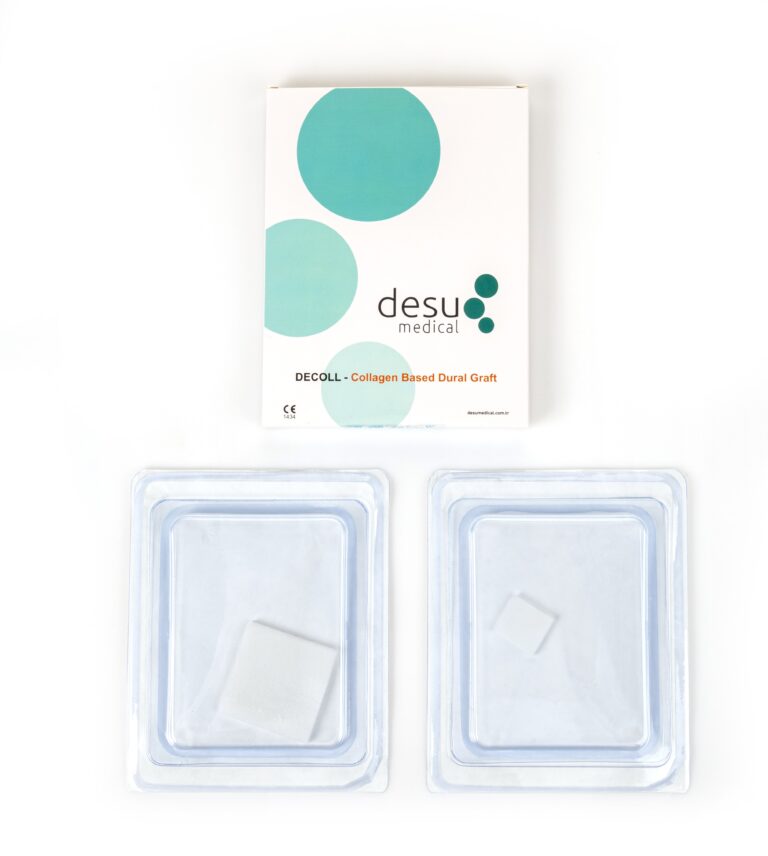
- Natural collagen graft: a graft made from purified natural collagen. Desu’s DURASHEET and DECOLL are made from natural, pure Type I bovine collagen.
- Synthetic graft: a graft made from synthetic polymers rather than natural tissue or collagen.
- Type I collagen: the most abundant collagen in the human body and the main structural protein of the dura. See Type I collagen as a natural dural graft.
- Resorbable: gradually broken down and absorbed by the body, as host tissue replaces the material.
- Dural sealant: a material applied over a repair to reinforce it against leakage. See dural sealants.
Complications
- CSF leak: escape of cerebrospinal fluid through a defect in the dural repair.
- Pseudomeningocele: a collection of CSF outside the dura, in the soft tissues. See pseudomeningocele repair.
- CSF fistula: a track through which CSF leaks to the skin or into the nose.
- Meningitis: inflammation of the meninges, most often caused by infection. See duraplasty infection prevention.
- Adhesion: scar tissue joining the dura or graft to the brain surface or other structures.
Quality and Regulation
- Biocompatibility: the ability of a material to perform without causing an unacceptable reaction in the body, tested according to ISO 10993. See dural graft biocompatibility.
- ISO 13485: the international standard for quality management systems for medical devices.
- CE marking: the mark showing that a device meets European requirements. See EU MDR and dural grafts.
- Gamma sterilisation: sterilisation with gamma radiation. See gamma sterilisation of collagen dura membranes.
- UDI: Unique Device Identification, the system of codes used to trace medical devices. See dural graft traceability.
- IFU: Instructions for Use, the document supplied with each device describing how it should be used.
How to Use This Glossary
Terms in dural repair are not always used consistently between textbooks, papers and product information. Where a term has more than one meaning, this glossary gives the meaning most commonly used in neurosurgical practice. For product-specific information, always refer to the Instructions for Use supplied with the device.
Why Terminology Matters in Dural Repair
Clear terminology helps the surgical team communicate quickly in theatre, for example when the surgeon asks for a graft for an onlay rather than a sutured repair, or for a particular size. It also helps purchasing teams compare products, and helps patients understand what their surgeon has told them about dural repair. When the same words are used consistently in operation notes, audit and product documentation, it becomes easier to compare results and improve practice.
Summary
Dural repair has its own language, covering anatomy, techniques, materials, complications and regulation. Understanding these terms makes it easier to read the literature, compare graft options and follow discussions between surgeons, nurses and patients.
Frequently Asked Questions
What is the difference between duraplasty and durotomy?
A durotomy is an opening in the dura; a duraplasty is the repair or enlargement of the dura using a graft.
What is the difference between an onlay and an inlay graft?
An onlay graft is laid over the defect and overlaps the outer surface of the dura; an inlay graft is placed beneath the dural edges, inside the defect.
Is a collagen dural graft natural or synthetic?
A collagen dural graft is a natural material. Desu’s DURASHEET and DECOLL are made from natural, pure Type I bovine collagen.
References and Further Reading
- PubMed: dural repair techniques
- PubMed: dural substitutes
- Desu Medical, DECOLL collagen dura membrane
About this article
Prepared by the Desu Medical editorial team. Desu Medical has designed and manufactured neurosurgical devices in Ankara, Türkiye, since 2007, including the DURASHEET and DECOLL collagen dura membranes, which are made from natural, pure Type I bovine collagen. Manufacturing operates under an ISO 13485 quality management system and the dural graft range is CE certified. This article is written for healthcare professionals and general information; it does not replace the Instructions for Use or clinical judgement. Last reviewed: October 2026.
