
The performance of a dural repair depends not only on the graft material and the surgeon’s technique but also on how the graft is managed from the moment the package is taken off the shelf. Careful dural graft handling protects sterility, keeps the material in the condition the manufacturer intended and saves time at a critical point of the operation. This guide is written for surgeons, scrub nurses and theatre staff who prepare and use collagen dural grafts.
Before the Operation
Good dural graft handling begins before the patient enters the room. The surgical team should agree in advance whether a graft is likely to be needed and which sizes should be available. For many cranial and spinal procedures it is sensible to have at least one graft of a suitable size in the room, unopened, so that it can be used without delay if the dura cannot be closed primarily.
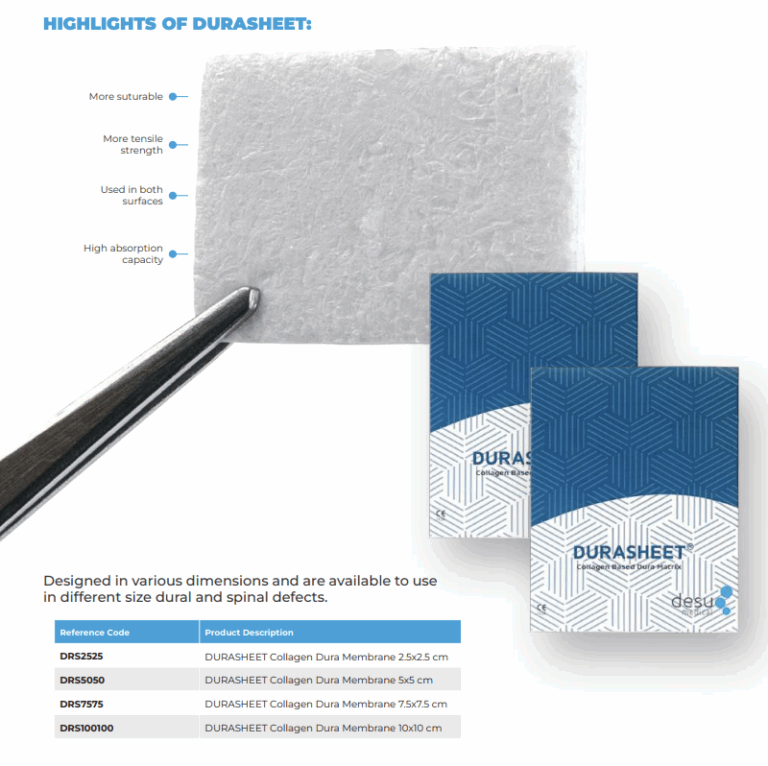
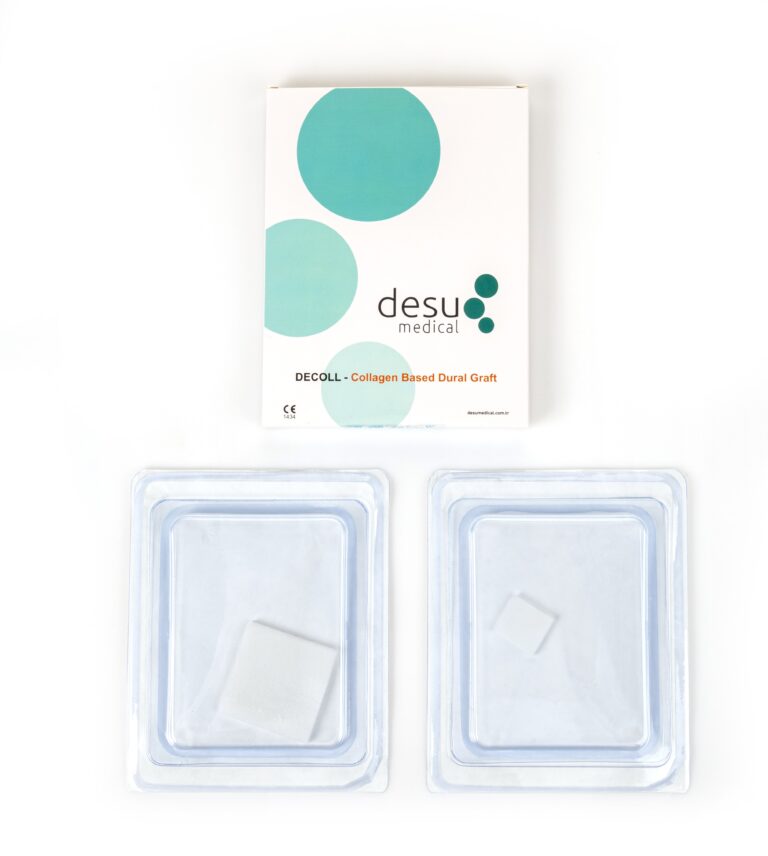
- Check the size range: Desu’s DECOLL is available in 2.5 x 2.5, 5 x 5, 7.5 x 7.5 and 10 x 10 cm formats.
- Check storage: confirm the graft has been stored as stated on the label.
- Check the expiry date on the outer package.
Dural Graft Handling in 7 Steps
- Inspect the package. Do not use the graft if the sterile barrier is damaged, wet or opened, or if the expiry date has passed.
- Open only when needed. Open the package when the surgeon confirms that a graft will be used, not at the start of the case.
- Present aseptically. The circulating nurse opens the outer package and presents the inner package or graft to the scrub nurse using standard aseptic technique.
- Use dry, clean instruments. Handle the graft with smooth forceps and avoid crushing it with toothed instruments.
- Cut to size. Trim the graft with sharp scissors to the shape of the defect, allowing an overlap beyond the dural edges.
- Place and secure. The surgeon positions the graft and sutures it or places it as an onlay according to the chosen technique and the Instructions for Use.
- Record traceability data. Attach the label or record the lot number and product code in the patient record.
No Pre-Treatment Required
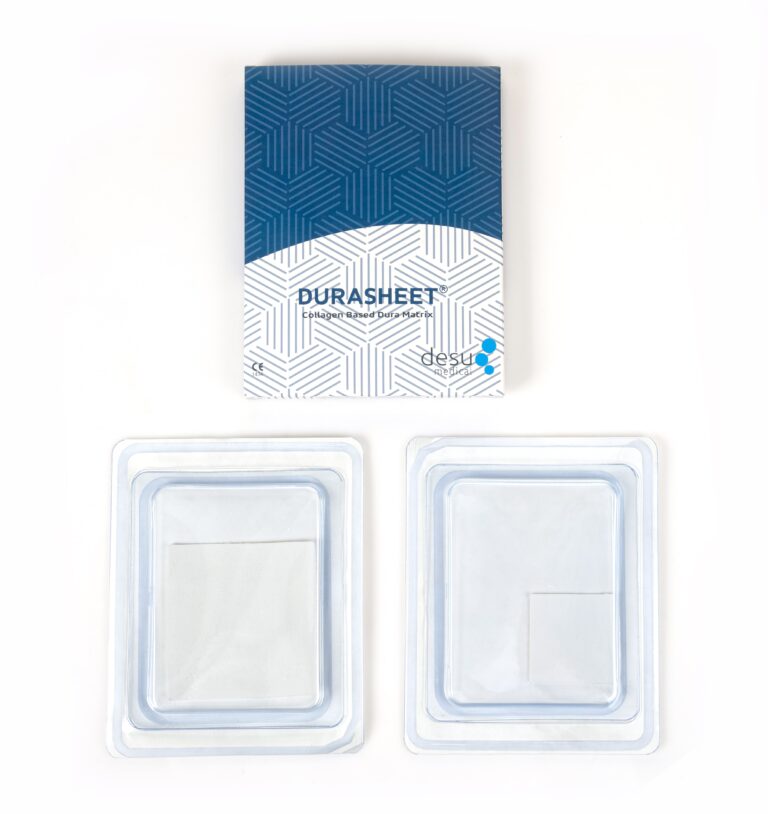
Preparation requirements differ between products and have a direct effect on dural graft handling. Some graft materials need to be rinsed, soaked or rehydrated before use. Desu’s DURASHEET and DECOLL collagen dura membranes are supplied ready to use and require no pre-treatment, which shortens preparation time and removes a step where errors could occur. Always follow the Instructions for Use supplied with the specific product.
Cutting and Shaping
Cutting is the step of dural graft handling where most of the material is touched. A collagen graft should be cut slightly larger than the defect so that its edges lie beneath or over healthy dura. Irregular defects at the skull base or around venous sinuses may need a template: some surgeons cut a piece of sterile paper or glove packaging to the shape of the defect first, then use it to trim the graft. Avoid repeated handling of the cut edges and keep offcuts off the sterile field once the final piece is chosen.
Orientation and Placement
The last part of dural graft handling happens in the surgeon’s hands. Check the product labelling for any guidance on which side should face the brain. Place the graft gently, without stretching it, and smooth it so that it lies in close contact with the dural edges. For suturing, use fine sutures and take bites at a consistent distance from the graft edge. For onlay techniques, make sure the graft overlaps the defect generously on all sides.
Single Use Only
One rule of dural graft handling has no exceptions: collagen dural grafts are single-use devices. A graft that has been opened but not used must not be re-sterilised or kept for another patient. Re-sterilisation can change the structure of the collagen and cannot guarantee sterility. Offcuts from one patient must never be used in another.
Common Dural Graft Handling Errors
- Opening the package too early and leaving the graft exposed on the trolley.
- Gripping the graft with toothed forceps, which can tear or crush it.
- Cutting the graft too small, so that it does not overlap the dural edges.
- Stretching the graft to cover a defect instead of choosing a larger size.
- Forgetting to record the lot number for traceability.
The Role of the Scrub Nurse
The scrub nurse plays a central role in dural graft handling. They keep the graft protected on the sterile field, prepare the instruments and sutures the surgeon prefers, and make sure the traceability label is passed to the circulating nurse. Clear communication about the size required, and when the graft will be needed, avoids delays at the end of the operation.
Training and Local Protocols
Hospitals often include dural graft handling in theatre induction for new staff. A short local protocol that lists the available sizes, where they are stored, how to check them and how to document their use helps keep practice consistent between teams and shifts. Our article on traceability and storage of dural grafts covers documentation in more detail.
Summary
Consistent dural graft handling, from package inspection to final placement and documentation, protects sterility and supports a reliable repair. Ready-to-use natural collagen grafts made from Type I bovine collagen simplify preparation, but the basic rules of aseptic technique, single use and traceability always apply.
Frequently Asked Questions
Does a collagen dural graft need to be soaked before use?
Some products do. Desu’s DURASHEET and DECOLL collagen dura membranes are supplied ready to use and need no pre-treatment. Always follow the Instructions for Use of the specific product.
Can an opened but unused graft be re-sterilised?
No. Collagen dural grafts are single-use devices. Re-sterilisation can alter the material and cannot guarantee sterility, so an opened graft must be discarded if it is not used.
How large should the graft be cut?
Slightly larger than the defect, so that the edges overlap healthy dura. The exact overlap depends on the technique and the surgeon’s preference.
Who is responsible for dural graft handling in theatre?
Dural graft handling is shared: the circulating nurse checks and opens the package, the scrub nurse keeps the graft protected on the sterile field, and the surgeon cuts and places it. Everyone contributes to documenting traceability.
References and Further Reading
- PubMed: dural substitute technique
- WHO Guidelines for Safe Surgery
- Desu Medical, DECOLL collagen dura membrane
About this article
Prepared by the Desu Medical editorial team. Desu Medical has designed and manufactured neurosurgical devices in Ankara, Türkiye, since 2007, including the DURASHEET and DECOLL collagen dura membranes, which are made from natural, pure Type I bovine collagen. Manufacturing operates under an ISO 13485 quality management system and the dural graft range is CE certified. This article is written for healthcare professionals and general information; it does not replace the Instructions for Use or clinical judgement. Last reviewed: October 2026.

Comments (2)
Dural Graft Traceability: Clear UDI Guide (EU MDR 2017/745)
[…] transcription errors and makes later searches by lot number fast and reliable. Our guide to dural graft handling places this documentation step within the full handling […]
Gamma Sterilisation of Dura Membranes: Safe Under ISO 11137
[…] article on dural graft handling in the operating room covers opening, trimming and placement in more […]