
Dural Greft Mevzuatı: AB MDR Sınıf III Hastaneler İçin Ne Anlama Geliyor

Dural greftler AB MDR kapsamında Sınıf III olarak sınıflandırılır. Bunun belge seti, izlenebilirlik ve hastane onay süreçlerine etkisi.
Öne Çıkanlar
- Sınıf III, en yüksek risk sınıfıdır ve onaylanmış kuruluş denetimini gerektirir.
- Hastane onay süreçleri bu sınıfta daha kapsamlı bir belge seti talep eder.
- UDI izlenebilirliği, implant kayıtlarının hastaya bağlanmasını zorunlu kılar.
- Uygunluk beyanı ve teknik dosya, ihale dosyasının ayrılmaz parçasıdır.
Bu yazının tam metni İngilizce olarak yayımlanmıştır. Türkçe özet ve öne çıkan başlıklar yukarıdadır.
Dural grafts sit in one of the most tightly regulated categories of medical devices in Europe. Under the EU MDR, the Medical Device Regulation (EU) 2017/745, a collagen dural graft made from animal tissue is a Class III device. For surgeons and procurement teams, understanding what that classification means helps when comparing products and reviewing supplier documentation. This article summarises the main EU MDR requirements that apply to dural grafts and the documents a hospital can check.
Why Dural Grafts Are Class III Under the EU MDR
The EU MDR classifies devices using the rules in Annex VIII. Two rules place collagen dural grafts in Class III:
- Rule 8: implantable devices that are in direct contact with the central nervous system are Class III.
- Rule 18: devices manufactured utilising non-viable tissues or cells of animal origin, or their derivatives, are Class III, unless they are intended to contact intact skin only.
Either rule alone would be sufficient. A dural graft made from bovine collagen meets both, which reflects the combination of its anatomical location and its biological origin.
Notified Body Review
Class III devices cannot be placed on the EU market on the manufacturer’s own declaration. A notified body, an independent organisation designated by an EU member state, audits the manufacturer’s quality management system and assesses the technical documentation of the device. For devices made with animal tissue, this review also covers the TSE risk assessment and the validation of the manufacturing process, as described in our article on bovine collagen safety.
The four-digit number of the notified body appears next to the CE mark on the label. Hospitals can check the scope of the certificate and the identity of the notified body against the NANDO database published by the European Commission.
Clinical Evaluation and Post-Market Clinical Follow-Up
The EU MDR requires every device to be supported by a clinical evaluation that demonstrates safety, performance and an acceptable benefit-risk profile. For Class III implants the expectations are high: the evaluation draws on clinical investigations, published literature and data from comparable devices where equivalence can be demonstrated. Once the device is on the market, the manufacturer must run post-market clinical follow-up (PMCF) to keep collecting clinical data and update the evaluation.
Summary of Safety and Clinical Performance
For implantable and Class III devices, the EU MDR requires a Summary of Safety and Clinical Performance (SSCP). This is a public document, validated by the notified body, that summarises the intended purpose, the clinical evidence, residual risks and undesirable effects in language that healthcare professionals, and where relevant patients, can understand. Once the European database EUDAMED is fully operational, SSCPs are made available there.
UDI and Traceability
Every device placed on the market under the EU MDR carries a Unique Device Identifier (UDI). The UDI combines a device identifier, which identifies the model, and a production identifier, which includes the lot or serial number and the expiry date. Health institutions are expected to store the UDI of implantable devices they supply or receive. Our article on dural graft traceability and UDI explains how this works in practice.
Implant Cards
Article 18 of the EU MDR requires manufacturers of implantable devices to provide an implant card and information for the patient, with a limited list of exemptions such as sutures, staples and screws. The implant card identifies the device and allows the patient to inform other healthcare providers about it. Hospitals complete the card with the patient’s details and hand it over after surgery.
Post-Market Surveillance and Vigilance
Under the EU MDR, manufacturers of Class III devices must maintain a post-market surveillance system and prepare a Periodic Safety Update Report (PSUR) that is reviewed by the notified body. Serious incidents must be reported to the competent authorities. Hospitals contribute by reporting device-related incidents through their national vigilance systems and by keeping traceability records that make field safety corrective actions possible.
Transition from the Medical Device Directives
The EU MDR has applied since 26 May 2021, replacing the earlier Medical Device Directives. To avoid shortages, the transition period for devices with valid certificates under the old directives was extended by Regulation (EU) 2023/607, with later deadlines for Class III and implantable devices than for lower risk classes, subject to conditions such as an ongoing application with a notified body. In practice, a hospital may therefore see some dural grafts supplied under an EU MDR certificate and others under a legacy directive certificate. Both can be lawfully on the market during the transition, but it is worth checking which applies and when it expires.
A Practical Checklist for Hospitals
- CE certificate with the notified body named and the device within the certificate scope;
- EU declaration of conformity;
- Instructions for Use and label, including UDI;
- implant card and patient information;
- SSCP, when available;
- summaries of biocompatibility and TSE risk management.
DESU Dural Grafts
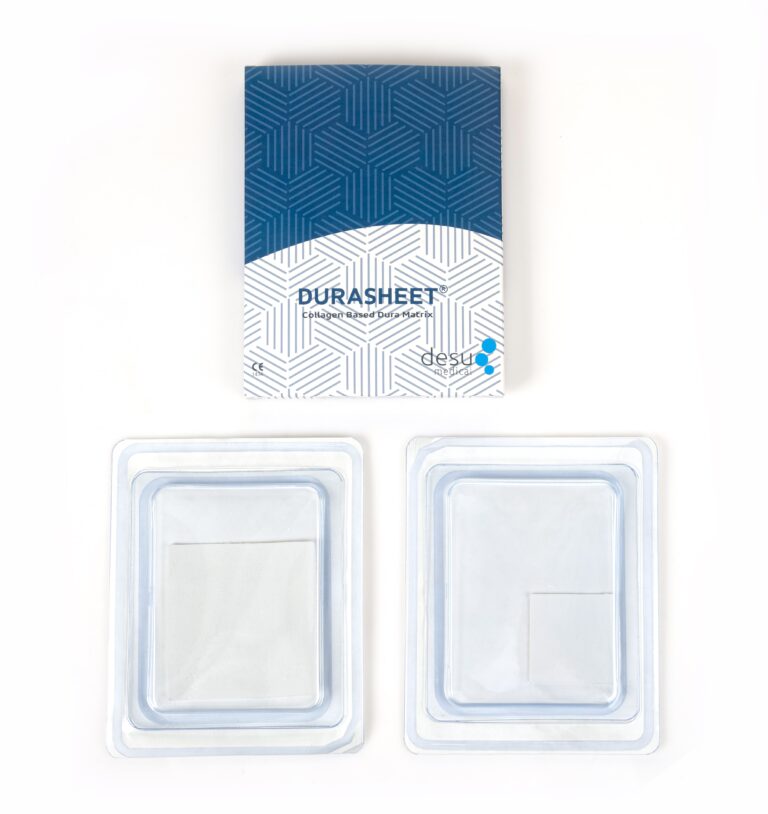
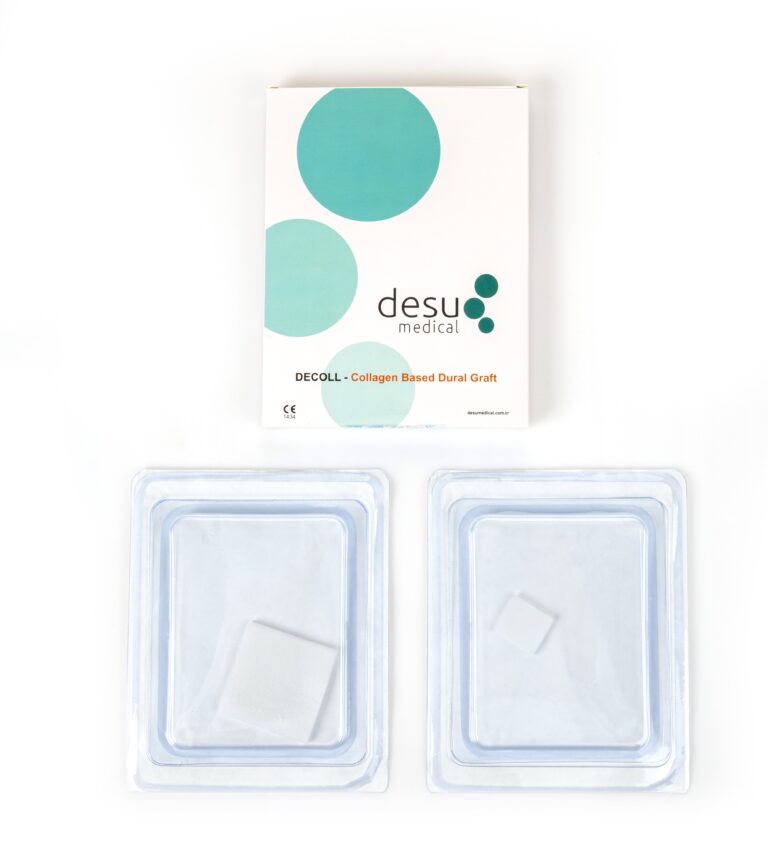
DESU’s DURASHEET dural graft matrix and DECOLL collagen dura membrane are made from pure Type I bovine collagen, each in four sizes, ready to use and gamma sterilized. The products carry the CE mark and are manufactured in DESU’s own cleanrooms under an ISO 13485 quality management system, and regulatory documentation is available to institutions on request.
Talk to a DESU Product Specialist
Requirements and registration routes differ from market to market. Hospital procurement teams and distributors who need certificates, the declaration of conformity or other documentation for DURASHEET and DECOLL, or who want to discuss registration in their country, can write to sales@desu.tr, use the contact page or request a quote. This article is written for healthcare professionals and general information; it is not legal advice.
Kaynaklar
- Regulation (EU) 2017/745 on medical devices (EUR-Lex)
- Commission Regulation (EU) No 722/2012 (EUR-Lex)
- European Commission, NANDO database of notified bodies
- ISO 13485: Medical devices – Quality management systems
Bu konuda uzmanımızla görüşün
Ürün seçimi, teknik özellikler, numune talebi veya distribütörlük başvurusu için ekibimize doğrudan ulaşabilirsiniz.
Yorumlar
Henüz yorum yok. İlk yorumu siz yazın.