
Collagen Bone Graft: How It Supports Bone Regeneration

A collagen bone graft pairs Type I collagen with a mineral such as β-TCP to give new bone an osteoconductive, resorbable scaffold. How it works and which forms exist.
Bu yazının tam metni İngilizce olarak yayımlanmıştır. Türkçe özet ve öne çıkan başlıklar yukarıdadır.
A collagen bone graft is a bone substitute that combines Type I collagen, the main protein of bone, with a calcium phosphate mineral such as β-TCP. Placed in a bone defect, it acts as an osteoconductive scaffold for new bone and is gradually resorbed as bone replaces it. DESU makes DEBONE in granule and sponge forms.
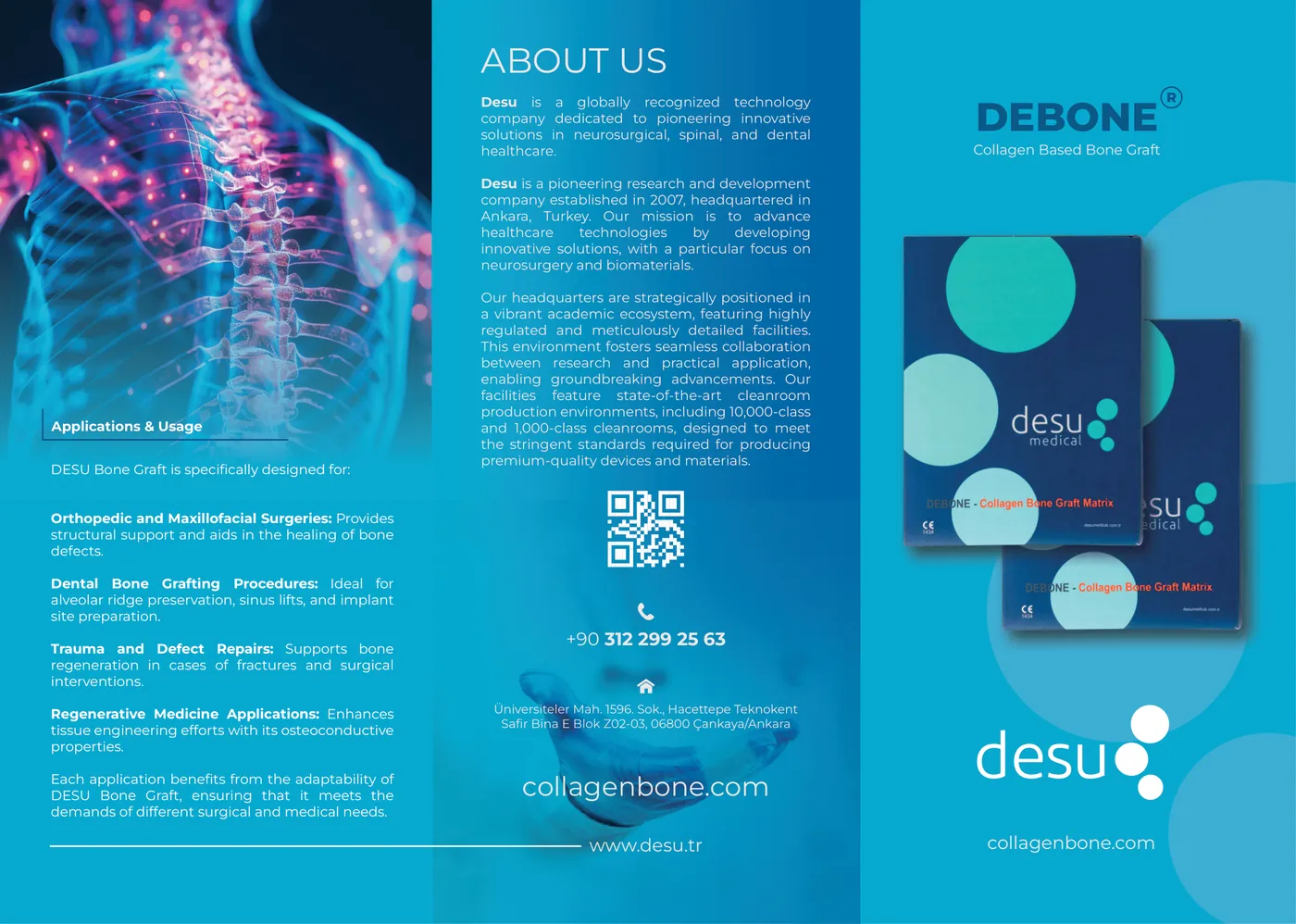
DEBONE is a bioresorbable, osteoconductive bone graft of Type I bovine collagen with β-tricalcium phosphate (β-TCP). It avoids a second harvest site and gives the patient’s own bone a framework to rebuild what was lost.
What is a collagen bone graft?
Bone itself is a composite. Type I collagen fibres give it toughness and resistance to tension, and a calcium phosphate mineral phase gives it stiffness. A collagen bone graft follows the same two-part design: the collagen gives bone-forming cells a familiar surface to attach to and holds the mineral together, while the mineral adds the calcium phosphate that new bone formation relies on.
Unlike a filler that only occupies space, the graft is meant to be temporary. It guides new bone into the defect from the surrounding bone bed and is then broken down as the patient’s own bone takes its place.
Bone grafts are usually described by three properties:
- Osteogenesis: living bone-forming cells delivered with the graft, a property of autograft.
- Osteoinduction: signals, such as bone morphogenetic proteins, that recruit cells and stimulate them to become bone-forming cells.
- Osteoconduction: a scaffold on which new bone can grow and along which blood vessels can advance.
Manufactured collagen bone grafts belong to the third group. They provide the framework; the patient supplies the cells and the blood supply. That is why they work best where the defect is surrounded by viable, well-vascularised bone. Collagen’s own role in bone is covered in what collagen does in bone tissue.
Why combine collagen with β-TCP?
Each component covers a weakness of the other. Collagen on its own is soft and resorbs relatively quickly. Pure ceramic granules are osteoconductive and provide volume, but loose granules are brittle and can scatter or migrate when they meet blood.
Together they form a composite that is easier to handle. The collagen holds the mineral in a coherent structure, so the graft can be shaped and packed into an irregular defect without crumbling or dispersing. β-TCP is a resorbable calcium phosphate: it supplies calcium and phosphate ions and helps the graft keep its volume in the defect during early healing.
In DEBONE, β-TCP is added to a pure Type I bovine collagen matrix to form a composite bone-graft structure. The Type I collagen molecules form a growth matrix for osteoblasts, and the composite provides an osteoconductive environment for filling the bone defect and supporting new bone formation.
How does a collagen bone graft support bone healing?
Bone healing passes through overlapping stages, and a collagen graft takes part in each of them:
- Clot and inflammation: when the graft is placed it takes up blood and marrow elements, and the collagen interacts with platelets, so the scaffold becomes part of the early clot from which healing begins.
- Vascular ingrowth: an open, porous structure leaves room for capillaries to grow into the graft, bringing the oxygen and nutrients that bone formation depends on. No bone forms without a blood supply.
- Bone formation: osteoblasts from the surrounding bed attach to the collagen and lay down new bone along the scaffold.
- Remodelling: osteoclasts gradually resorb the graft while osteoblasts deposit bone in the space they free, until the defect is filled with the patient’s own bone.
The pace of this process depends on the defect, the site and the patient. The timeline and the factors that change it are covered in collagen bone graft healing time.
Why does the resorption rate matter?
The gradual replacement of a graft by new bone is called creeping substitution. The graft should stay in the defect long enough to guide new bone, then make room for it. If it resorbs too quickly, the site can lose volume before bone has formed; if it persists too long, it occupies space that new bone needs and can delay natural remodelling.
In a collagen–β-TCP graft, the collagen matrix is broken down by the body’s enzymatic pathways and the β-TCP by cell-mediated resorption. DEBONE is a bioresorbable bone-graft material: its collagen-based structure is developed to offer a graft matrix that remodels together with the bone-healing process, so no removal is needed and no permanent foreign body remains.
Collagen–β-TCP grafts fill defects; they are not structural, load-bearing implants. Where a defect carries load, stability must come from the bone itself or from fixation, and the graft provides biological support within that construct.
Which forms do collagen bone grafts come in?
Defects differ in size, shape and access, so the physical form of a graft matters as much as its composition. In every case the aim is close contact between graft and host bone.
| Form | Handling | Typical use |
|---|---|---|
| Sponge | Flexible and compressible; can be cut and conforms to the cavity walls once moistened | Larger or irregular voids |
| Granules | Pack into confined spaces; large surface area for cell attachment | Cavitary and irregular defects |
| Particles in defined size ranges | Particle size matched to the defect | Dental and oral bone grafting |
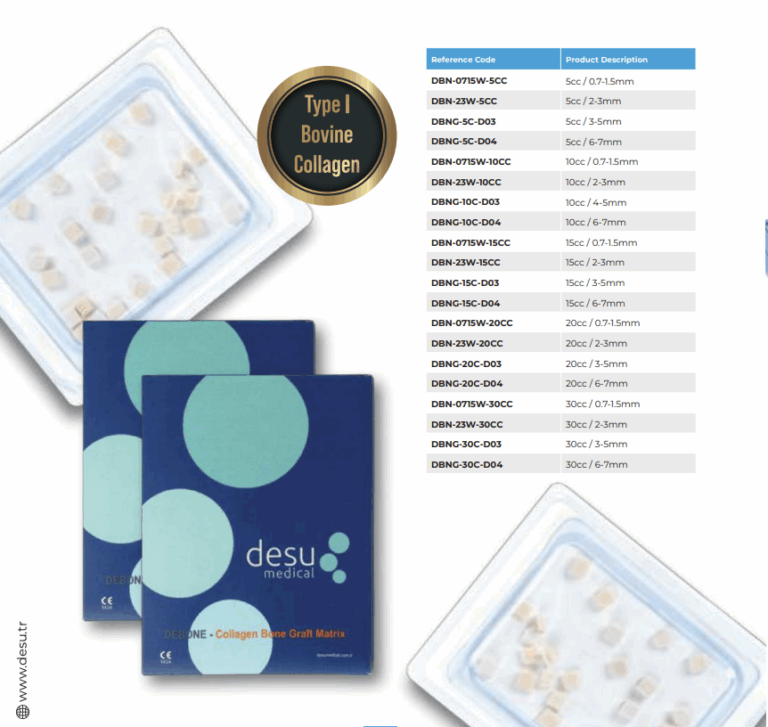
DEBONE is designed in granule and sponge form so that it can adapt to bone defects of different sizes and geometries. It is offered at a product size of 6–7 mm in 5 cc, 10 cc, 20 cc and 30 cc volumes, so the amount of graft can be chosen to suit the defect. Sponge use in orthopaedic and spinal defects is covered in the orthopedic collagen bone graft sponge.
For dentistry, DESU has a separate dental line: XENOBONE particles of 0.7–1.5 mm, 2–3 mm and 4–5 mm, used with the COLL-OS collagen barrier membrane. Dental use is covered in collagen bone grafts for dental implants. The choice of form, size and volume follows the defect and the product’s instructions for use, and the surgeon decides.
Where are collagen bone grafts used?
In general surgical practice, collagen-based bone graft substitutes are used to:
- fill voids left by trauma, together with appropriate fixation;
- fill cavitary defects after curettage of cysts or benign bone lesions;
- extend autograft when the harvested volume is not enough;
- rebuild bone volume in dental, oral and maxillofacial surgery, in particulate form.
These are general uses of the material class. The indications of each DESU product are those given in its instructions for use, and whether and how a graft is used is the surgeon’s decision.
How do collagen bone grafts compare with autograft and other options?
Autograft remains the reference because it is osteogenic, osteoinductive and osteoconductive. Its drawbacks are a second surgical site, with donor-site pain and morbidity, and a limited volume. Allograft avoids the donor site but depends on tissue bank supply and processing. Purely synthetic ceramics are osteoconductive but harder to handle.
Collagen–β-TCP composites sit between these options: osteoconductive and resorbable like many ceramics, easier to handle thanks to the collagen, available off the shelf in defined forms and quantities, and with no harvest site. They are often used where autograft is limited or undesirable, or mixed with it to extend the volume. A fuller comparison is in collagen bone graft vs. synthetic alternatives; animal-derived graft science is covered in the science of xenografts.
What makes a good collagen bone graft?
- A defined, controlled collagen source. DESU uses Type I bovine collagen only.
- Purification that removes cells, lipids and non-collagenous proteins, the components most likely to provoke an immune response.
- An open, porous structure that allows vascular ingrowth.
- Resorption that keeps pace with new bone formation.
- Forms and volumes that suit the defects the team treats.
- Validated manufacturing under a quality system, with traceability from raw material to finished device.
For devices made with animal tissue, the ISO 22442 series sets requirements for risk management, controlled sourcing and the validated elimination or inactivation of viruses and TSE agents, and biological safety is evaluated under the ISO 10993 series. Research continues on combining scaffolds with biological factors and on matching resorption more closely to bone formation, but a controlled source, a validated process and a sound quality system remain the foundation of a reliable graft.
How does DESU make DEBONE?
DESU designs and manufactures DEBONE in its own cleanrooms in Ankara, Türkiye, under an ISO 13485 quality management system, and the product carries the CE mark. As with any implant, risks such as infection or a local inflammatory reaction exist, and use follows the instructions for use. The budget side of a graft decision is covered in the cost of collagen bone grafts.
Talk to a DESU product specialist
Surgeons, hospital purchasing teams and distributors evaluating DEBONE can discuss forms, volumes, documentation and availability in their market with our product specialists. Write to sales@desu.tr, use the contact page or request a quote.
Kaynaklar
- ISO 22442 series: Medical devices utilizing animal tissues and their derivatives
- ISO 10993 series: Biological evaluation of medical devices
- ISO 13485:2016 Medical devices — Quality management systems
Bu konuda uzmanımızla görüşün
Ürün seçimi, teknik özellikler, numune talebi veya distribütörlük başvurusu için ekibimize doğrudan ulaşabilirsiniz.
İlgili yazılar
- BiyomateryallerOral Surgery Success: Collagen Bone Grafts for Dental Implants
- BiyomateryallerErfolg in der Oralchirurgie: Kollagen-Knochentransplantate für Zahnimplantate
- BiyomateryallerFortschrittliche resorbierbare Kollagen-Knochentransplantat-Lösungen
- BiyomateryallerHochwertige Kollagen-Knochentransplantat-Reparaturmaterialien
Yorumlar
Henüz yorum yok. İlk yorumu siz yazın.