
Type I collagen is the most abundant protein in the human body and the main structural component of skin, tendon, bone and the dura mater. For anyone choosing a dural graft, this matters: a graft made from Type I collagen offers the surrounding tissue a scaffold built from the same family of protein that forms the native dura. This article explains what Type I collagen is, why bovine Type I collagen is biologically familiar to human tissue, and how a natural collagen graft differs from a synthetic one.
What Collagen Is
Collagens are a family of structural proteins found in the extracellular matrix, the network that holds cells together and gives tissues their mechanical properties. More than twenty collagen types have been described. They share a characteristic triple-helical structure but differ in where they are found and what they do:
- Type I collagen: forms strong fibres in skin, tendon, bone, ligaments and the dura mater.
- Type II collagen: the main collagen of cartilage.
- Type III collagen: found alongside Type I in more elastic tissues such as blood vessels and early wound tissue.
- Type IV collagen: forms sheet-like networks in basement membranes.
The Structure of Type I Collagen
Each Type I collagen molecule is made of three polypeptide chains wound around each other in a triple helix: two identical alpha-1 chains and one alpha-2 chain. Every third amino acid in the helical region is glycine, the smallest amino acid, which allows the chains to pack tightly. Proline and hydroxyproline stabilise the helix.
Individual molecules assemble into fibrils, and fibrils bundle into fibres. This hierarchical structure gives Type I collagen its combination of tensile strength and flexibility, exactly the properties a membrane covering the brain or spinal cord needs.
Why Bovine Type I Collagen Is Familiar to Human Tissue
The amino acid sequence of Type I collagen is highly conserved across mammals. Bovine and human Type I collagen are very similar in structure, which is why bovine collagen has been used in surgical and medical materials for decades, from haemostatic agents to wound dressings, dental membranes and bone graft matrices.
The components of animal tissue that are most likely to provoke an immune response are not the collagen itself but the other material that comes with it: non-collagenous proteins, lipids and cellular remnants. Purification is therefore central to a bovine collagen implant. The goal is a graft that consists of pure Type I collagen while its native fibrillar architecture is preserved, so that cells can still recognise and attach to it.
How Cells Interact with a Type I Collagen Scaffold
Cells do not simply sit on a collagen graft; they bind to it. Integrin receptors on the surface of fibroblasts recognise specific binding sites on Type I collagen fibrils. This attachment allows fibroblasts to migrate into the graft, multiply and begin producing their own extracellular matrix.
As new tissue forms, enzymes such as collagenases gradually break down the implanted collagen. The result, over time, is replacement of the graft by the patient’s own connective tissue. Our article on collagen graft resorption describes this remodelling process in more detail.
Natural Type I Collagen vs Synthetic Dural Substitutes
Synthetic dural substitutes are made from manufactured polymers. Some are non-resorbable and remain in the body permanently; others are designed to degrade by hydrolysis. Natural collagen grafts behave differently in several ways:
- Integration: Type I collagen offers native binding sites for cells, whereas many polymers must be modified to support cell attachment.
- Resorption: a collagen graft is gradually remodelled into host tissue rather than persisting as a foreign body.
- Handling: collagen membranes are soft and conform to the surface of the brain or dural sac.
- Origin: natural collagen comes from animal tissue, so sourcing, traceability and validated processing are essential parts of its safety profile.
Synthetic materials have their own advantages, such as consistent mechanical properties and no animal origin, and the choice ultimately rests with the surgeon. What is important is clarity about what a product actually is. Desu dural grafts are not synthetic: they are made from natural, pure Type I bovine collagen.
Purity Without Losing Structure
Two goals have to be met at the same time when Type I collagen is prepared for implantation. The first is purity: removing the non-collagenous material that can trigger inflammation. The second is structural preservation: aggressive processing can denature collagen into gelatin, which loses the fibrillar organisation cells need. A well-designed process balances both, producing a membrane that is clean, mechanically useful and biologically recognisable.
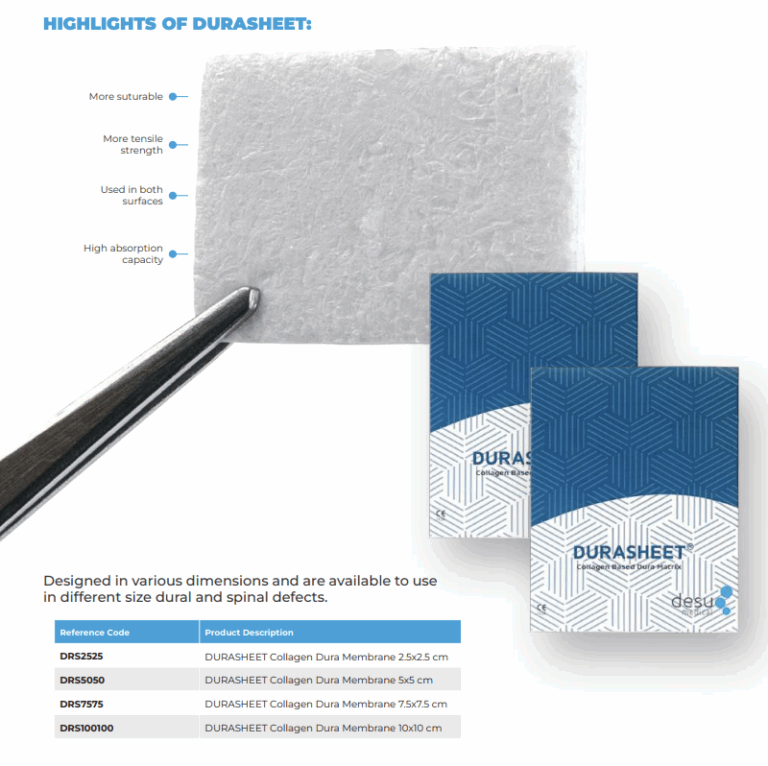
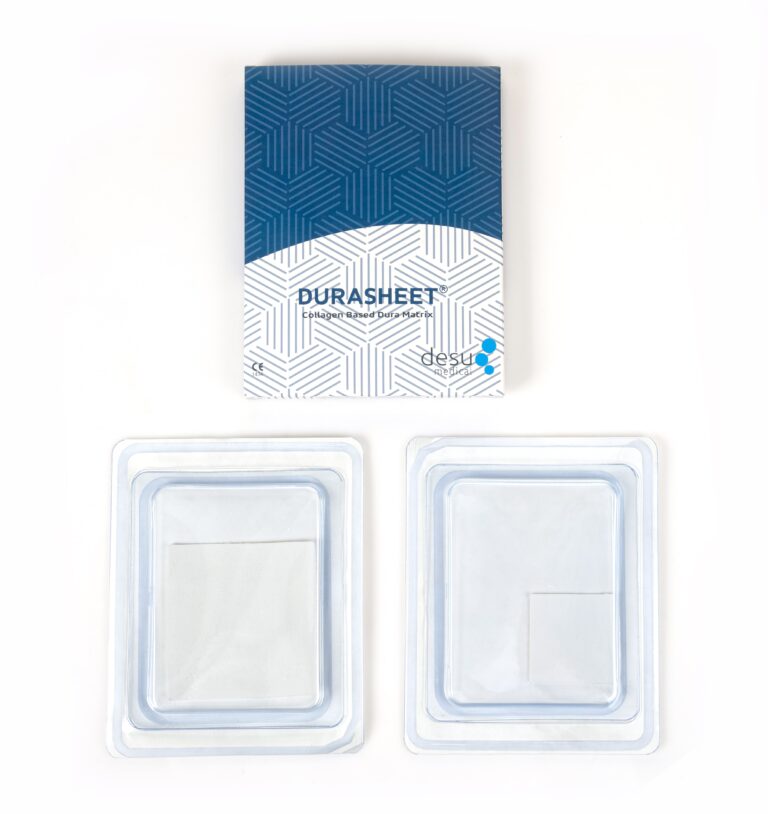
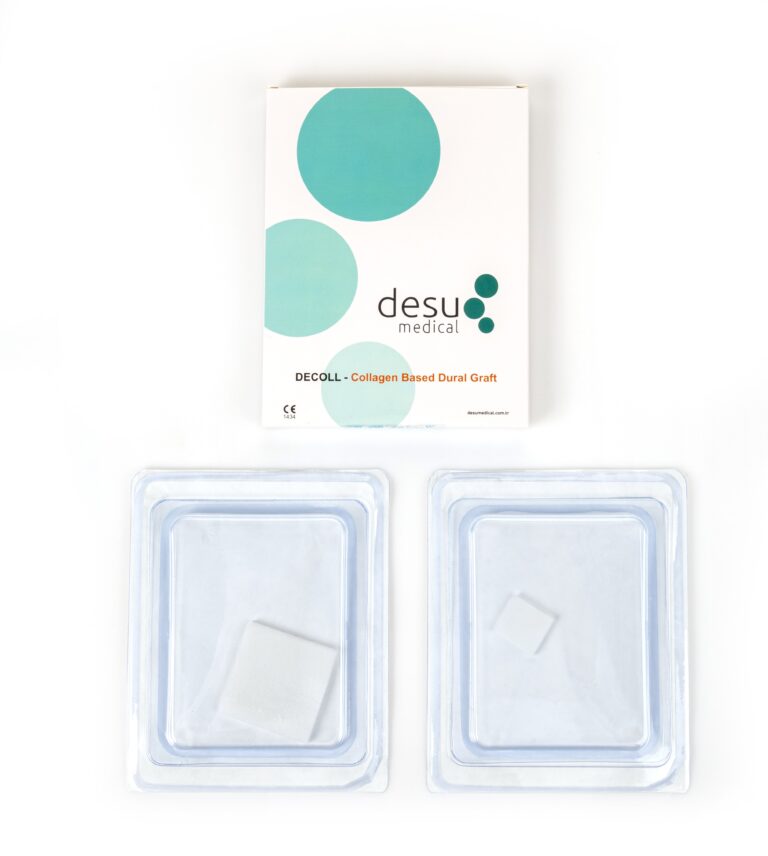
Desu’s DURASHEET and DECOLL membranes are made from natural, pure Type I bovine collagen sourced from controlled, traceable tissue. They are gamma sterilised, supplied ready to use and have an impermeable pore structure that acts as a barrier against cerebrospinal fluid leakage.
What This Means in the Operating Room
For the surgical team, the biology of Type I collagen translates into practical considerations: a membrane that can be cut to shape, conforms to the surface, can be used as an onlay or sutured, and is resorbed as healing progresses. For the hospital, it means asking suppliers clear questions about the collagen type, its origin, the purification and sterilisation methods, and the biocompatibility evidence. Our dural graft procurement checklist lists these questions.
Frequently Asked Questions
Is bovine Type I collagen the same as human Type I collagen?
Not identical, but very similar. The Type I collagen sequence is highly conserved across mammals, which is why purified bovine Type I collagen is well tolerated and recognised by human cells.
Is a collagen dural graft synthetic?
No. A collagen dural graft is made from natural collagen obtained from animal tissue. Desu dural grafts are made from natural, pure Type I bovine collagen and contain no synthetic polymers.
Can Type I collagen cause an allergic reaction?
Reactions to purified Type I collagen implants are uncommon, but a known sensitivity to bovine-derived products should be discussed with the surgical team and checked against the contraindications in the Instructions for Use.
References and Further Reading
- PubMed: Type I collagen structure
- PubMed: collagen dural graft
- Desu Medical, Dural Grafts product information
About this article
Prepared by the Desu Medical editorial team. Desu Medical has designed and manufactured neurosurgical devices in Ankara, Türkiye, since 2007, including the DURASHEET and DECOLL collagen dura membranes, which are made from natural, pure Type I bovine collagen. Manufacturing operates under an ISO 13485 quality management system and the dural graft range is CE certified. This article is written for healthcare professionals and general information; it does not replace the Instructions for Use or clinical judgement. Last reviewed: October 2026.
