
Surgeons who use a collagen dura membrane often ask what happens before the sterile package reaches the operating room. How is the collagen obtained? How is it made safe? What controls are in place? This article gives an overview of the stages involved in producing a natural collagen dural graft and the quality framework around them. It describes general principles and how Desu Medical approaches them; detailed process parameters are part of each manufacturer’s confidential technical documentation.
Why Collagen?
Collagen is the main structural protein of connective tissue in the human body, and Type I collagen is the most abundant form. It is also the main component of the natural dura mater. A collagen dura membrane therefore offers a material that the body recognises as a scaffold: fibroblasts and blood vessels can grow into it, and it is gradually replaced by the patient’s own connective tissue. Our article on Type I collagen as a natural dural graft explains this biology in more detail.
Natural, Not Synthetic
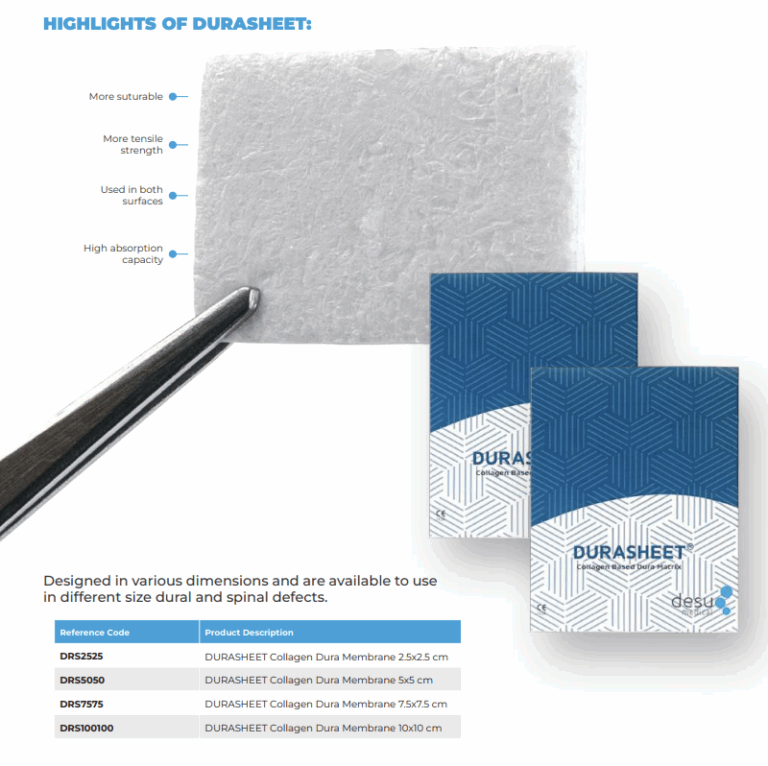
Dural substitutes fall into two broad groups: natural materials based on collagen or tissue, and synthetic polymers. Desu’s DURASHEET and DECOLL belong to the first group. Each collagen dura membrane is made from natural, pure Type I bovine collagen, not from synthetic polymers, and it is resorbed as host tissue forms rather than remaining as a permanent foreign body.
Stage 1: Controlled Raw Material
The quality of a collagen dura membrane starts with the raw material. Collagen of bovine origin must come from controlled sources with documented origin. European requirements for devices made with animal tissue, including Regulation (EU) 722/2012 and the ISO 22442 series of standards, set out how the source animals, their geographical origin and the collection of tissue are controlled to manage risks such as transmissible spongiform encephalopathies. These principles are discussed in our article on bovine collagen safety.
Stage 2: Purification
Raw tissue contains many components besides collagen, including other proteins, lipids and cells. Purification steps remove these components and leave purified Type I collagen. Purification is important for biocompatibility, because the aim is a material that integrates with host tissue without provoking unnecessary inflammation. Validated steps for the reduction of viruses and other agents are also part of processing for materials of animal origin.
Stage 3: Forming the Membrane
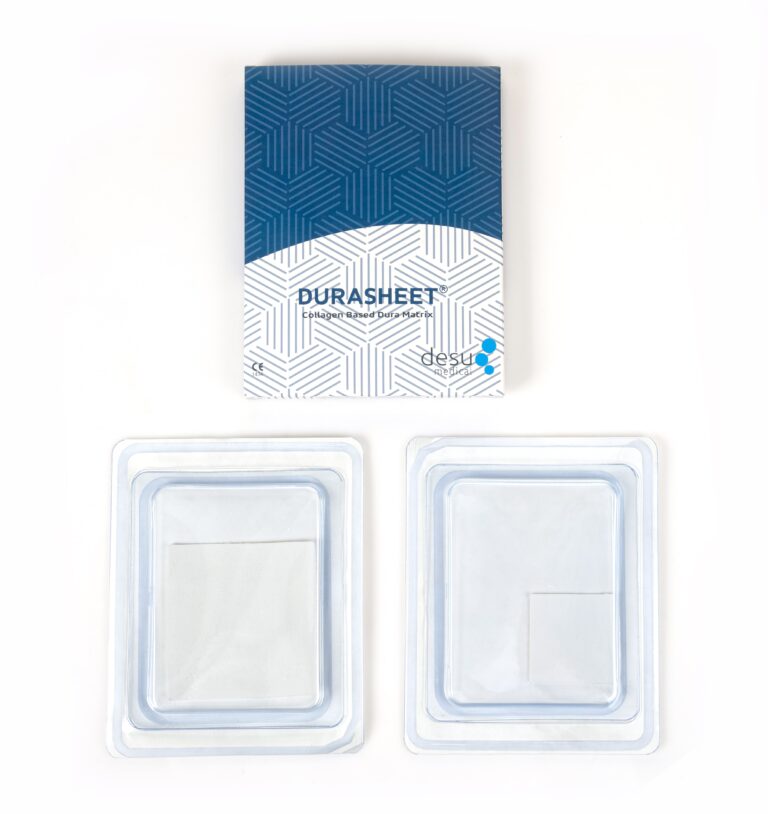
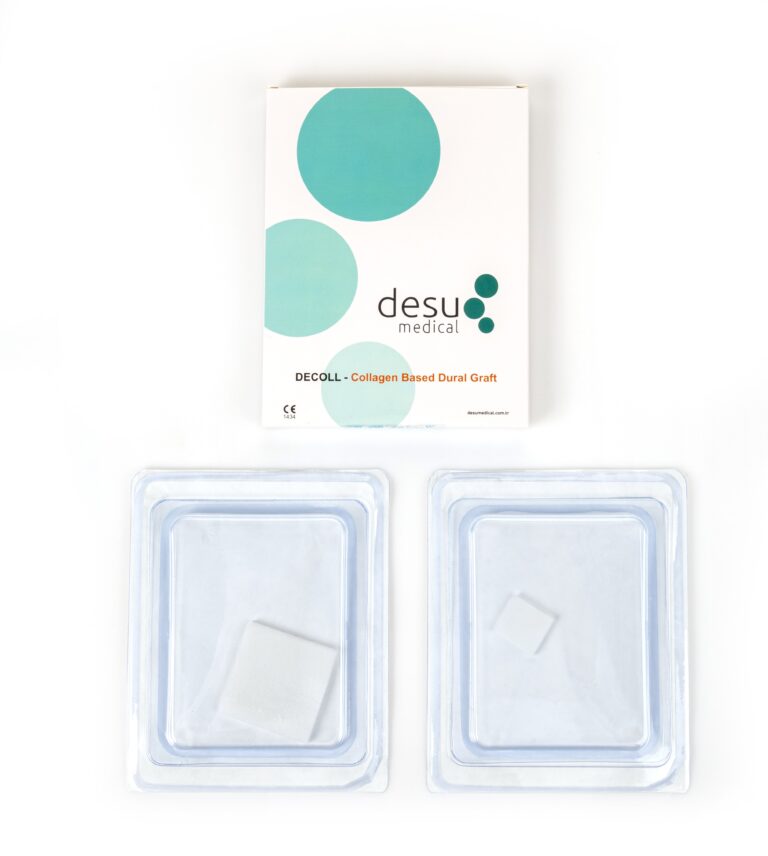
The purified collagen is then formed into a sheet with a defined thickness and structure. The structure determines how the membrane handles and how it behaves in the body. Desu’s membranes are designed with an impermeable pore structure that acts as a barrier against cerebrospinal fluid while still allowing the material to be remodelled into the patient’s own tissue. The membrane is then cut into standard sizes; DECOLL, for example, is produced in four square formats from 2.5 x 2.5 cm to 10 x 10 cm.
Stage 4: Packaging and Sterilisation
Each collagen dura membrane is packed in a sterile barrier system and then sterilised. Desu’s dura membranes are gamma sterilised and supplied sterile, ready for use in the operating room. Sterilisation is validated to show that it reliably achieves sterility without damaging the collagen. See our article on gamma sterilisation of collagen dura membranes for more information.
Stage 5: Testing and Release
Before a lot is released, it is checked against its specifications. Product-level testing typically covers physical properties, packaging integrity and sterility assurance. The design of the device as a whole has been evaluated for biocompatibility according to the ISO 10993 series, including cytotoxicity, sensitisation, systemic toxicity and implantation testing, as described in our article on dural graft biocompatibility.
The Quality Management System
All of these stages take place within a quality management system. Desu Medical’s system is certified to ISO 13485, the international standard for medical device quality management. It covers design control, supplier control, production, documentation, traceability, handling of complaints and corrective actions. Each collagen dura membrane carries a lot number that links it to its production records, as explained in our guide to dural graft traceability.
Regulatory Approval
A collagen dura membrane of animal origin is a high-risk device in Europe. Before it can carry the CE mark, the manufacturer’s technical documentation, clinical evaluation and quality system are assessed by a notified body. Desu’s DURASHEET and DECOLL membranes are CE marked. Our article on EU MDR requirements for dural grafts describes this process.
About Desu Medical
Desu Medical was founded in 2007 in Ankara, Türkiye, and develops and manufactures neurosurgical products, including collagen dura membranes, hydrocephalus shunt systems and drainage catheters. Its collagen dura membranes are supplied ready to use, with no pre-treatment, and can be cut to the size of the defect in the operating room.
Summary
Making a collagen dura membrane involves controlled sourcing of natural bovine collagen, purification, forming a membrane with a defined structure, sterile packaging, gamma sterilisation and lot-by-lot release, all within a certified quality system and a European regulatory framework. These steps are what allow a natural material to be used safely as an implant in contact with the brain and spinal cord.
Frequently Asked Questions
Is a collagen dura membrane synthetic?
No. Desu’s DURASHEET and DECOLL are made from natural, pure Type I bovine collagen. They are natural collagen products, not synthetic polymers.
How is the safety of bovine collagen controlled?
Through controlled sourcing with documented origin, validated processing steps and compliance with European requirements for devices made with animal tissue, such as Regulation (EU) 722/2012 and the ISO 22442 series.
Why does a collagen dura membrane need no pre-treatment?
It is supplied sterile and ready to use, so it can be cut and placed directly in the operating room. Always follow the Instructions for Use.
References and Further Reading
- Regulation (EU) No 722/2012 on devices manufactured using tissues of animal origin
- ISO 13485 Medical devices: Quality management systems
- Desu Medical, DURASHEET collagen dura membrane
About this article
Prepared by the Desu Medical editorial team. Desu Medical has designed and manufactured neurosurgical devices in Ankara, Türkiye, since 2007, including the DURASHEET and DECOLL collagen dura membranes, which are made from natural, pure Type I bovine collagen. Manufacturing operates under an ISO 13485 quality management system and the dural graft range is CE certified. This article is written for healthcare professionals and general information; it does not replace the Instructions for Use or clinical judgement. Last reviewed: October 2026.
